- Home
- Catalog
- Naval Destroyers (Warships)
- Sejong the Great-class Destroyer
Sejong the Great-class Destroyer
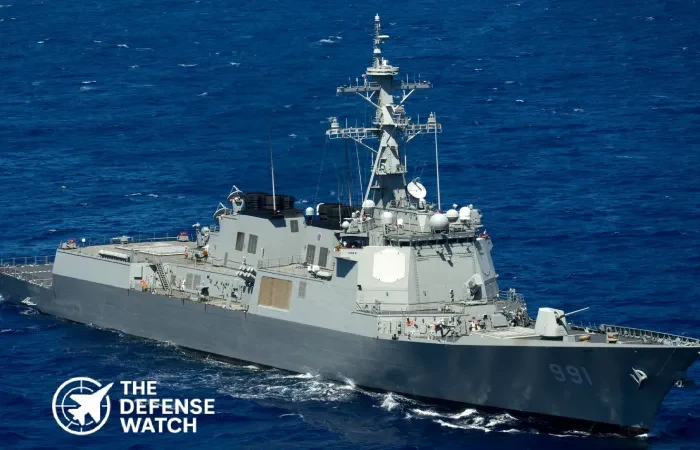
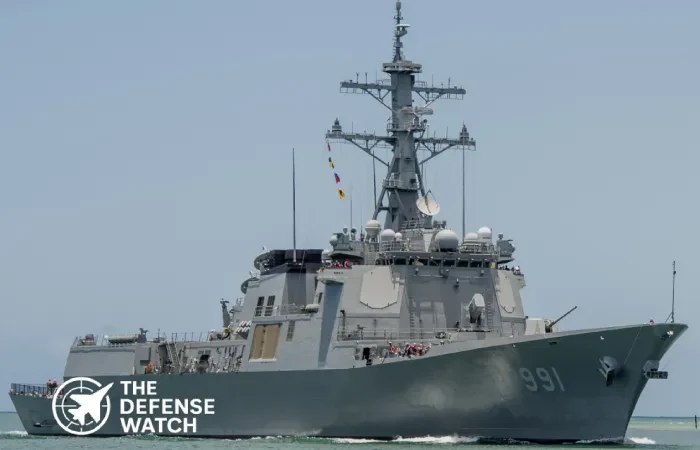

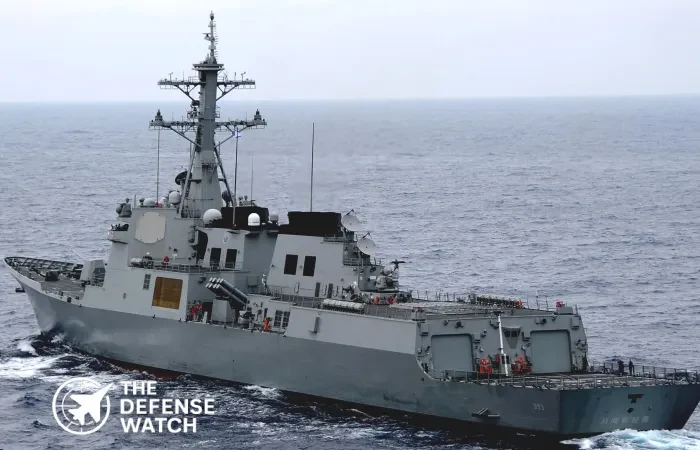
Full Specifications
1. General Information
| System Name | Sejong the Great-class (KDX-III) |
| Type / Role | Guided Missile Destroyer |
| Manufacturer | Hyundai Heavy Industries / DSME |
| Country of Origin | South Korea |
| In Service | Yes |
| Year Introduced | 2008 |
| Unit Cost | USD 900 million – 1.1 billion |
| Crew | Approx. 300 |
2. Dimensions & Structure
| Length | 166 meters |
| Beam (Width) | 21.4 meters |
| Draft | 6.25 meters |
| Displacement | ~11,000 tons (full load) |
| Hull Material | Steel |
| Deck Configuration | Flush deck |
3. Performance & Propulsion
| Propulsion Type | COGAG |
| Engine Model | 4 × LM2500 Gas Turbines |
| Power Output | ~100,000 shp |
| Maximum Speed | 30+ knots |
| Range | ~5,500 nautical miles |
| Endurance | 30+ days |
4. Sensors & Radar Systems
| Primary Radar | AN/SPY-1D(V) AESA |
| Radar Range | 300+ km |
| Sonar System | Hull-mounted + Towed Array |
| Electro-Optical / IR System | EO/IR targeting system |
| Electronic Warfare Suite | Integrated ESM/ECM |
| Fire Control Radar | Aegis Fire Control |
5. Weapons & Armament
| Main Gun | 127mm naval gun |
| Vertical Launch System (VLS) Cells | 128 |
| Missiles | SM-2, SM-3, SM-6 |
| Anti-Ship Missiles | Haeseong (SSM-700K) |
| Anti-Submarine Torpedoes | 324mm torpedoes |
| Close-In Weapon System (CIWS) | Phalanx CIWS |
| Decoy Systems | Chaff & flares |
6. Aviation & Support
| Helicopter Capability | Yes |
| Hangar Capacity | 2 helicopters |
| UAV Operations | Limited |
| Flight Deck Size | Full-size |
| Replenishment at Sea | Supported |
7. Defensive & Electronic Systems
| Countermeasures | Chaff / Decoys |
| ECM / ECCM | Advanced EW suite |
| Missile Defense System | Aegis Ballistic Missile Defense |
| Combat Management System | Aegis Combat System |
| Communication Systems | Secure SATCOM & datalinks |
8. Operational Information
| Service Branch | Republic of Korea Navy |
| Primary Operator | South Korea |
| Operational History | Active Indo-Pacific deployments |
| Notable Feature | World’s largest destroyer-class VLS capacity |
PROS
- Exceptionally large VLS capacity (128 cells)
- Proven Aegis Combat System integration
- Strong ballistic missile defense capability
- High interoperability with U.S. Navy forces
- Advanced multi-domain warfare capabilities
CONS
- High procurement and maintenance costs
- Limited stealth shaping compared to newer designs
- Large crew requirements
- Primarily optimized for regional operations
- Dependence on U.S.-origin combat systems
Sejong the Great-Class Destroyer – Aegis Naval Powerhouse
The Sejong the Great-class destroyer (KDX-III) represents one of the most capable surface combatants operating in the Indo-Pacific region today. Designed to deliver area air defense, ballistic missile tracking, and multi-role strike capabilities, this warship places the Republic of Korea Navy (ROKN) among the world’s most technologically advanced naval forces.
Design, Origin, and Mission Role
Built by Hyundai Heavy Industries and Daewoo Shipbuilding & Marine Engineering, the Sejong the Great-class originates from South Korea and is heavily inspired by U.S. Navy Arleigh Burke-class destroyers. Its primary mission is fleet air defense, ballistic missile detection, anti-submarine warfare (ASW), and land-attack operations, supporting both national and allied maritime security objectives.
Advanced Combat Capabilities
At the core of the destroyer is the Aegis Combat System paired with the AN/SPY-1D(V) phased-array radar, enabling simultaneous tracking of hundreds of airborne and surface targets at long range. With 128 Vertical Launch System (VLS) cells, the ship carries a mix of SM-series surface-to-air missiles, land-attack cruise missiles, and anti-submarine rockets.
Performance and Operational Reach
Powered by a COGAG propulsion system, the Sejong the Great-class reaches speeds exceeding 30 knots and offers long endurance for extended blue-water operations. Its robust sonar suite, embarked helicopters, and network-centric warfare systems allow seamless integration with U.S. Navy and allied task forces.
Operational Significance
Deployed primarily in regional missile defense and carrier escort roles, these destroyers significantly enhance deterrence against aerial, surface, and submarine threats, making them central to South Korea–U.S. maritime cooperation.
Sejong the Great-Class Destroyer Price
The unit cost of a Sejong the Great-class destroyer is commonly cited at approximately $923 million USD per ship. This figure reflects the first batch of vessels built for the Republic of Korea Navy and is based on open-source defense data.
Get real time update about this post category directly on your device, subscribe now.
Reviews
Disclaimer Note
The information provided on TheDefenseWatch.com is for general informational purposes only. While we strive to ensure the accuracy, completeness, and timeliness of our content regarding defense and aerospace products, technologies, and specifications, we cannot guarantee that all information is 100% accurate or up-to-date due to the evolving nature of military technology and classified data.TheDefenseWatch.com does not warrant the reliability, suitability, or availability of the information for any specific purpose. Users are advised to consult official sources, such as manufacturers, government publications, or defense agencies, for precise and verified data before making decisions based on our content.We are not affiliated with any defense manufacturers, governments, or military organizations mentioned. Opinions, reviews, and ratings reflect expert analysis but are subjective and should not be considered endorsements. TheDefenseWatch.com is not responsible for any errors, omissions, or consequences arising from the use of this website’s content.External links are provided for convenience and do not imply endorsement. TheDefenseWatch.com reserves the right to update or modify content without prior notice. By using this website, you agree to our Privacy & Cookies Policy.
New Arrivals

Popular Comparisons
-
 SIG XM7 Rifle vs M4: Key Differences and Performance Comparison
View Comparison →
SIG XM7 Rifle vs M4: Key Differences and Performance Comparison
View Comparison → -
Eurofighter Typhoon vs Rafale vs F-35: Fighter Jet Comparison
View Comparison →
-
J-20 vs F-22: Stealth Fighter Showdown Explained
View Comparison →
-
F-14 Tomcat vs Su-57: Can a Legend Challenge Russia’s Stealth Fighter?
View Comparison →
-
Su-35 vs Su-57: Russia’s Top Fighter Jets Compared
View Comparison →
-
Eurofighter Typhoon vs Su-57: Ultimate Fighter Jet Comparison
View Comparison →
-
Rafale vs Su-57: 4.5 Gen vs 5th Gen Fighter Jet Comparison
View Comparison →
-
Su-57 vs F-16 Fighting Falcon: Stealth vs Speed
View Comparison →
-
China vs Russia: J-20 Mighty Dragon vs Su-57 Felon Comparison
View Comparison →
-
Su-57 Felon vs F-22 Raptor: Stealth Air Superiority Face-Off
View Comparison →


- France Unveils 78,000-Ton Nuclear Aircraft Carrier France Libre With 40-Aircraft Capacity

- L3Harris Wins $77.8M U.S. Navy Contract for Kineto Tracking Mount Sustainment
- US Navy Awards $15.38B Columbia-Class Submarine Contract To Strengthen Nuclear Deterrent
- China Surges Production Capacity For J-20 And J-35 Stealth Fighters As Beijing Expands Fifth-Generation Fleet
- Netanyahu Announces Elimination Of Senior Iranian Figures In Air Campaign
- US Bombers Avoid European Airspace On Iran Bombing Runs In Strategic Route Shift
- Japan’s EC-2 Electronic Warfare Jet Completes First Flight, Expanding Standoff Jamming Capabilities
- NASA’s X-59 Quiet Supersonic Jet Gears Up for Second Flight — A Giant Leap Toward Silent Boom AviationNASA X-59 Second Flight: Supersonic Aviation Reborn
- US Weapons Shipments to Taiwan Unaffected by Iran War, Officials Confirm
- USS Gerald R. Ford Fire Incident Exposes Crew Strain And Carrier Readiness Risks