- Home
- Catalog
- Submarines
- Saab A26 Submarine
Saab A26 Submarine

Full Specifications
1. General Information
| Name / Class | Saab A26 / Blekinge‑class |
| Country of Origin | Sweden |
| Type | Conventional diesel-electric submarine (SSK) with AIP |
| Manufacturer | Saab (Kockums) |
| Operators | (Planned) Swedish Navy; prospective export navies (e.g., selected by Poland 2025) |
| In Service | Planned for early 2030s (2031 and 2033) under latest contract |
| Status | Under production / pre‑delivery |
2. Dimensions & Design
| Length | ~66.0 m – 66.1 m |
| Beam (Width) | ~6.75 m |
| Draught / Draft | ~6.0 m |
| Displacement (Surfaced) | ~1,925–2,000 tonnes |
| Displacement (Submerged) | ~2,100 tonnes |
| Hull Material | Reinforced pressure‑resistant steel (shock-resistant) |
| Crew | 17–26 standard; up to ~35 with additional mission personnel / special-forces teams |
3. Propulsion & Performance
| Power Source | Diesel-electric + AIP (Stirling) |
| Engine / Reactor Type | Kockums Stirling AIP units (MkV V4‑275R) + diesel engines |
| Propulsion System | Single-shaft propeller drive via diesel-electric + AIP |
| Speed (Surfaced) | Moderate diesel-electric surfaced speed (specific not publicly emphasized) |
| Speed (Submerged) | Approx. 20 km/h (on AIP / submerged) |
| Range | Dependent on fuel / logistics; export variants offer extended range; baseline suited for littoral and regional patrols |
| Endurance | Up to ~45 days submerged (including ~18 days on AIP) |
| Operational Depth | Maximum Depth Specific depths not publicly disclosed |
| Test Depth | designed for Baltic littoral and coastal conditions |
| Maximum Depth | pressure‑resistant hull for mine‑resistance and seabed resting use |
4. Armament
| Torpedo Tubes | 4×533 mm, 2×400 mm |
| Torpedoes / Missiles | Heavyweight Torpedo 62 (or 63 depending on variant), and Saab lightweight Torpedo 47 (SLWT) for close/submerged combat; capability for mines and modular payloads depending on role. |
| Cruise / Ballistic Missiles | Not in baseline A26 — export variants may support modular payloads, but no confirmed ballistic missile capability. |
| Mines | Supported (modular payload), for seabed warfare / mine-laying roles. |
| Decoys / Countermeasures | Likely included as part of standard submarine defensive suite (though specific public data limited) |
5. Sensors & Electronics
| Sonar System | Bow and flank sonar arrays |
| Radar | None (submerged operations) |
| Combat Management System | Saab 9LV CMS, integrating sensor, navigation, weapons and communication data — standard across A26 design. |
| Electronic Warfare System | Electronic support / passive signal detection for underwater ISR and information‑warfare tasks; supports data fusion and networked operations. |
| Communication Systems | Secure underwater and surface comms, data links for allied networked operations (e.g. NATO interoperability) — part of Saab’s system‑of‑systems concept. |
| Navigation Systems | Standard submarine navigation, inertial navigation, sonar‑aided navigation; modular upgradeable systems. |
6. Stealth & Defense
| Anechoic Coating | Specialized hull coatings to reduce sonar echo strength, maintain hydrodynamic performance. |
| Noise Reduction Features | Acoustic damping, vibration isolation, quiet Stirling AIP, optimized hull design for low flow noise. |
| Magnetic Signature Reduction | Adaptive degaussing system, corrosion / electric signature control. |
| Acoustic Signature Level | Extremely low; optimized for shallow, acoustically complex littoral environments (e.g. Baltic Sea). |
7. Payload & Capacity
| Weapons Payload | Heavy and lightweight torpedoes, mines, modular seabed payloads (depending on mission). |
| Special Forces Accommodation | Multi‑Mission Portal allows insertion/recovery of special forces, divers, UUVs/SDVs. |
| UUV / Drone Capability | Yes — designed to deploy/recover unmanned underwater vehicles for seabed warfare and ISR via portal. |
8. Notable Technologies
| Reactor / AIP Type | Four Kockums MkV V4-275R Stirling AIP units (air‑independent propulsion) + conventional diesel-electric engines. |
| Automation Level | High — modular systems, integrated CMS, streamlined maintenance for through-life upgrades. |
| Special Features | Multi‑Mission Portal for seabed operations and special‑forces deployment; balanced multi‑domain signature management; modular payload architecture; shock-resistant hull suitable for mine-threat environments. |
9. Operational History
| Major Deployments | Still under construction; first units scheduled for delivery 2031 and 2033 under latest contract. |
| Combat / Exercises | Not yet applicable — design and production phase. |
| Upgrades | Modular architecture intended to ease future upgrades, payload changes, and export customization. |
10. Cost & Production
| Unit Cost | Programme value revised to ~SEK 25 billion for first two submarines (~ USD 2.3 billion at current rates) under 2025 contract renegotiation. |
| Number Built | Initial order: two submarines for Swedish Navy (export customers may follow) |
| Production Period | Steel cut 2015; deliveries now planned for 2031 and 2033 after delays. |
11. Media & Credits
| Image / Video Source | Saab public photos and renderings; corporate material. |
| Official Website | Saab — A26 product page. |
| Reference Credit | Data compiled from Saab, Naval‑News, Army Recognition, and open defense‑industry sources. |
PROS
- Highly stealthy — multi‑domain signature reduction (acoustic, magnetic, IR, radar).
- Extremely long submerged endurance via Stirling AIP — covert, persistent presence.
- Multi‑Mission Portal enables UUV/SDV/reconnaissance and special‑forces operations.
- Modular design allows future upgrades and flexibility for various mission profiles.
- Well suited for littoral and shallow-water environments; ideal for seabed warfare and infrastructure protection.
CONS
- Not nuclear-powered — range and transit speed are limited compared with SSNs.
- Delivery delays and cost overruns have pushed timelines out to 2031+ for earliest units.
- Smaller size limits endurance, payload and crew comfort compared with larger submarines.
- Lacks built-in vertical-launch missile capability in baseline design (though export variants may allow it).
- Deep-ocean or global power-projection capabilities are more limited than with larger nuclear submarines.
Saab A26 – Next‑Gen Blekinge‑Class Submarine
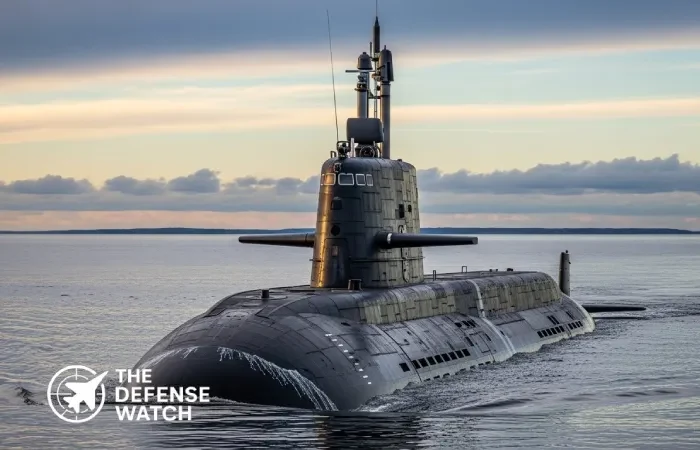
The Saab A26 represents the cutting edge of conventional submarine design — a modern, stealth‑optimized platform built for the complex demands of littoral and blue‑water operations. Developed by Saab (via its Kockums submarine division) in Sweden, the A26 is tailored for intelligence, surveillance, reconnaissance (ISR), anti‑submarine/anti‑surface warfare (ASW/ASuW), seabed warfare, and special‑forces operations. It reflects Saab’s vision for a “fifth-generation” submarine capable of integrating into multi-domain operations for NATO and allied navies.
What sets the A26 apart is its advanced stealth and signature management. Its hull geometry and specialized coatings reduce acoustic, magnetic, hydrodynamic, radar, infrared and visual signatures — making the vessel extremely difficult to detect. An adaptive degaussing system further minimizes magnetic emissions.
At the heart of the A26’s endurance is Saab’s patented Stirling air-independent propulsion (AIP) system. Combined with conventional diesel-electric machinery, this allows the submarine to stay submerged for weeks — essential for covert patrols and long-duration missions without surfacing.
A defining capability is its “Multi‑Mission Portal,” a 1.5‑meter diameter, forward‑mounted lock that enables deployment and recovery of unmanned underwater vehicles (UUVs), swimmer delivery vehicles (SDVs), or even small teams of naval commandos. This gives the A26 a unique seabed-warfare and special-operations dimension, enabling undersea infrastructure surveillance, mine deployment or recovery, and covert insertion of personnel or payloads.
Despite its relatively compact size compared with nuclear submarines, A26 remains formidable. Its modular architecture allows future upgrades or payload customization — including mine warfare, torpedoes and potentially export variants with extended-range or enhanced payloads.
For the U.S.-focused defense professional or naval analyst, the Saab A26 offers a clear example of how modern diesel-electric submarines, properly engineered, continue to play a critical role in undersea deterrence, intelligence gathering, and asymmetric warfare — especially in confined or shallow seas where stealth and low signatures often matter more than raw speed or range.
Saab A26 Submarine Price
As of 2025 contract renegotiation, the A26 program for two submarines is budgeted at roughly SEK 25 billion — equivalent to about USD 2.3 billion. Exact unit pricing in a U.S. dollar context will depend on exchange rates, configuration, export variant and associated support packages.
Get real time update about this post category directly on your device, subscribe now.
Reviews
Disclaimer Note
The information provided on TheDefenseWatch.com is for general informational purposes only. While we strive to ensure the accuracy, completeness, and timeliness of our content regarding defense and aerospace products, technologies, and specifications, we cannot guarantee that all information is 100% accurate or up-to-date due to the evolving nature of military technology and classified data.TheDefenseWatch.com does not warrant the reliability, suitability, or availability of the information for any specific purpose. Users are advised to consult official sources, such as manufacturers, government publications, or defense agencies, for precise and verified data before making decisions based on our content.We are not affiliated with any defense manufacturers, governments, or military organizations mentioned. Opinions, reviews, and ratings reflect expert analysis but are subjective and should not be considered endorsements. TheDefenseWatch.com is not responsible for any errors, omissions, or consequences arising from the use of this website’s content.External links are provided for convenience and do not imply endorsement. TheDefenseWatch.com reserves the right to update or modify content without prior notice. By using this website, you agree to our Privacy & Cookies Policy.



New Arrivals



Popular Comparisons
-
 SIG XM7 Rifle vs M4: Key Differences and Performance Comparison
View Comparison →
SIG XM7 Rifle vs M4: Key Differences and Performance Comparison
View Comparison → -
Eurofighter Typhoon vs Rafale vs F-35: Fighter Jet Comparison
View Comparison →
-
J-20 vs F-22: Stealth Fighter Showdown Explained
View Comparison →
-
F-14 Tomcat vs Su-57: Can a Legend Challenge Russia’s Stealth Fighter?
View Comparison →
-
Su-35 vs Su-57: Russia’s Top Fighter Jets Compared
View Comparison →
-
Eurofighter Typhoon vs Su-57: Ultimate Fighter Jet Comparison
View Comparison →
-
Rafale vs Su-57: 4.5 Gen vs 5th Gen Fighter Jet Comparison
View Comparison →
-
Su-57 vs F-16 Fighting Falcon: Stealth vs Speed
View Comparison →
-
China vs Russia: J-20 Mighty Dragon vs Su-57 Felon Comparison
View Comparison →
-
Su-57 Felon vs F-22 Raptor: Stealth Air Superiority Face-Off
View Comparison →


- UK Nightfall Procurement Plans Face Government Silence Amid Air Defense Debate

- NASA Completes First Flight Of Laminar Flow Scaled Wing Design In Aerodynamic Breakthrough
- Singapore Orders Three G550 Maritime Surveillance Aircraft To Boost Early Warning Network
- Polish Defense Industry Backs EU SAFE Mechanism To Boost National Production And Exports
- How StormBreaker Integration Expands Super Hornet Precision Strike Options for The U.S. Navy
- Former US F-35 Pilot Arrested for Allegedly Training Chinese Air Force
- NATO Intelligence From Germany: SWARM Biotactics Cybernetic Insect Swarms Enter Operational Use
- UK And Norway Sign Naval Helicopter Pact To Deepen Maritime Defense Cooperation
- Israel MOD Signs $42 Million Merkava Tank Transmission Deal With Ashot Ashkelon
- China’s New Aircraft Carrier Faces Persistent Design Flaw, Raising Questions About PLAN Power Projection