- Home
- Catalog
- Tanks & Armored Vehicles
- Neptune Missile Launcher
Neptune Missile Launcher
Full Specifications
1. General Information
| Vehicle Name | Neptune RK-360MC |
| Type / Role | Coastal Defense Missile Launcher |
| Manufacturer | Luch Design Bureau |
| Country of Origin | Ukraine |
| In Service | Yes |
| Year Introduced | 2020 |
| Unit Cost | Classified / Estimates vary |
| Crew | 3–4 per launcher vehicle |
2. Dimensions & Weight
| Length (Gun Forward) | ~9–10 m |
| Width | ~2.6 m |
| Height | ~3 m |
| Weight | ~20–22 tons |
| Ground Clearance | High-mobility standard |
| Chassis Material | Steel / light armor |
3. Performance
| Engine Type | Diesel |
| Engine Power | 420–500 hp |
| Power-to-Weight Ratio | ~20 hp/ton |
| Transmission | Automatic |
| Maximum Speed (Road) | 60–70 km/h |
| Maximum Speed (Off-Road) | 35–40 km/h |
| Operational Range | 450–500 km (vehicle) |
| Suspension Type | Independent / Heavy-duty |
4. Armament
| Main Gun | Not Applicable (Missile-based system) |
| Ammunition Capacity | 4 × R-360 Neptune Missiles per launcher (TEL) |
| Secondary Armament | None |
| Gun Elevation/Depression | Not Applicable (No gun; missile launch angle fixed/programmable) |
| Fire Control System | Digital Missile Fire-Control & Command Guidance System |
| Stabilization | Vehicle Stabilization for Missile Launch (Hydraulic outriggers) |
| Rate of Fire | 4 missiles can be launched sequentially; reload not rapid-fire |
5. Protection & Armor
| Armor Type | Light Armored Cab (Vehicle) |
| Reactive Armor | No |
| Active Protection System (APS) | No |
| NBC Protection | Basic Vehicle-Level Protection |
| Smoke Grenade Launchers | No |
| Fire Suppression System | Standard Vehicle Suppression |
| Mine Protection | Limited / Standard for 8×8 Chassis |
6. Mobility & Capability
| Maximum Gradient | 60% |
| Side Slope | 40% |
| Trench Crossing | ~1–1.5 m |
| Vertical Obstacle | ~0.5–0.7 m |
| Fording Depth | ~1 m |
| Turning Radius | Wide-turn / Large 8×8 |
| Amphibious Capability | No |
7. Sensors & Electronics
| Fire Control Computer | Yes (Integrated) |
| Thermal Imaging | Provided through command vehicle |
| Night Vision | Yes |
| Laser Rangefinder | Over-the-horizon coastal surveillance |
| Ballistic Computer | GPS/INS |
| Communication System | Secure VHF/UHF Tactical Networks |
| Battlefield Management System | External radar + UAV reconnaissance |
8. Operational Info
| Service Branch | Ukrainian Navy / Coastal Defense |
| Primary Operator | Ukraine |
| Combat Experience | 2022–Present |
| Upgrade Packages | Range & guidance enhancements ongoing |
| Export Status | Not publicly exported |
| Production Status | Limited-rate production |
PROS
- Long-range strike capability up to 300 km
- High-precision radar-guided targeting
- Mobile 8×8 launcher platform for survivability
- Capable of engaging land and naval targets
- Indigenous, low-cost alternative to foreign systems
CONS
- Limited production capacity
- Requires integrated surveillance radar support
- Vulnerable to counterbattery detection if stationary
- Subsonic speed reduces survivability against advanced ship defenses
- Not widely exported, limiting logistics support
Neptune Coastal Defense Missile Launcher
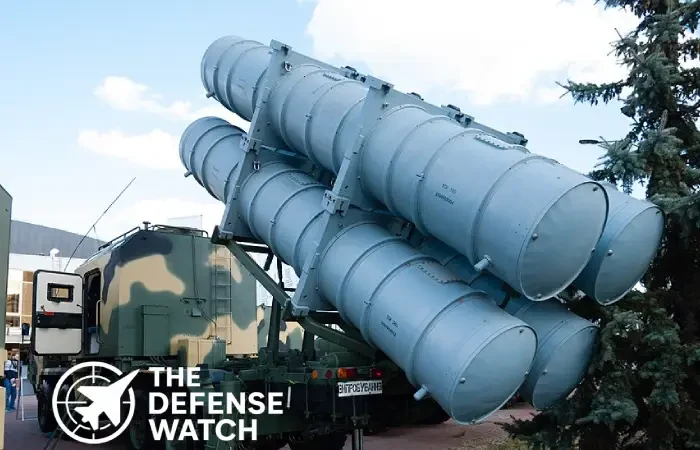
The Neptune coastal missile launcher, officially designated RK-360MC “Neptune,” is one of Ukraine’s most notable modern defense systems—designed to strengthen coastal security and deliver precision strikes against enemy ships, infrastructure, and high-value ground targets. Developed by Luch Design Bureau, the system emerged from Ukraine’s broader effort to rebuild domestic long-range strike capabilities following 2014. Its operational debut in 2022 marked a significant milestone when the missile system reportedly played a key role in the sinking of the Russian cruiser Moskva—a success story that thrust Neptune into global headlines.
The Neptune system consists of a mobile launcher vehicle, command and control trucks, transporter-erector-launchers (TELs), and the R-360 missile. With a range of up to 300 km, the missile flies at high subsonic speed and uses active radar guidance for terminal accuracy. The system’s mobility—built on an 8×8 heavy military chassis—enables rapid relocation and survivability against counterstrikes.
Designed primarily for coastal defense, Neptune has evolved into a multi-role precision-strike platform capable of engaging both naval targets and fixed land targets. It provides Ukraine with an indigenous, cost-effective alternative to foreign anti-ship systems and has demonstrated operational reliability under combat conditions.
Neptune Coastal Defense Missile Launcher Price
While official pricing is not publicly disclosed, Western defense analysts estimate that a full Neptune battery—including TELs, command vehicles, and support units—falls into the tens of millions of dollars range. Costs vary based on configuration, support equipment, and missile quantity.
Get real time update about this post category directly on your device, subscribe now.
Reviews
Disclaimer Note
The information provided on TheDefenseWatch.com is for general informational purposes only. While we strive to ensure the accuracy, completeness, and timeliness of our content regarding defense and aerospace products, technologies, and specifications, we cannot guarantee that all information is 100% accurate or up-to-date due to the evolving nature of military technology and classified data.TheDefenseWatch.com does not warrant the reliability, suitability, or availability of the information for any specific purpose. Users are advised to consult official sources, such as manufacturers, government publications, or defense agencies, for precise and verified data before making decisions based on our content.We are not affiliated with any defense manufacturers, governments, or military organizations mentioned. Opinions, reviews, and ratings reflect expert analysis but are subjective and should not be considered endorsements. TheDefenseWatch.com is not responsible for any errors, omissions, or consequences arising from the use of this website’s content.External links are provided for convenience and do not imply endorsement. TheDefenseWatch.com reserves the right to update or modify content without prior notice. By using this website, you agree to our Privacy & Cookies Policy.
New Arrivals

Popular Comparisons
-
 SIG XM7 Rifle vs M4: Key Differences and Performance Comparison
View Comparison →
SIG XM7 Rifle vs M4: Key Differences and Performance Comparison
View Comparison → -
Eurofighter Typhoon vs Rafale vs F-35: Fighter Jet Comparison
View Comparison →
-
J-20 vs F-22: Stealth Fighter Showdown Explained
View Comparison →
-
F-14 Tomcat vs Su-57: Can a Legend Challenge Russia’s Stealth Fighter?
View Comparison →
-
Su-35 vs Su-57: Russia’s Top Fighter Jets Compared
View Comparison →
-
Eurofighter Typhoon vs Su-57: Ultimate Fighter Jet Comparison
View Comparison →
-
Rafale vs Su-57: 4.5 Gen vs 5th Gen Fighter Jet Comparison
View Comparison →
-
Su-57 vs F-16 Fighting Falcon: Stealth vs Speed
View Comparison →
-
China vs Russia: J-20 Mighty Dragon vs Su-57 Felon Comparison
View Comparison →
-
Su-57 Felon vs F-22 Raptor: Stealth Air Superiority Face-Off
View Comparison →


- Pentagon Seeks AI Model Evaluation System To Ensure Military AI Reliability

- UK Confirms Limits On US Strikes From British Bases Amid Iran Escalation
- New British Military Helicopter Set To Enter Service In 2031 Under NMH Program
- US B 1B Bombers Loaded With Bunker Buster JDAMs At RAF Fairford As Iran Strike Campaign Expands
- Rolls Royce And ZF To Develop Hybrid Propulsion System For Europe MGCS Main Battle Tank
- Rheinmetall Iveco Military Trucks Deal Delayed As Leonardo Acquisition Yet To Close
- US Central Command Says 16 Iranian Mine‑Laying Vessels Destroyed Near Strait Of Hormuz
- North Korean Destroyer Conducts Repeat Ripple Launch Of Strategic Cruise Missiles
- Thales Unveils SkyDefender Air And Missile Defence Dome For Integrated Threat Protection
- Iran India Foreign Ministers Discuss Strait Of Hormuz Security Amid Rising Regional Tensions