- Home
- Catalog
- Tanks & Armored Vehicles
- K3 Main Battle Tank
K3 Main Battle Tank
Full Specifications
1. General Information
| Vehicle Name | K3 Main Battle Tank |
| Type / Role | Next-Generation MBT |
| Manufacturer | Hyundai Rotem |
| Country of Origin | South Korea |
| In Service | Development Phase |
| Year Introduced | Mid-2020s (Prototype) |
| Unit Cost | TBD |
| Crew | 3 (Commander, Gunner, Driver) |
2. Dimensions & Weight
| Length (Gun Forward) | ~10.0 m |
| Width | ~3.8 m |
| Height | ~2.5 m |
| Weight | 55–60 tons (estimat |
| Ground Clearance | 0.45 m |
| Chassis Material | Composite / Modular Armor |
3. Performance
| Engine Type | High-Output Diesel |
| Engine Power | 1,500–1,800 hp |
| Power-to-Weight Ratio | ~27–30 hp/ton |
| Transmission | Automatic Digital |
| Maximum Speed (Road) | ~70 km/h |
| Maximum Speed (Off-Road) | ~45 km/h |
| Operational Range | ~450 km |
| Suspension Type | Hydropneumatic |
4. Armament
| Main Gun | 130–140 mm Smoothbore |
| Ammunition Capacity | 30–36 rounds (est.) |
| Secondary Armament | RWS + Coax MG |
| Gun Elevation/Depression | +20° / -9° |
| Fire Control System | AI-Enhanced Digital FCS |
| Stabilization | Advanced Dual-Axis |
| Rate of Fire | 10–12 rpm (autoloader) |
5. Protection & Armor
| Armor Type | Composite / Modular |
| Reactive Armor | Optional ERA |
| Active Protection System (APS) | Hard- & Soft-Kill APS |
| NBC Protection | Yes |
| Smoke Grenade Launchers | 2 × 6 launchers |
| Fire Suppression System | Automatic |
| Mine Protection | Reinforced Belly Armor |
6. Mobility & Capability
| Maximum Gradient | 60% |
| Side Slope | 40% |
| Trench Crossing | ~3.0 m |
| Vertical Obstacle | ~1.1 m |
| Fording Depth | 1.2 m (2 m w/ kit) |
| Turning Radius | Neutral Turn |
| Amphibious Capability | Optional Kit |
7. Sensors & Electronics
| Fire Control Computer | Yes |
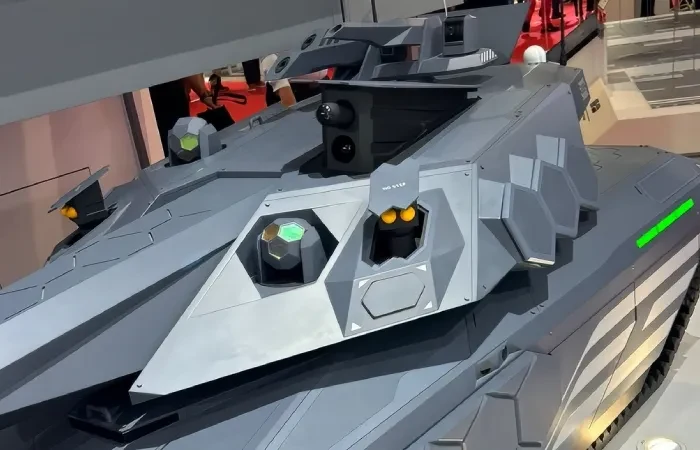
| Thermal Imaging | 360° Syst |
| Night Vision | IR / Low-Light |
| Laser Rangefinder | Yes |
| Ballistic Computer | Yes |
| Communication System | Secure Digit |
| Battlefield Management System | Integrated |
8. Operational Info
| Service Branch | ROK Army (fut |
| Primary Operator | South Korea |
| Combat Experience | None (development) |
| Upgrade Packages | Modular Architecture |
| Export Status | Expected |
| Production Status | Pre-production |
PROS
- Advanced gun caliber offering higher lethality
- AI-enabled fire control and sensor fusion
- Strong armor with APS for modern survivability
- High power-to-weight ratio for superior mobility
- Modular design for long-term upgrade flexibility
CONS
- Expected high procurement and maintenance cost
- Technology complexity may affect early reliability
- Heavy weight limits some bridge and terrain access
- Large caliber ammunition reduces onboard capacity
- APS maintenance requirements increase logistics load
K3 Next-Generation Main Battle Tank
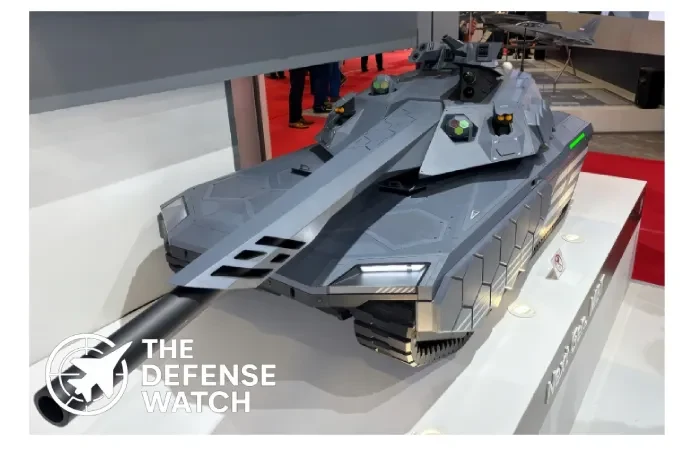
The K3 Main Battle Tank represents South Korea’s next major leap in armored warfare, designed to succeed the K2 Black Panther and deliver a decisive edge on future high-intensity battlefields. Developed by Hyundai Rotem, the K3 incorporates advanced technologies inspired by global sixth-generation armored concepts, integrating enhanced mobility, superior firepower, and AI-driven situational awareness.
Created to address emerging threats such as drone swarms, top-attack munitions, and network-centric warfare, the K3 is built around a modular open-architecture system that supports rapid upgrades over its service life. Its mission is to operate as the centerpiece of combined-arms maneuver forces, capable of leading mechanized assaults while providing overmatch against peer-level adversaries.
The K3 is expected to mount a 130 mm or 140 mm next-generation smoothbore cannon, offering significantly greater kinetic energy than current 120 mm systems. Enhanced autoloader technology enables a higher rate of fire and reduces crew workload. Secondary armament includes a coaxial machine gun and a remotely operated weapon station for counter-UAV and close-range defense.
Powered by a 1,500–1,800 hp high-output diesel engine, the K3 aims to improve both acceleration and sustained high-speed maneuvering, even across challenging terrain. Its digital transmission and adaptive suspension support superior ride stability, increasing accuracy while firing on the move.
Protection focuses on survivability against modern anti-armor threats. The K3 combines next-generation composite armor, active protection systems (APS), and top-attack defeat mechanisms. A layered defense suite—featuring hard-kill interceptors and soft-kill jamming—provides robust resilience against guided missiles and precision munitions.
Internally, the K3 leverages AI-assisted fire control, sensor fusion, 360° thermal imaging, and battlefield networking, giving the crew improved targeting speed and enhanced situational awareness in day or night operations.
Designed for export as well as Republic of Korea Army modernization, the K3 positions itself as one of the most advanced MBTs entering development in the mid-2020s.
FAQs – K3 Main Battle Tank
Third-generation main battle tanks are armored vehicles developed primarily from the late Cold War era onward. They typically feature thermal imaging sights, computerized fire-control systems, 120 mm smoothbore guns, composite armor, and enhanced mobility. Examples include the M1A1 Abrams, Leopard 2A4, Challenger 1, and T-80U. These tanks prioritize high first-round hit probability, night-fighting capability, and strong survivability.
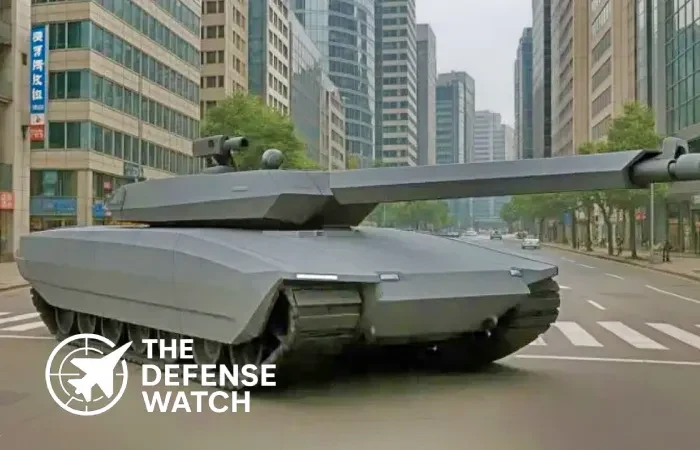
The K3 tank, still under development, is expected to incorporate reduced-signature technologies, though not full “stealth” like aircraft. Projected stealth-related features include:
Infrared signature reduction through heat-shielded exhaust systems
Low-observable turret shaping to deflect radar and laser detection
Thermal masking panels to dampen heat signatures
Acoustic dampening to reduce engine and track noise
Electronic countermeasures to disrupt targeting systems
These features are designed to decrease detection range and improve survivability against modern sensors and guided weapons.
South Korea’s current main battle tank is the K2 Black Panther, produced by Hyundai Rotem. It is one of the most advanced operational MBTs in the world, featuring a 120 mm smoothbore gun, advanced suspension, composite armor, and a sophisticated fire-control suite. The K3 is intended to be the next-generation successor but is still in development.
There is no universally agreed “best” tank, as performance depends on doctrine, environment, and mission profile. However, tanks frequently cited among the top include:
M1A2 SEP v3 Abrams (U.S.)
K2 Black Panther (South Korea)
Leopard 2A7+ (Germany)
Challenger 3 (UK, upcoming)
Leclerc XLR (France)
These MBTs are known for advanced fire control, strong armor protection, and modern digital systems.
Since the K3 is still in development and has not reached production, no official price has been released. However, defense analysts estimate that a next-generation MBT of this class—featuring a 130–140 mm gun, advanced sensors, and APS—could cost USD $12–16 million per unit, depending on configuration, export packages, and production scale.
Get real time update about this post category directly on your device, subscribe now.
Reviews
Disclaimer Note
The information provided on TheDefenseWatch.com is for general informational purposes only. While we strive to ensure the accuracy, completeness, and timeliness of our content regarding defense and aerospace products, technologies, and specifications, we cannot guarantee that all information is 100% accurate or up-to-date due to the evolving nature of military technology and classified data.TheDefenseWatch.com does not warrant the reliability, suitability, or availability of the information for any specific purpose. Users are advised to consult official sources, such as manufacturers, government publications, or defense agencies, for precise and verified data before making decisions based on our content.We are not affiliated with any defense manufacturers, governments, or military organizations mentioned. Opinions, reviews, and ratings reflect expert analysis but are subjective and should not be considered endorsements. TheDefenseWatch.com is not responsible for any errors, omissions, or consequences arising from the use of this website’s content.External links are provided for convenience and do not imply endorsement. TheDefenseWatch.com reserves the right to update or modify content without prior notice. By using this website, you agree to our Privacy & Cookies Policy.
More Products from Hyundai Rotem
New Arrivals



Popular Comparisons
-
 SIG XM7 Rifle vs M4: Key Differences and Performance Comparison
View Comparison →
SIG XM7 Rifle vs M4: Key Differences and Performance Comparison
View Comparison → -
Eurofighter Typhoon vs Rafale vs F-35: Fighter Jet Comparison
View Comparison →
-
J-20 vs F-22: Stealth Fighter Showdown Explained
View Comparison →
-
F-14 Tomcat vs Su-57: Can a Legend Challenge Russia’s Stealth Fighter?
View Comparison →
-
Su-35 vs Su-57: Russia’s Top Fighter Jets Compared
View Comparison →
-
Eurofighter Typhoon vs Su-57: Ultimate Fighter Jet Comparison
View Comparison →
-
Rafale vs Su-57: 4.5 Gen vs 5th Gen Fighter Jet Comparison
View Comparison →
-
Su-57 vs F-16 Fighting Falcon: Stealth vs Speed
View Comparison →
-
China vs Russia: J-20 Mighty Dragon vs Su-57 Felon Comparison
View Comparison →
-
Su-57 Felon vs F-22 Raptor: Stealth Air Superiority Face-Off
View Comparison →


- Pentagon Considers Second B-21 Raider Production Line To Accelerate U.S. Stealth Bomber Expansion

- France Unveils 78,000-Ton Nuclear Aircraft Carrier France Libre With 40-Aircraft Capacity
- L3Harris Wins $77.8M U.S. Navy Contract for Kineto Tracking Mount Sustainment
- US Navy Awards $15.38B Columbia-Class Submarine Contract To Strengthen Nuclear Deterrent
- China Surges Production Capacity For J-20 And J-35 Stealth Fighters As Beijing Expands Fifth-Generation Fleet
- Netanyahu Announces Elimination Of Senior Iranian Figures In Air Campaign
- US Bombers Avoid European Airspace On Iran Bombing Runs In Strategic Route Shift
- Japan’s EC-2 Electronic Warfare Jet Completes First Flight, Expanding Standoff Jamming Capabilities
- NASA’s X-59 Quiet Supersonic Jet Gears Up for Second Flight — A Giant Leap Toward Silent Boom AviationNASA X-59 Second Flight: Supersonic Aviation Reborn
- US Weapons Shipments to Taiwan Unaffected by Iran War, Officials Confirm