- Home
- Catalog
- Naval Destroyers (Warships)
- HMS Victory Warship
HMS Victory Warship


Full Specifications
1. General Information
| System Name | HMS Victory |
| Type / Role | First Rate Ship of the Line |
| Manufacturer | Chatham Dockyard |
| Country of Origin | United Kingdom |
| In Service | 1778 to Present (ceremonial status) |
| Year Introduced | 1765 (Launched) |
| Unit Cost | Approx. 63,000 British pounds (18th century) |
| Crew | Approx. 820 personnel |
2. Dimensions & Structure
| Length | 69.3 m |
| Beam (Width) | 15.8 m |
| Draft | 8.8 m |
| Displacement | Approx. 3,500 tons |
| Hull Material | Oak timber with copper sheathing |
| Deck Configuration | hree gun decks |
3. Performance & Propulsion
| Propulsion Type | Wind powered sail |
| Engine Model | None |
| Power Output | Wind dependent |
| Maximum Speed | 8 to 11 knots |
| Range | Operationally unlimited (supply dependent) |
| Endurance | Several months at sea |
4. Sensors & Radar Systems
| Primary Radar | None |
| Radar Range | Not Applicable |
| Fire Control Radar | Visual targeting and signal commands |
5. Weapons & Armament
| Main Gun | 104 smoothbore muzzle loading cannons |
6. Aviation & Support
| Replenishment at Sea | Manual resupply in port |
7. Defensive & Electronic Systems
| Combat Management System | Command hierarchy structure |
| Communication Systems | Signal flags, lanterns, messengers |
8. Operational Information
| Service Branch | Royal Navy |
| Primary Operator | United Kingdom |
| Operational History | American War of Independence, Napoleonic Wars, Battle of Trafalgar |
| Notable Feature | Flagship of Admiral Nelson at Trafalgar |
PROS
- Heavy 104 gun broadside capability
- Strong oak hull construction
- Long operational endurance at sea
- Central role in decisive naval battles
- Still preserved and accessible for study
CONS
- Dependent entirely on wind conditions
- Slow maneuverability compared to modern vessels
- Large crew requirement of over 800 personnel
- Limited onboard medical facilities by modern standards
- Vulnerable to fire and splinter damage
HMS Victory: Britain Flagship of the Age of Sail
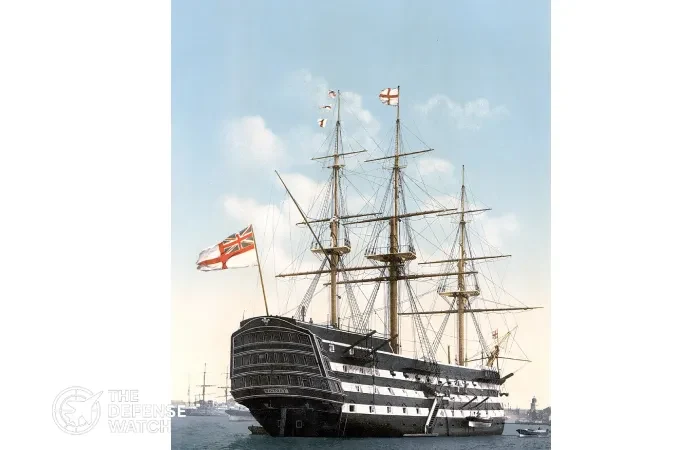
HMS Victory remains one of the most recognized warships in naval history. Best known as Admiral Horatio Nelson flagship at the 1805 Battle of Trafalgar, the first rate ship of the line symbolizes the height of wooden sailing warship design in the Age of Sail. Built for line of battle engagements, HMS Victory carried heavy broadside firepower designed to break enemy fleets at close range.
Commissioned into the Royal Navy in 1778, the vessel saw combat during the American War of Independence, the French Revolutionary Wars, and the Napoleonic Wars. Today, it remains a commissioned warship and serves as a museum ship in Portsmouth, UK.
Manufacturer
HMS Victory was built at Chatham Dockyard in Kent, England. Designed by naval architect Sir Thomas Slade, she was constructed using oak timbers, with copper sheathing later added to protect the hull from marine growth. The ship reflects 18th century British naval engineering focused on durability, heavy armament, and fleet dominance.
Speed and Range
Powered entirely by sail across three masts, HMS Victory could reach speeds of approximately 8 to 11 knots depending on wind conditions. Range was effectively unlimited, constrained mainly by food, water, and crew endurance rather than fuel. The vessel could remain at sea for months during sustained operations.
Cost/Price
Original construction cost was approximately 63,000 British pounds in the 18th century, equivalent to tens of millions of dollars today when adjusted for inflation and material value. Maintenance and periodic refits significantly added to lifetime costs.
Get real time update about this post category directly on your device, subscribe now.
Reviews
Disclaimer Note
The information provided on TheDefenseWatch.com is for general informational purposes only. While we strive to ensure the accuracy, completeness, and timeliness of our content regarding defense and aerospace products, technologies, and specifications, we cannot guarantee that all information is 100% accurate or up-to-date due to the evolving nature of military technology and classified data.TheDefenseWatch.com does not warrant the reliability, suitability, or availability of the information for any specific purpose. Users are advised to consult official sources, such as manufacturers, government publications, or defense agencies, for precise and verified data before making decisions based on our content.We are not affiliated with any defense manufacturers, governments, or military organizations mentioned. Opinions, reviews, and ratings reflect expert analysis but are subjective and should not be considered endorsements. TheDefenseWatch.com is not responsible for any errors, omissions, or consequences arising from the use of this website’s content.External links are provided for convenience and do not imply endorsement. TheDefenseWatch.com reserves the right to update or modify content without prior notice. By using this website, you agree to our Privacy & Cookies Policy.
New Arrivals










Popular Comparisons
-
 SIG XM7 Rifle vs M4: Key Differences and Performance Comparison
View Comparison →
SIG XM7 Rifle vs M4: Key Differences and Performance Comparison
View Comparison → -
Eurofighter Typhoon vs Rafale vs F-35: Fighter Jet Comparison
View Comparison →
-
J-20 vs F-22: Stealth Fighter Showdown Explained
View Comparison →
-
F-14 Tomcat vs Su-57: Can a Legend Challenge Russia’s Stealth Fighter?
View Comparison →
-
Su-35 vs Su-57: Russia’s Top Fighter Jets Compared
View Comparison →
-
Eurofighter Typhoon vs Su-57: Ultimate Fighter Jet Comparison
View Comparison →
-
Rafale vs Su-57: 4.5 Gen vs 5th Gen Fighter Jet Comparison
View Comparison →
-
Su-57 vs F-16 Fighting Falcon: Stealth vs Speed
View Comparison →
-
China vs Russia: J-20 Mighty Dragon vs Su-57 Felon Comparison
View Comparison →
-
Su-57 Felon vs F-22 Raptor: Stealth Air Superiority Face-Off
View Comparison →


- UK Nightfall Procurement Plans Face Government Silence Amid Air Defense Debate

- NASA Completes First Flight Of Laminar Flow Scaled Wing Design In Aerodynamic Breakthrough
- Singapore Orders Three G550 Maritime Surveillance Aircraft To Boost Early Warning Network
- Polish Defense Industry Backs EU SAFE Mechanism To Boost National Production And Exports
- How StormBreaker Integration Expands Super Hornet Precision Strike Options for The U.S. Navy
- Former US F-35 Pilot Arrested for Allegedly Training Chinese Air Force
- NATO Intelligence From Germany: SWARM Biotactics Cybernetic Insect Swarms Enter Operational Use
- UK And Norway Sign Naval Helicopter Pact To Deepen Maritime Defense Cooperation
- Israel MOD Signs $42 Million Merkava Tank Transmission Deal With Ashot Ashkelon
- China’s New Aircraft Carrier Faces Persistent Design Flaw, Raising Questions About PLAN Power Projection