- Home
- Catalog
- Naval Destroyers (Warships)
- HMS Belfast Warship
HMS Belfast Warship
Full Specifications
1. General Information
| System Name | HMS Belfast |
| Type / Role | Light Cruiser |
| Manufacturer | Harland and Wolff |
| Country of Origin | United Kingdom |
| In Service | 1939 to 1963 |
| Year Introduced | 1939 |
| Unit Cost | £2.14 million, 1939 value |
| Crew | Approx. 950 personnel |
2. Dimensions & Structure
| Length | 613 ft, 187 m |
| Beam (Width) | 63 ft, 19.2 m |
| Draft | 17 ft, 5.2 m |
| Displacement | 11,550 tons full load |
| Hull Material | Steel |
| Deck Configuration | Flush deck with four main gun turrets |
3. Performance & Propulsion
| Propulsion Type | Steam turbines |
| Engine Model | Parsons geared steam turbines |
| Power Output | Approx. 80,000 shaft horsepower |
| Maximum Speed | 32 knots |
| Range | Approx. 8,600 nautical miles at 13 knots |
| Endurance | Long range ocean deployment capable |
4. Sensors & Radar Systems
| Primary Radar | Type 284 gunnery radar |
| Radar Range | Up to 40 nautical miles |
| Sonar System | ASDIC sonar |
| Electro-Optical / IR System | None |
| Electronic Warfare Suite | Early WWII electronic countermeasures |
| Fire Control Radar | Type 284 |
5. Weapons & Armament
| Main Gun | 12 × 6 inch Mk XXIII naval guns |
| Vertical Launch System (VLS) Cells | None |
| Missiles | None |
| Anti-Ship Missiles | None |
| Anti-Submarine Torpedoes | 2 × triple 21 inch torpedo tubes |
| Close-In Weapon System (CIWS) | None |
| Decoy Systems | Chaff systems in later service |
6. Aviation & Support
| Helicopter Capability | None |
| Hangar Capacity | None |
| UAV Operations | None |
| Flight Deck Size | Not applicable |
| Replenishment at Sea | Yes |
7. Defensive & Electronic Systems
| Countermeasures | Chaff launchers, late service |
| ECM / ECCM | Early generation ECM |
| Missile Defense System | None |
| Combat Management System | Analog fire control computers |
| Communication Systems | Naval HF and VHF radio systems |
8. Operational Information
| Service Branch | Royal Navy |
| Primary Operator | United Kingdom |
| Operational History | Arctic convoys, Battle of North Cape, Normandy landings, Korean War |
| Notable Feature | Preserved museum ship on the River Thames |
PROS
- Proven WWII combat record
- Strong main gun armament
- Long operational range
- Early adoption of naval radar
- Preserved in near original condition
CONS
- Vulnerable to air attack by modern standards
- No guided missile capability
- Large crew requirement
- High operating and maintenance costs
- Obsolete compared to post war missile ships
HMS Belfast Light Cruiser Profile
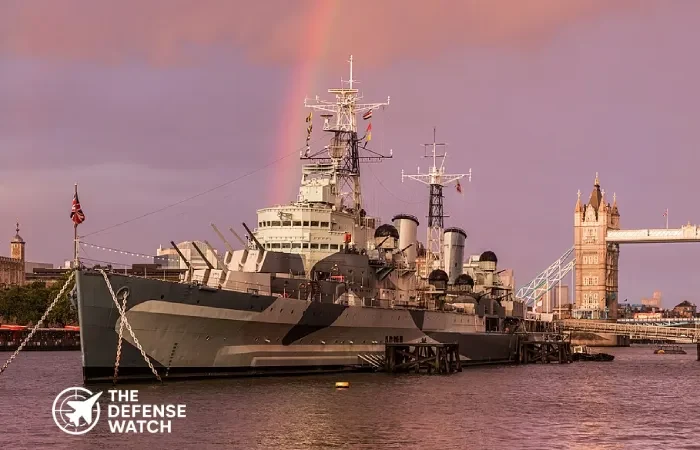
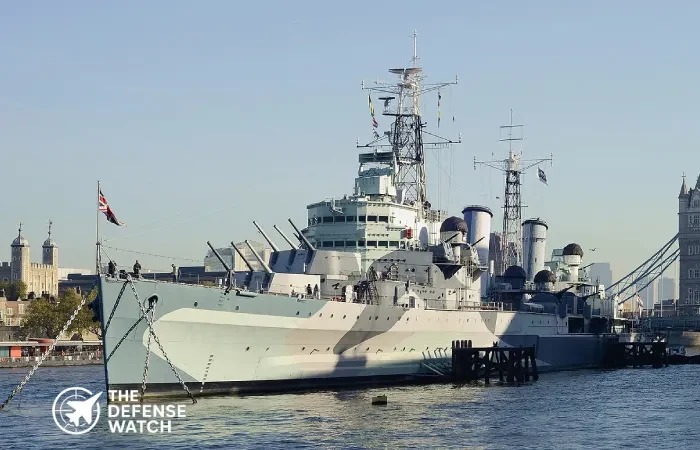
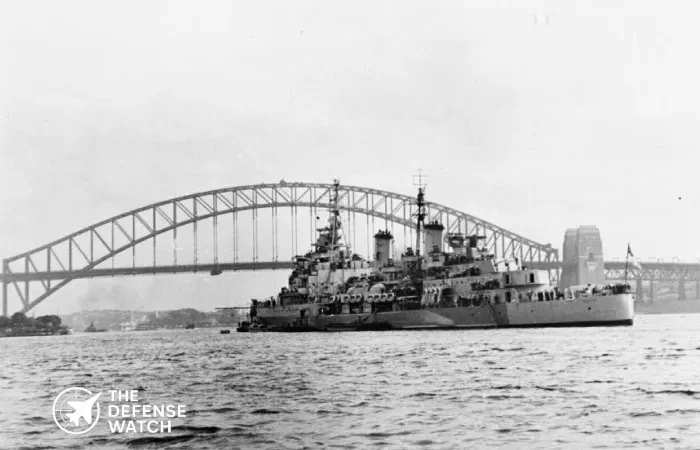
HMS Belfast is one of the most well preserved warships of the Second World War era. Commissioned in 1939, the Royal Navy light cruiser played a key role in Arctic convoy escorts, the sinking of the German battleship Scharnhorst, and naval gunfire support during the Normandy landings. Later, she served in the Korean War before being preserved as a museum ship in London.
Designed as part of the Town class, HMS Belfast was built for fleet screening, trade protection, and surface engagements. Her main battery of twelve 6 inch guns, supported by dual purpose secondary weapons and anti aircraft guns, made her a formidable surface combatant for her time. The ship combined firepower, endurance, and radar equipped targeting systems that reflected rapid wartime naval innovation.
Manufacturer
HMS Belfast was constructed by Harland and Wolff in Belfast, Northern Ireland. Built for the Royal Navy, she represented British naval engineering priorities on survivability and gunnery power during the late 1930s rearmament period.
Speed and Range
Powered by oil fired boilers and steam turbines producing roughly 80,000 shaft horsepower, HMS Belfast reached a maximum speed of about 32 knots. Her operational range extended to approximately 8,600 nautical miles at cruising speed, enabling long Atlantic and Arctic deployments.
Cost/Price
The estimated construction cost was about £2.14 million in late 1930s British currency, equivalent to significantly higher values in today’s terms when adjusted for inflation. The investment reflected the complexity of cruiser level firepower and armor protection before the missile age.
Get real time update about this post category directly on your device, subscribe now.
Reviews
Disclaimer Note
The information provided on TheDefenseWatch.com is for general informational purposes only. While we strive to ensure the accuracy, completeness, and timeliness of our content regarding defense and aerospace products, technologies, and specifications, we cannot guarantee that all information is 100% accurate or up-to-date due to the evolving nature of military technology and classified data.TheDefenseWatch.com does not warrant the reliability, suitability, or availability of the information for any specific purpose. Users are advised to consult official sources, such as manufacturers, government publications, or defense agencies, for precise and verified data before making decisions based on our content.We are not affiliated with any defense manufacturers, governments, or military organizations mentioned. Opinions, reviews, and ratings reflect expert analysis but are subjective and should not be considered endorsements. TheDefenseWatch.com is not responsible for any errors, omissions, or consequences arising from the use of this website’s content.External links are provided for convenience and do not imply endorsement. TheDefenseWatch.com reserves the right to update or modify content without prior notice. By using this website, you agree to our Privacy & Cookies Policy.
New Arrivals






Popular Comparisons
-
 SIG XM7 Rifle vs M4: Key Differences and Performance Comparison
View Comparison →
SIG XM7 Rifle vs M4: Key Differences and Performance Comparison
View Comparison → -
Eurofighter Typhoon vs Rafale vs F-35: Fighter Jet Comparison
View Comparison →
-
J-20 vs F-22: Stealth Fighter Showdown Explained
View Comparison →
-
F-14 Tomcat vs Su-57: Can a Legend Challenge Russia’s Stealth Fighter?
View Comparison →
-
Su-35 vs Su-57: Russia’s Top Fighter Jets Compared
View Comparison →
-
Eurofighter Typhoon vs Su-57: Ultimate Fighter Jet Comparison
View Comparison →
-
Rafale vs Su-57: 4.5 Gen vs 5th Gen Fighter Jet Comparison
View Comparison →
-
Su-57 vs F-16 Fighting Falcon: Stealth vs Speed
View Comparison →
-
China vs Russia: J-20 Mighty Dragon vs Su-57 Felon Comparison
View Comparison →
-
Su-57 Felon vs F-22 Raptor: Stealth Air Superiority Face-Off
View Comparison →


- UK Nightfall Procurement Plans Face Government Silence Amid Air Defense Debate

- NASA Completes First Flight Of Laminar Flow Scaled Wing Design In Aerodynamic Breakthrough
- Singapore Orders Three G550 Maritime Surveillance Aircraft To Boost Early Warning Network
- Polish Defense Industry Backs EU SAFE Mechanism To Boost National Production And Exports
- How StormBreaker Integration Expands Super Hornet Precision Strike Options for The U.S. Navy
- Former US F-35 Pilot Arrested for Allegedly Training Chinese Air Force
- NATO Intelligence From Germany: SWARM Biotactics Cybernetic Insect Swarms Enter Operational Use
- UK And Norway Sign Naval Helicopter Pact To Deepen Maritime Defense Cooperation
- Israel MOD Signs $42 Million Merkava Tank Transmission Deal With Ashot Ashkelon
- China’s New Aircraft Carrier Faces Persistent Design Flaw, Raising Questions About PLAN Power Projection