- Home
- Catalog
- Tanks & Armored Vehicles
- CAESAR Howitzer
CAESAR Howitzer
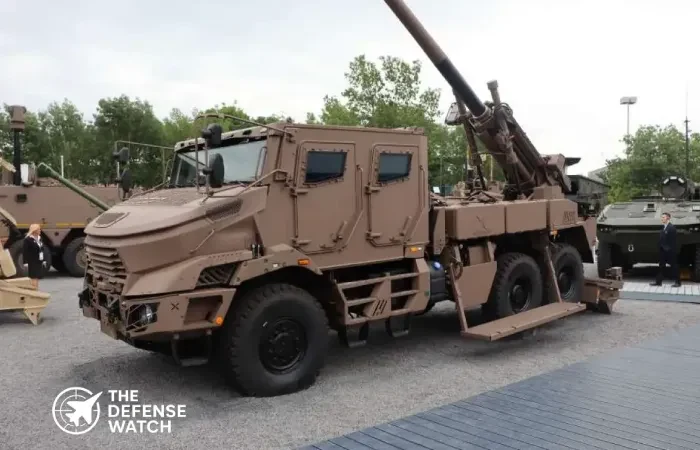
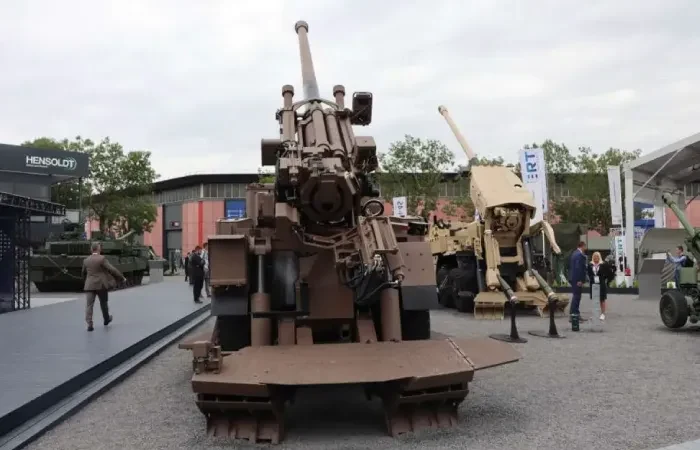
Full Specifications
1. General Information
| Vehicle Name | CAESAR 155mm Self‑Propelled Howitzer |
| Type / Role | Wheeled Self‑Propelled Artillery |
| Manufacturer | KNDS France |
| Country of Origin | France |
| In Service | Yes |
| Year Introduced | 2008 |
| Unit Cost | Approx USD 5 million |
| Crew | 3–5 |
2. Dimensions & Weight
| Length (Gun Forward) | ~10.0 m |
| Width | ~2.55 m |
| Height | ~3.1 m |
| Weight | ~17.7–30.2 tonnes |
| Ground Clearance | Standard truck level |
| Chassis Material | Military truck steel frame |
3. Performance
| Engine Type | Diesel Engine |
| Engine Power | 215 hp (6x6) / 460 hp (8x8) |
| Power-to-Weight Ratio | 12-15 hp/ton |
| Transmission | Automatic |
| Maximum Speed (Road) | 100 km/h |
| Maximum Speed (Off-Road) | 50 km/h |
| Operational Range | 600 km |
| Suspension Type | Independent Wheel |
4. Armament
| Main Gun | 155 mm/52 cal Howitzer |
| Ammunition Capacity | 18-30 rounds |
| Secondary Armament | Optional 7.62mm MG |
| Gun Elevation/Depression | +72° / -3° |
| Fire Control System | Digital Automated FCS |
| Stabilization | Hydraulic Stabilizer |
| Rate of Fire | 6 rounds per minute |
5. Protection & Armor
| Armor Type | Light Ballistic Protection |
| Reactive Armor | None |
| Active Protection System (APS) | Optional |
| NBC Protection | Yes |
| Smoke Grenade Launchers | Optional |
| Fire Suppression System | Manual/Automatic |
| Mine Protection | Basic |
6. Mobility & Capability
| Maximum Gradient | 30% |
| Side Slope | 20% |
| Trench Crossing | 1.2 m |
| Vertical Obstacle | 0.5 m |
| Fording Depth | 1.2 m |
| Turning Radius | 15 m |
| Amphibious Capability | No |
7. Sensors & Electronics
| Fire Control Computer | Yes |
| Thermal Imaging | Optional |
| Night Vision | Infrared |
| Laser Rangefinder | Yes |
| Ballistic Computer | Yes |
| Communication System | Tactical Radio |
| Battlefield Management System | Integrated |
8. Operational Info
| Service Branch | French Army |
| Primary Operator | France, Ukraine, Saudi Arabia, Morocco |
| Combat Experience | Ukraine, Mali, Afghanistan, Yemen |
| Upgrade Packages | MkII, 8x8 Variant |
| Export Status | Approved for Allies |
| Production Status | Active |
PROS
- High tactical mobility on varied terrain
- Long‑range fire support beyond 40 km
- Quick set‑up and shoot‑and‑scoot capability
- Modern fire control with integration options
- Air transportable for rapid deployment
CONS
- Armor protection limited on baseline models
- Requires logistical support for ammo supply
- Wheeled chassis less off‑road than tracked guns
- Cost per unit significant for large armies
- Crew exposed during resupply without upgrades
CAESAR 155mm Self‑Propelled Howitzer
Manufacturer, Purpose, and Combat Use
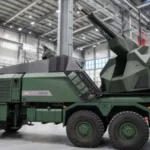
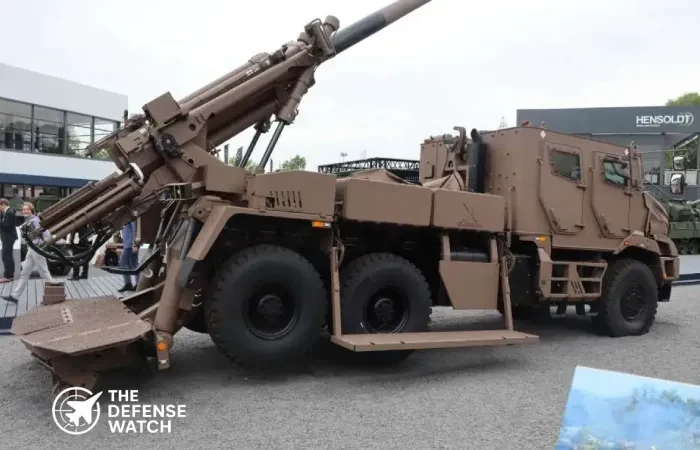
Built by KNDS France (formerly Nexter Systems), CAESAR stands for Camion Équipé d’un Système d’Artillerie, or truck with an artillery system. It was designed to give brigades a highly mobile gun capable of shoot‑and‑scoot operations, reducing exposure to counter‑battery fire. The howitzer gives U.S. partners and NATO allies a NATO‑standard 155mm gun on a tactical vehicle that moves quickly, fires with little preparation, then relocates. Its combat history includes deployments in Middle East conflicts and significant use in Ukraine since 2022.
Major Capabilities
The heart of CAESAR is its 155mm, 52‑caliber cannon with an effective range of up to 42 km using extended‑range shells. Advanced ammunition types such as rocket‑assisted or guided rounds can propel fire beyond 50 km, giving commanders flexible engagement options. The system sustains a rate of fire around six rounds per minute and carries about 18 ready‑to‑fire projectiles.
Technology and Mobility
CAESAR uses an inertial navigation system, ballistic computer, and optional muzzle velocity radar to quickly lay the gun without traditional survey teams. The wheeled chassis (6×6 or 8×8) brings strategic mobility with road speeds up to 100 km/h and a 600 km operational range, all while being transportable by tactical airlifters like C‑130 or A400M aircraft. Crew cab protection can be upgraded to STANAG level 2 ballistic and mine resistance on modern variants.
CAESAR 155mm Self‑Propelled Howitzer Price
The CAESAR 155mm Self‑Propelled Howitzer is a mobile artillery platform trusted by modern armies for fast, accurate long‑range fire support. Mounted on a rugged wheeled truck chassis, this French‑designed system brings heavy firepower without the logistical burden of heavier tracked guns. Since entering service in the late 2000s, CAESAR has seen action from Afghanistan to Ukraine, where it has supported maneuver forces with rapid, precise indirect fire.
Get real time update about this post category directly on your device, subscribe now.
Reviews
Disclaimer Note
The information provided on TheDefenseWatch.com is for general informational purposes only. While we strive to ensure the accuracy, completeness, and timeliness of our content regarding defense and aerospace products, technologies, and specifications, we cannot guarantee that all information is 100% accurate or up-to-date due to the evolving nature of military technology and classified data.TheDefenseWatch.com does not warrant the reliability, suitability, or availability of the information for any specific purpose. Users are advised to consult official sources, such as manufacturers, government publications, or defense agencies, for precise and verified data before making decisions based on our content.We are not affiliated with any defense manufacturers, governments, or military organizations mentioned. Opinions, reviews, and ratings reflect expert analysis but are subjective and should not be considered endorsements. TheDefenseWatch.com is not responsible for any errors, omissions, or consequences arising from the use of this website’s content.External links are provided for convenience and do not imply endorsement. TheDefenseWatch.com reserves the right to update or modify content without prior notice. By using this website, you agree to our Privacy & Cookies Policy.
New Arrivals





Popular Comparisons
-
 SIG XM7 Rifle vs M4: Key Differences and Performance Comparison
View Comparison →
SIG XM7 Rifle vs M4: Key Differences and Performance Comparison
View Comparison → -
Eurofighter Typhoon vs Rafale vs F-35: Fighter Jet Comparison
View Comparison →
-
J-20 vs F-22: Stealth Fighter Showdown Explained
View Comparison →
-
F-14 Tomcat vs Su-57: Can a Legend Challenge Russia’s Stealth Fighter?
View Comparison →
-
Su-35 vs Su-57: Russia’s Top Fighter Jets Compared
View Comparison →
-
Eurofighter Typhoon vs Su-57: Ultimate Fighter Jet Comparison
View Comparison →
-
Rafale vs Su-57: 4.5 Gen vs 5th Gen Fighter Jet Comparison
View Comparison →
-
Su-57 vs F-16 Fighting Falcon: Stealth vs Speed
View Comparison →
-
China vs Russia: J-20 Mighty Dragon vs Su-57 Felon Comparison
View Comparison →
-
Su-57 Felon vs F-22 Raptor: Stealth Air Superiority Face-Off
View Comparison →


- UK Nightfall Procurement Plans Face Government Silence Amid Air Defense Debate

- NASA Completes First Flight Of Laminar Flow Scaled Wing Design In Aerodynamic Breakthrough
- Singapore Orders Three G550 Maritime Surveillance Aircraft To Boost Early Warning Network
- Polish Defense Industry Backs EU SAFE Mechanism To Boost National Production And Exports
- How StormBreaker Integration Expands Super Hornet Precision Strike Options for The U.S. Navy
- Former US F-35 Pilot Arrested for Allegedly Training Chinese Air Force
- NATO Intelligence From Germany: SWARM Biotactics Cybernetic Insect Swarms Enter Operational Use
- UK And Norway Sign Naval Helicopter Pact To Deepen Maritime Defense Cooperation
- Israel MOD Signs $42 Million Merkava Tank Transmission Deal With Ashot Ashkelon
- China’s New Aircraft Carrier Faces Persistent Design Flaw, Raising Questions About PLAN Power Projection