- Home
- Catalog
- Bombers & Strategic Aircraft
- Avro Vulcan Bomber
Avro Vulcan Bomber
Full Specifications
1. General Information
| Name | Avro Vulcan |
| Manufacturer | Avro Aircraft |
| Country of Origin | United Kingdom |
| Introduction / In Service Since | 1956 |
| Status | Retired |
| Category | Strategic Bomber |
| Crew | 5 |
| Unit Cost | Not publicly disclosed |
2. Dimensions & Structure
| Length | 99 ft |
| Wingspan | 111 ft |
| Height | 26 ft |
| Wing Area | 3,800 sq ft |
| Empty Weight | Approx. 74,000 lb |
| Maximum Takeoff Weight (MTOW) | 204,000 lb |
3. Performance
| Maximum Speed | Mach 0.96 |
| Range | 4,600 miles |
| Combat Radius | Approx. 2,000 miles |
| Service Ceiling | 55,000 ft |
| Rate of Climb | 8,000 ft per min |
4. Powerplant
| Engine Type | 4x Rolls Royce Olympus |
| Thrust (per engine) | 20,000 lbf |
| Total Thrust | 80,000 lbf |
5. Payload & Armament
| Internal Payload Capacity | 21,000 lb |
| Weapons Bay | Internal |
| Compatible Weapons | Nuclear bombs, conventional bombs |
| Hardpoints | None |
6. Avionics & Systems
| Radar System | Terrain following radar |
| Navigation | Inertial navigation |
| Electronic Warfare (EW) | Basic ECM suite |
| Stealth Features | None |
7. Operational History
| Primary Operator | Royal Air Force |
| Conflict Usage | Falklands War |
| Notable Missions | Operation Black Buck |
8. Additional Information
| Variants | B.1, B.2 |
| Successor / Future Replacement | Submarine based nuclear deterrent |
| Notable Features | Delta wing design |
| Estimated Operational Life | 1956 to 198 |
PROS
- Long range strategic strike capability
- Large internal payload capacity
- Advanced aerodynamics for its era
- Proven operational history
- High altitude performance
CONS
- No stealth features
- High maintenance demands
- Limited defensive systems
- Outdated avionics by modern standards
- Large radar signature
Avro Vulcan Strategic Bomber
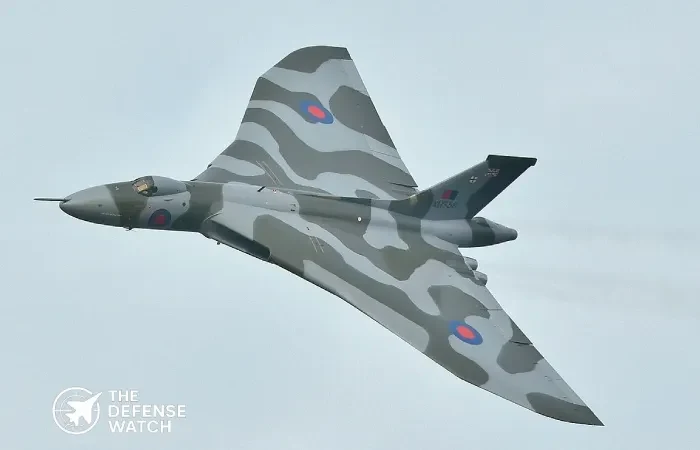
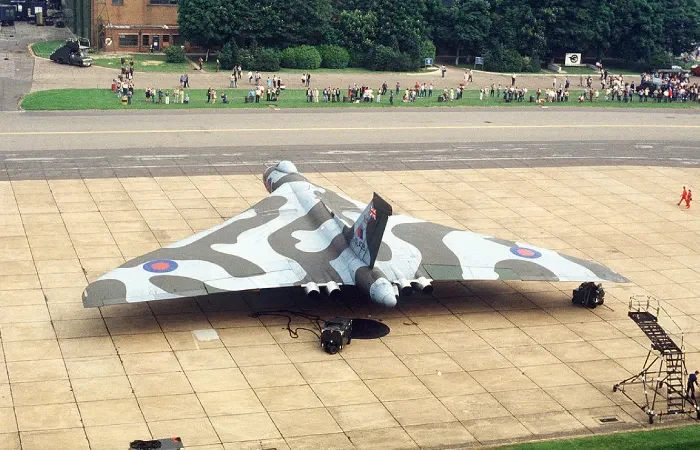
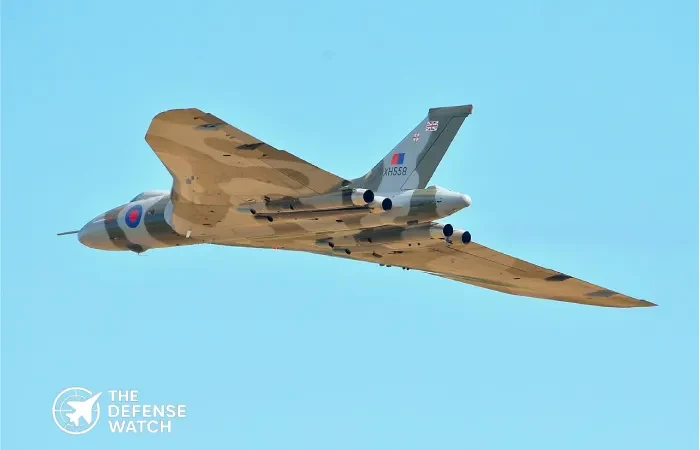
The Avro Vulcan remains one of the most recognizable military aircraft of the Cold War era. Developed during a time of intense nuclear rivalry, the Vulcan was designed to deliver Britain’s airborne nuclear deterrent deep into enemy territory. Its distinctive delta wing shape gave it both a futuristic look and advanced performance for its time.
Built by Avro Aircraft in the United Kingdom, the Vulcan entered service with the Royal Air Force in 1956. It was one of three V bombers developed to carry nuclear weapons, alongside the Victor and Valiant. The Vulcan’s primary mission was high altitude nuclear strike, later shifting to low level penetration as air defenses improved.
Powered by four Rolls Royce Olympus turbojet engines, the Vulcan could reach speeds close to Mach 0.96 and operate at high altitudes above 55,000 feet. It had a long operational range, allowing it to conduct global missions with aerial refueling support. Its internal bomb bay could carry nuclear gravity bombs or a large conventional payload.
Although built for nuclear war, the Vulcan saw real combat late in its service life. During the 1982 Falklands War, Vulcan bombers flew some of the longest bombing missions in history during Operation Black Buck, striking Argentine positions from Ascension Island. These missions highlighted the aircraft’s endurance and adaptability.
The Vulcan was retired in 1984, replaced by more modern systems and submarine based deterrence. Today, it is remembered as a symbol of Cold War airpower and British aerospace innovation, with a lasting impact on bomber design and long range strike doctrine.
Avro Vulcan Strategic Bomber Price
The Avro Vulcan Strategic Bomber was never sold on the open market. It was built exclusively for the UK Royal Air Force as part of Britain’s nuclear deterrent force during the Cold War.
Get real time update about this post category directly on your device, subscribe now.
Reviews
Disclaimer Note
The information provided on TheDefenseWatch.com is for general informational purposes only. While we strive to ensure the accuracy, completeness, and timeliness of our content regarding defense and aerospace products, technologies, and specifications, we cannot guarantee that all information is 100% accurate or up-to-date due to the evolving nature of military technology and classified data.TheDefenseWatch.com does not warrant the reliability, suitability, or availability of the information for any specific purpose. Users are advised to consult official sources, such as manufacturers, government publications, or defense agencies, for precise and verified data before making decisions based on our content.We are not affiliated with any defense manufacturers, governments, or military organizations mentioned. Opinions, reviews, and ratings reflect expert analysis but are subjective and should not be considered endorsements. TheDefenseWatch.com is not responsible for any errors, omissions, or consequences arising from the use of this website’s content.External links are provided for convenience and do not imply endorsement. TheDefenseWatch.com reserves the right to update or modify content without prior notice. By using this website, you agree to our Privacy & Cookies Policy.
New Arrivals





Popular Comparisons
-
 SIG XM7 Rifle vs M4: Key Differences and Performance Comparison
View Comparison →
SIG XM7 Rifle vs M4: Key Differences and Performance Comparison
View Comparison → -
Eurofighter Typhoon vs Rafale vs F-35: Fighter Jet Comparison
View Comparison →
-
J-20 vs F-22: Stealth Fighter Showdown Explained
View Comparison →
-
F-14 Tomcat vs Su-57: Can a Legend Challenge Russia’s Stealth Fighter?
View Comparison →
-
Su-35 vs Su-57: Russia’s Top Fighter Jets Compared
View Comparison →
-
Eurofighter Typhoon vs Su-57: Ultimate Fighter Jet Comparison
View Comparison →
-
Rafale vs Su-57: 4.5 Gen vs 5th Gen Fighter Jet Comparison
View Comparison →
-
Su-57 vs F-16 Fighting Falcon: Stealth vs Speed
View Comparison →
-
China vs Russia: J-20 Mighty Dragon vs Su-57 Felon Comparison
View Comparison →
-
Su-57 Felon vs F-22 Raptor: Stealth Air Superiority Face-Off
View Comparison →


- UK Nightfall Procurement Plans Face Government Silence Amid Air Defense Debate

- NASA Completes First Flight Of Laminar Flow Scaled Wing Design In Aerodynamic Breakthrough
- Singapore Orders Three G550 Maritime Surveillance Aircraft To Boost Early Warning Network
- Polish Defense Industry Backs EU SAFE Mechanism To Boost National Production And Exports
- How StormBreaker Integration Expands Super Hornet Precision Strike Options for The U.S. Navy
- Former US F-35 Pilot Arrested for Allegedly Training Chinese Air Force
- NATO Intelligence From Germany: SWARM Biotactics Cybernetic Insect Swarms Enter Operational Use
- UK And Norway Sign Naval Helicopter Pact To Deepen Maritime Defense Cooperation
- Israel MOD Signs $42 Million Merkava Tank Transmission Deal With Ashot Ashkelon
- China’s New Aircraft Carrier Faces Persistent Design Flaw, Raising Questions About PLAN Power Projection