- Home
- Catalog
- Artillery & Indirect Fire
- ASTROS II Rocket Launcher System
ASTROS II Rocket Launcher System
Full Specifications
1. General Information
| System Name | ASTROS II Rocket Launcher |
| Manufacturer | Avibras Industria Aeroespacial |
| Country of Origin | Brazil |
| Type / Role | Wheeled Rocket Artillery / Tactical MLRS |
| Caliber | 127 mm / 180 mm / 300 mm / 450 mm |
| Year Introduced | 1983 |
| In Service | Yes |
| Unit Cost | USD 350,000 – 5 Million (depending on variant) |
| Crew Required | 3–6 Personnel |
| Platform Type | Vehicle-Mounted 6×6 or 8×8 |
| Power Source | Diesel |
2. Performance & Firepower
| Maximum Effective Range | 9–300 km (caliber-dependent) |
| Minimum Range | 9 km |
| Rate of Fire (Sustained / Burst) | 12 rockets / 24 rockets per salvo |
| Accuracy (CEP) | 50–150 m (unguided), <30 m (guided) |
| Elevation Range | 0–60° |
| Traverse Range | 90°–360° |
| Recoil System | Wheeled vehicle-mounted |
| Reload Time | 10–30 minutes |
3. Ammunition & Warhead Options
| Compatible Ammunition | HE, Fragmentation, Practice, Guided |
| Caliber Standard | 127–450 mm |
| Warhead Type | HE, Fragmentation, Precision-Guided |
| Warhead Weight | 50–600 kg |
| Fuse Type | Impact / Proximity / Programmable |
| Muzzle Velocity | 400–1,200 m/s |
| Guidance | Unguided / GPS / INS / Laser |
| Effective Burst Radius | 25–300 m |
4. Fire Control & Targeting Systems
| Fire Control System | Digital fire control computer with manual backup |
| Aiming System | GPS aided inertial navigation with optical alignment |
| Communication Link | Secure tactical radio data link |
| Night Operation | Supported via night vision and thermal devices |
| Automation Level | Semi automated launch sequencing |
| Targeting Assistance | Integrated ballistic computation and external target cueing |
5. Launcher / Platform & Mobility
| Platform Type | Truck mounted wheeled launcher |
| Vehicle Model | Custom Avibras Tatra based six by six or eight by eigh |
| Mobility Range | Up to 600 km |
| Top Speed | Up to 90 km per hour |
| Ground Clearance | Approx 350 mm |
| Setup / Emplacement Time | Around 3 minutes |
| Transportability | Air transportable by C 130 class aircraft |
6. Protection & Survivability
| Armor Level | Light ballistic protection for cab |
| CBRN Protection | Optional overpressure system |
| Counter-Battery Radar Integration | Compatible with external radar systems |
| Smoke Launcher System | Available on selected variants |
| Shoot-and-Scoot Capability | Yes |
| Signature Reduction | Reduced acoustic and infrared signature |
7. Command, Control & Networking
| C2 System | Integrated artillery command and control network |
| Connectivity | Secure radio and satellite communication |
| Network Capability | Fully network enabled with joint fire coordination |
| Operation Mode | Manual or network coordinated fire missions |
| Compatible Systems | UAV spotters, forward observers, battlefield radars |
8. Operational History
| Primary Operators | Brazil, Saudi Arabia, Indonesia, Malaysia, Qatar |
| Combat Proven | Yes |
| Operational Deployment | Middle East operations and regional conflicts |
| Conflict History | Gulf War era regional use |
| Notable Feature | High mobility with sustained rocket saturation capability |
9. Dimensions & Weight
| System Weight | Approx 24 tons fully loaded |
| Barrel Length | Approx 9.8 m |
| Vehicle Weight | 18 to 24 tons depending on configuration |
| Dimensions (L×W×H) | Varies by launcher and rocket type |
| Transport Configuration | Road, sea, and military airlift compatible |
10. Maintenance & Support
| Maintenance Cycle | Scheduled preventive maintenance every 12 months |
| Field Servicing Time | Under 1 hour for basic servicing |
| Spare Parts Availability | High through OEM support |
| Training Requirement | Three to four weeks for full crew qualification |
| Support Package | OEM logistics, training, and lifecycle support |
11. Economic / Procurement Data
| Estimated unit cost | USD 1 to 5 million depending on rockets and vehicles |
| Cost per Round | USD 10,000 to 200,000 depending on caliber |
| Country Procurement Program | Brazil Army and export customers |
| Export Status | Export approved under Brazilian defense regulations |
| Manufacturer Website | Avibras official defense systems portal |
PROS
- Multi-caliber rocket capability
- Rapid shoot-and-scoot deployment
- Digital fire-control with GPS/INS
- Long-range and precision strike options
- Wheeled platform allows high mobility
CONS
- Dependent on crew training for optimal operation
- Larger rockets require logistical support
- Vulnerable during reload or setup phases
- Not fully armored against heavy fire
- Limited availability of advanced guided munitions in some operators
ASTROS II Tactical Rocket Launcher System
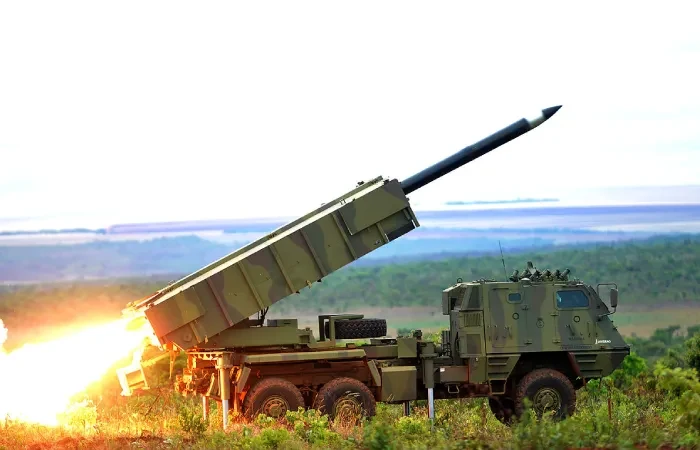
The ASTROS II (Artillery Saturation Rocket System) is a versatile and modern rocket artillery system developed in Brazil by Avibras Industria Aeroespacial. Designed for rapid, long-range fire support, ASTROS II provides armed forces with flexible, high-volume rocket strikes against strategic targets while maintaining mobility and survivability on the battlefield.
Manufacturer and Purpose
Developed by Avibras, the ASTROS II system entered service in the late 1980s and has since been adopted by multiple countries, including Saudi Arabia, Indonesia, and Qatar. Its primary role is to deliver precise and concentrated firepower over medium to long ranges, supporting conventional artillery and armored units in high-intensity conflict scenarios.
Capabilities and Technology
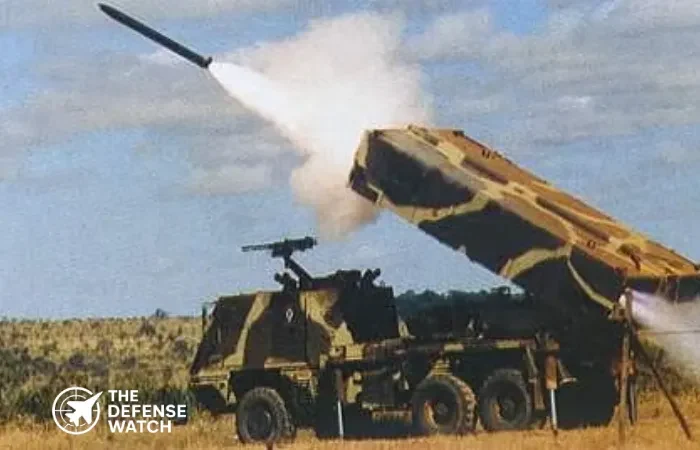
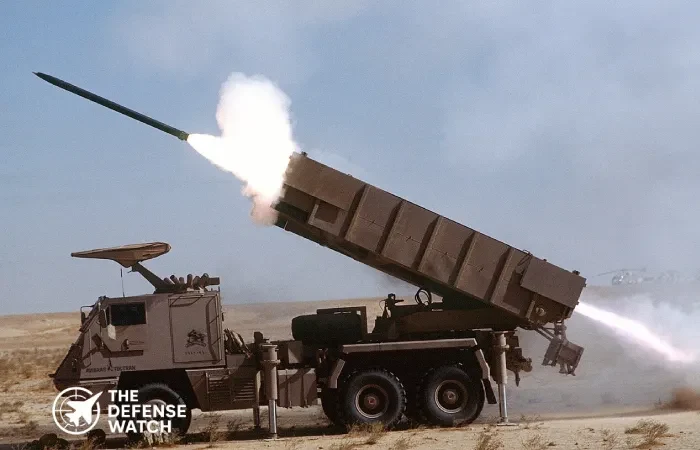
The system features a modular launcher capable of firing rockets of varying calibers (127 mm, 180 mm, 300 mm, and 450 mm), allowing operational flexibility. Mounted on wheeled 6×6 or 8×8 vehicles, ASTROS II can rapidly relocate after firing, minimizing exposure to counter-battery fire. It integrates a digital fire-control system with GPS and inertial navigation, enabling improved targeting accuracy and semi-automated launch sequences.
Rockets achieve ranges from 9 km for smaller calibers up to 300 km for larger, guided variants. The system supports multiple warhead types, including high-explosive, fragmentation, and precision-guided munitions. This versatility makes ASTROS II suitable for suppressing enemy artillery, neutralizing fortified positions, and providing area-denial capabilities.
Operational Use
ASTROS II has seen deployment in various military exercises and peacekeeping missions worldwide. Its mobility, rapid setup, and shoot-and-scoot capability allow commanders to execute fire missions efficiently while minimizing logistical strain. The platform’s modularity ensures that it can be integrated with existing command-and-control networks for coordinated operations.
Overall, the ASTROS II Rocket Launcher System combines range, accuracy, and adaptability in a wheeled rocket artillery platform, making it a key asset for modern armies seeking scalable firepower and tactical flexibility.
Get real time update about this post category directly on your device, subscribe now.
Reviews
Disclaimer Note
The information provided on TheDefenseWatch.com is for general informational purposes only. While we strive to ensure the accuracy, completeness, and timeliness of our content regarding defense and aerospace products, technologies, and specifications, we cannot guarantee that all information is 100% accurate or up-to-date due to the evolving nature of military technology and classified data.TheDefenseWatch.com does not warrant the reliability, suitability, or availability of the information for any specific purpose. Users are advised to consult official sources, such as manufacturers, government publications, or defense agencies, for precise and verified data before making decisions based on our content.We are not affiliated with any defense manufacturers, governments, or military organizations mentioned. Opinions, reviews, and ratings reflect expert analysis but are subjective and should not be considered endorsements. TheDefenseWatch.com is not responsible for any errors, omissions, or consequences arising from the use of this website’s content.External links are provided for convenience and do not imply endorsement. TheDefenseWatch.com reserves the right to update or modify content without prior notice. By using this website, you agree to our Privacy & Cookies Policy.
New Arrivals



Popular Comparisons
-
 SIG XM7 Rifle vs M4: Key Differences and Performance Comparison
View Comparison →
SIG XM7 Rifle vs M4: Key Differences and Performance Comparison
View Comparison → -
Eurofighter Typhoon vs Rafale vs F-35: Fighter Jet Comparison
View Comparison →
-
J-20 vs F-22: Stealth Fighter Showdown Explained
View Comparison →
-
F-14 Tomcat vs Su-57: Can a Legend Challenge Russia’s Stealth Fighter?
View Comparison →
-
Su-35 vs Su-57: Russia’s Top Fighter Jets Compared
View Comparison →
-
Eurofighter Typhoon vs Su-57: Ultimate Fighter Jet Comparison
View Comparison →
-
Rafale vs Su-57: 4.5 Gen vs 5th Gen Fighter Jet Comparison
View Comparison →
-
Su-57 vs F-16 Fighting Falcon: Stealth vs Speed
View Comparison →
-
China vs Russia: J-20 Mighty Dragon vs Su-57 Felon Comparison
View Comparison →
-
Su-57 Felon vs F-22 Raptor: Stealth Air Superiority Face-Off
View Comparison →


- UK Nightfall Procurement Plans Face Government Silence Amid Air Defense Debate

- NASA Completes First Flight Of Laminar Flow Scaled Wing Design In Aerodynamic Breakthrough
- Singapore Orders Three G550 Maritime Surveillance Aircraft To Boost Early Warning Network
- Polish Defense Industry Backs EU SAFE Mechanism To Boost National Production And Exports
- How StormBreaker Integration Expands Super Hornet Precision Strike Options for The U.S. Navy
- Former US F-35 Pilot Arrested for Allegedly Training Chinese Air Force
- NATO Intelligence From Germany: SWARM Biotactics Cybernetic Insect Swarms Enter Operational Use
- UK And Norway Sign Naval Helicopter Pact To Deepen Maritime Defense Cooperation
- Israel MOD Signs $42 Million Merkava Tank Transmission Deal With Ashot Ashkelon
- China’s New Aircraft Carrier Faces Persistent Design Flaw, Raising Questions About PLAN Power Projection