- Home
- Catalog
- Military Helicopters
- AH-64E Apache Helicopter
AH-64E Apache Helicopter
Full Specifications
1. General Information
| Name / Designation | AH-64E Apache Guardian |
| Type / Role | Attack / Reconnaissance / Escort |
| Country of Origin | United States |
| Manufacturer | Boeing Defense, Space & Security |
| Introduced / Service Entry | 2011 |
| Operational Status | Active |
| Operators | USA, UK, India, Israel, Indonesia |
2. Performance
| Maximum Speed (Road) | 293 km/h (158 knots) |
| Cruise Speed | 265 km/h |
| Range | 480 km (Combat) / 1,900 km (Ferry) |
| Endurance | 2.5–3 hours |
| Service Ceiling | 6,400 m |
| Rate of Climb | 12.7 m/s |
3. Dimensions & Weight
| Length | 17.7 m |
| Height | 4.95 m |
| Rotor Diameter | 14.6 m |
| Empty Weight | 5,165 kg |
| Maximum Takeoff Weight (MTOW) | 10,400 kg |
4. Armament & Payload
| Primary Armament | 30mm M230 Chain Gun |
| Secondary Armament | AGM-114 Hellfire / AIM-92 Stinger / Rockets |
| Hardpoints / Weapon Stations | 4–6 |
| Payload Capacity | 1,200–4,000 kg |
| Countermeasures | Flares, Chaff, ECM Suite |
5. Avionics & Systems
| Radar Name | Longbow Fire Control Radar / AESA |
| Targeting System | FLIR / Laser Designator / NVG |
| Navigation System | GPS / INS / Digital Flight Control |
| Communication System | Secure Radio / Data Link |
| Defensive Systems | MAWS / RWR / IR Jammer |
6. Powerplant
| Engines | 2 × T700-GE-701D Turboshafts |
| Engine Model | T700-GE-701D |
| Power Output | 1,994 shp each |
| Fuel Capacity | 1,400 L |
7. Crew & Capacity
| Crew | 2 (Pilot + Co-Pilot/Gunner) |
| Passenger Capacity | N/A |
| Cabin Configuration | Tandem cockpit |
| Cargo Load (Internal/External) | Up to 5,000 kg (External) |
8. Operational Capabilities
| Night Operation Capability | Yes |
| All-weather Operation | Yes |
| Combat Proven | Yes |
PROS
- Exceptional firepower and precision targeting
- Advanced radar and sensor suite
- Proven combat survivability
- All-weather, day-night operational capability
- High-speed and maneuverable in low-altitude flight
CONS
- High maintenance and operational costs
- Requires extensive pilot training
- Vulnerable to MANPADS in low-altitude zones
- Limited transport capacity
- High noise signature
AH-64E Apache Guardian: America’s Premier Attack Helicopter
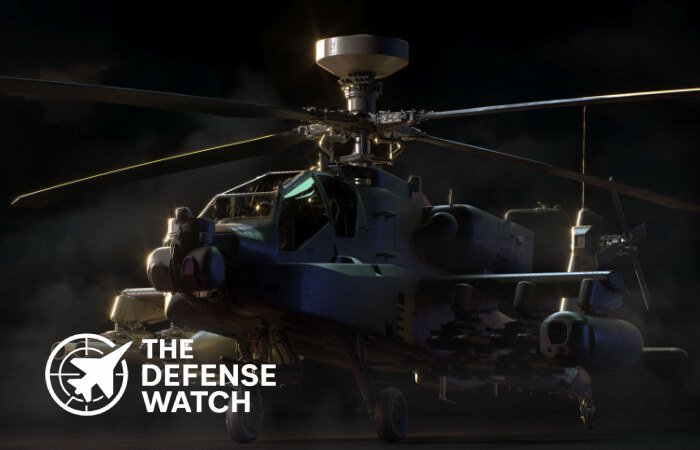
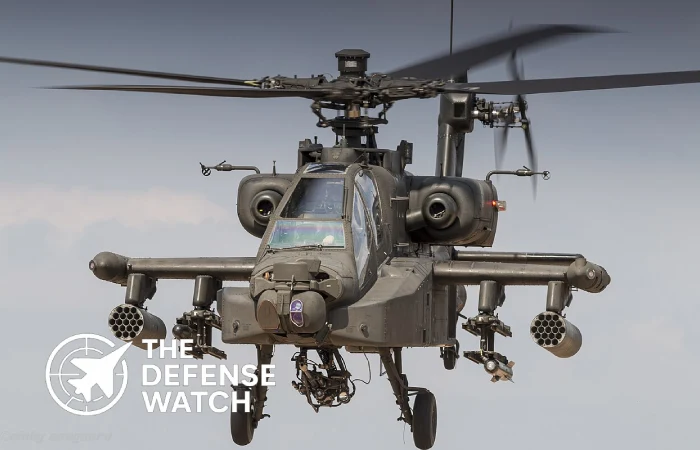
The AH-64E Apache Guardian represents the cutting edge of U.S. Army attack helicopter technology. Built by Boeing Defense, Space & Security, this advanced variant of the iconic Apache series enhances battlefield lethality, survivability, and connectivity. Originally developed in the United States, the AH-64E entered service in 2011, providing next-generation capabilities to American and allied forces worldwide.
Design and Capabilities
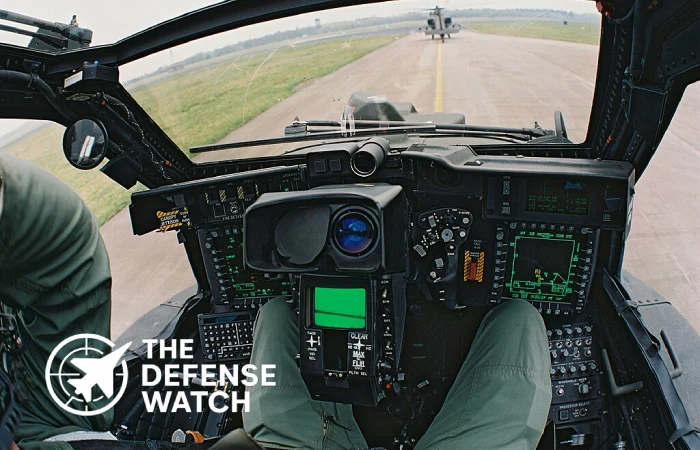
Equipped with twin T700-GE-701D turboshaft engines, the AH-64E achieves speeds up to 293 km/h (158 knots) and can operate at altitudes exceeding 6,000 meters. Its Longbow Fire Control Radar enables simultaneous tracking and engagement of multiple targets, while an AESA radar upgrade option improves situational awareness and countermeasure effectiveness. The helicopter’s FLIR, laser designator, and night vision systems support precision strikes in all-weather and low-visibility conditions.
Armed with a 30mm M230 chain gun, AGM-114 Hellfire missiles, AIM-92 Stingers, and 70mm rockets, the Apache Guardian delivers unmatched close air support and anti-armor capability. Its digital connectivity allows for real-time data sharing with ground forces and UAVs, reinforcing network-centric warfare operations.
Operational Use
The AH-64E is operational across the U.S., UK, India, Israel, and other allies, playing key roles in Iraq, Afghanistan, and counterterrorism missions. Its superior avionics, composite rotor blades, and advanced flight control systems ensure exceptional maneuverability and survivability in high-threat environments.
AH-64E Apache Guardian Helicopter Price in US
In recent defense procurement disclosures, the unit flyaway cost for a brand‐new AH-64E Apache Guardian is commonly cited at around $52 million USD. That figure typically reflects the airframe plus core subsystems (engines, avionics, mission systems) but excludes ancillary costs like training, spares, ground support equipment, munitions, and sustainment. In large foreign military sales packages, the total price per helicopter (including weapons, logistics, infrastructure, and long-term support) can rise significantly—some deals see per-aircraft effective cost rise by tens of millions. For instance, the Polish procurement of 96 Apache Guardians, valued at approximately $12 billion, implies an average per-unit total package cost well above the base airframe cost.
Budget planners in the U.S. and allied nations often assume that the “through life cost” of an Apache (acquisition + operations + sustainment) can double or triple the initial purchase price over its service lifespan. In the U.S. Army’s internal estimates, efforts to reduce flight-hour costs and maintenance burden have improved affordability—but still, the up-front unit cost remains a major investment.
Thus, for U.S. defense budget discussions or foreign military sale proposals, quoting ~$52 million USD as the base price is defensible, with strong caveats that real program costs may be much higher once full integration, weapons packages, and long-term support are factored in.
Get real time update about this post category directly on your device, subscribe now.
Reviews
Disclaimer Note
The information provided on TheDefenseWatch.com is for general informational purposes only. While we strive to ensure the accuracy, completeness, and timeliness of our content regarding defense and aerospace products, technologies, and specifications, we cannot guarantee that all information is 100% accurate or up-to-date due to the evolving nature of military technology and classified data.TheDefenseWatch.com does not warrant the reliability, suitability, or availability of the information for any specific purpose. Users are advised to consult official sources, such as manufacturers, government publications, or defense agencies, for precise and verified data before making decisions based on our content.We are not affiliated with any defense manufacturers, governments, or military organizations mentioned. Opinions, reviews, and ratings reflect expert analysis but are subjective and should not be considered endorsements. TheDefenseWatch.com is not responsible for any errors, omissions, or consequences arising from the use of this website’s content.External links are provided for convenience and do not imply endorsement. TheDefenseWatch.com reserves the right to update or modify content without prior notice. By using this website, you agree to our Privacy & Cookies Policy.


New Arrivals


Popular Comparisons
-
 SIG XM7 Rifle vs M4: Key Differences and Performance Comparison
View Comparison →
SIG XM7 Rifle vs M4: Key Differences and Performance Comparison
View Comparison → -
Eurofighter Typhoon vs Rafale vs F-35: Fighter Jet Comparison
View Comparison →
-
J-20 vs F-22: Stealth Fighter Showdown Explained
View Comparison →
-
F-14 Tomcat vs Su-57: Can a Legend Challenge Russia’s Stealth Fighter?
View Comparison →
-
Su-35 vs Su-57: Russia’s Top Fighter Jets Compared
View Comparison →
-
Eurofighter Typhoon vs Su-57: Ultimate Fighter Jet Comparison
View Comparison →
-
Rafale vs Su-57: 4.5 Gen vs 5th Gen Fighter Jet Comparison
View Comparison →
-
Su-57 vs F-16 Fighting Falcon: Stealth vs Speed
View Comparison →
-
China vs Russia: J-20 Mighty Dragon vs Su-57 Felon Comparison
View Comparison →
-
Su-57 Felon vs F-22 Raptor: Stealth Air Superiority Face-Off
View Comparison →


- Iran-US Ceasefire Negotiations Stall as Strait of Hormuz Standoff Deepens

- US Deploys Uncrewed Drone Boats In Conflict With Iran As Maritime Tensions Escalate
- Raytheon Expands Alabama Missile Integration Facility To Boost U.S. Defense Production Capacity
- Australian-Built Boxer Combat Reconnaissance Vehicles Roll Off Production Line, Boosting Land 400 Program
- U.S. Army To Begin M1E3 Abrams Prototype Operational Testing In Summer 2026
- Raytheon Secures $773.5M Contract Boost For AN/TPY-2 Radar Development Through 2030
- Javelin Missile Production Ramp Accelerates as Lockheed Martin Overhauls Supply Chain for High-Volume Output
- Indian Army To Buy 800 Km Plus Range BrahMos Supersonic Cruise Missiles
- US Navy Iwo Jima Amphibious Ready Group Expands Caribbean Anti-Trafficking Push
- Chinas Laser Air Defense Systems Light Arrow 21A And Light Arrow 11E Form Layered Counter Drone Shield