- Home
- Catalog
- Bombers & Strategic Aircraft
- AC-130U Aircraft
AC-130U Aircraft

Full Specifications
1. General Information
| Name | AC-130U Spooky II |
| Manufacturer | Lockheed Martin (airframe) / Boeing (modifications) |
| Country of Origin | United States |
| Introduction / In Service Since | 1995 |
| Status | Retired (final retirement 2020) |
| Category | Gunship / Close Air Support |
| Crew | 13 (5 officers, 8 enlisted) |
| Unit Cost | $210 million (approx., as of retirement period) |
2. Dimensions & Structure
| Length | 97 ft 9 in (29.8 m) |
| Wingspan | 132 ft 7 in (40.4 m) |
| Height | 38 ft 6 in (11.7 m) |
| Wing Area | 1,745 sq ft (162.1 sq m) |
| Empty Weight | ~72,892 lb (33,063 kg) |
| Maximum Takeoff Weight (MTOW) | 155,000 lb (70,307 kg) |
3. Performance
| Maximum Speed | 300 mph (483 km/h) |
| Range | ~1,300 nautical miles (unlimited with refueling) |
| Combat Radius | ~575 nautical miles (estimated) |
| Service Ceiling | 25,000 ft (7,620 m) |
| Rate of Climb | ~1,830 ft/min (9.3 m/s) |
4. Powerplant
| Engine Type | 4 × Allison T56-A-15 turboprop |
| Thrust (per engine) | 4,910 shp (3,660 kW) |
| Total Thrust | 19,640 shp |
5. Payload & Armament
| Internal Payload Capacity | Fixed guns and ammunition stores |
| Weapons Bay | N/A (side-firing fuselage mounts) |
| Compatible Weapons | 1 × 25mm GAU-12/U Gatling gun, 1 × 40mm L/60 Bofors cannon, 1 × 105mm M102 howitzer |
| Hardpoints | None (integrated side-firing only) |
6. Avionics & Systems
| Radar System | AN/APQ-180 synthetic aperture radar |
| Navigation | INS/GPS |
| Electronic Warfare (EW) | AN/ALQ-172 countermeasures suite, flares, chaff |
| Stealth Features | Minimal / None |
7. Operational History
| Primary Operator | U.S. Air Force (Special Operations Command) |
| Conflict Usage | Operations in Afghanistan, Iraq, Somalia, Bosnia, and others |
| Notable Missions | Extensive support in Operation Enduring Freedom, Iraqi Freedom, and urban CAS roles |
8. Additional Information
| Variants | AC-130H Spectre (predecessor), AC-130W Stinger II |
| Successor / Future Replacement | AC-130J Ghostrider |
| Notable Features | Precision side-firing firepower, long loiter endurance, all-weather/night targeting |
| Estimated Operational Life | 1995–2020 |
PROS
- Exceptional loiter time for prolonged mission support.
- Precise, multi-weapon armament for versatile engagements.
- Advanced sensors enable all-weather, night operations.
- Proven combat effectiveness in special operations.
- Aerial refueling extends operational range indefinitely.
CONS
- Vulnerable to surface-to-air missiles due to low speed and altitude.
- High maintenance requirements for aging airframe.
- Large crew size increases logistical demands.
- Limited stealth features expose it to radar detection.
- Retired status limits availability for current use.
AC-130U Spooky Gunship
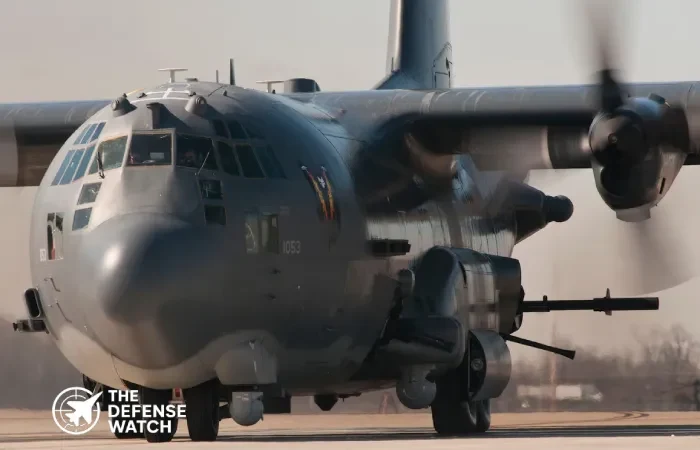
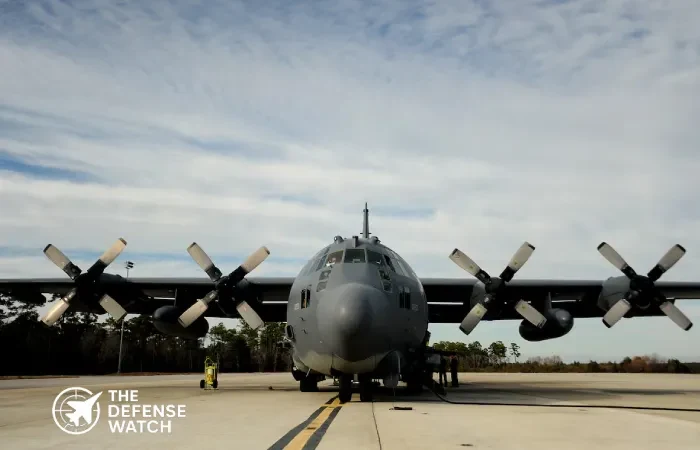
The AC-130U Spooky II is a heavily armed ground-attack aircraft derived from the C-130 Hercules transport plane. Developed to provide precise, sustained firepower in support of ground troops, this gunship excels in close air support (CAS), air interdiction, and force protection missions. First introduced in 1995, the AC-130U represented a significant upgrade over earlier models, incorporating advanced sensors, fire control systems, and increased ammunition capacity. Its side-firing configuration allows it to circle targets at low altitudes, delivering accurate strikes day or night, even in adverse weather. Primarily used by U.S. Special Operations Forces, the AC-130U has been deployed in conflicts like Operation Enduring Freedom and Iraqi Freedom, where its ability to loiter for hours and engage multiple targets simultaneously proved invaluable. Equipped with a 25mm Gatling gun, 40mm cannon, and 105mm howitzer, it combines overwhelming firepower with sophisticated avionics for surgical precision. Despite its retirement in 2020, the AC-130U’s legacy endures in modern variants like the AC-130J Ghostrider.
Manufacturer
Built on the Lockheed C-130H airframe, the AC-130U was modified by Boeing (formerly Rockwell) to integrate gunship capabilities. Lockheed Martin handled the base aircraft production, while Boeing managed the weapons, sensors, and fire control integrations. This collaboration ensured the platform’s robustness, drawing from the proven Hercules design used extensively by the U.S. military since the 1950s.
Speed and Range
The AC-130U achieves a maximum speed of 300 mph (Mach 0.4) at sea level, powered by four Allison T56-A-15 turboprop engines. Its cruise speed supports extended loiter times over targets. The aircraft’s range is approximately 1,300 nautical miles without refueling, but aerial refueling extends this indefinitely, limited only by crew endurance. This capability allows for long-duration missions, often exceeding seven hours, making it ideal for persistent surveillance and support in remote operational areas.
AC-130U Spooky Gunship Price
The unit cost of the AC-130U is approximately $210 million, reflecting its advanced modifications, including precision weaponry and sensor suites. This price tag encompasses the base C-130 airframe conversion, armament installation, and avionics upgrades. For U.S. defense budgets, it represented a high-value investment in special operations, though costs could vary with inflation and specific configurations.
The AC-130U’s operational prowess stems from its all-weather, day-night targeting systems, including infrared and low-light TV sensors, enabling strikes with minimal collateral damage. In urban environments, its ability to engage two targets at once with varying ordnance levels minimized risks to friendly forces. However, its large size and low-altitude operations made it vulnerable to anti-aircraft threats, necessitating escort or nighttime use. Post-retirement, lessons from the AC-130U inform next-generation gunships, emphasizing endurance and firepower for asymmetric warfare.
Get real time update about this post category directly on your device, subscribe now.
Reviews
Disclaimer Note
The information provided on TheDefenseWatch.com is for general informational purposes only. While we strive to ensure the accuracy, completeness, and timeliness of our content regarding defense and aerospace products, technologies, and specifications, we cannot guarantee that all information is 100% accurate or up-to-date due to the evolving nature of military technology and classified data.TheDefenseWatch.com does not warrant the reliability, suitability, or availability of the information for any specific purpose. Users are advised to consult official sources, such as manufacturers, government publications, or defense agencies, for precise and verified data before making decisions based on our content.We are not affiliated with any defense manufacturers, governments, or military organizations mentioned. Opinions, reviews, and ratings reflect expert analysis but are subjective and should not be considered endorsements. TheDefenseWatch.com is not responsible for any errors, omissions, or consequences arising from the use of this website’s content.External links are provided for convenience and do not imply endorsement. TheDefenseWatch.com reserves the right to update or modify content without prior notice. By using this website, you agree to our Privacy & Cookies Policy.





New Arrivals



Popular Comparisons
-
 SIG XM7 Rifle vs M4: Key Differences and Performance Comparison
View Comparison →
SIG XM7 Rifle vs M4: Key Differences and Performance Comparison
View Comparison → -
Eurofighter Typhoon vs Rafale vs F-35: Fighter Jet Comparison
View Comparison →
-
J-20 vs F-22: Stealth Fighter Showdown Explained
View Comparison →
-
F-14 Tomcat vs Su-57: Can a Legend Challenge Russia’s Stealth Fighter?
View Comparison →
-
Su-35 vs Su-57: Russia’s Top Fighter Jets Compared
View Comparison →
-
Eurofighter Typhoon vs Su-57: Ultimate Fighter Jet Comparison
View Comparison →
-
Rafale vs Su-57: 4.5 Gen vs 5th Gen Fighter Jet Comparison
View Comparison →
-
Su-57 vs F-16 Fighting Falcon: Stealth vs Speed
View Comparison →
-
China vs Russia: J-20 Mighty Dragon vs Su-57 Felon Comparison
View Comparison →
-
Su-57 Felon vs F-22 Raptor: Stealth Air Superiority Face-Off
View Comparison →


- Pentagon Used $5.6 Billion In Munitions During First Two Days Of U.S. Operations Against Iran

- WB Group Partners With Applied AGI To Develop AI Enabled UAV Capabilities
- Dominican Republic Acquires Surplus Portuguese Patrol Ships To Strengthen Maritime Security
- Hecto Drone HD-606 Armed Prototype UAS Unveiled With Twin .50 Caliber Firepower
- Iran Conflict 2026: Iranian Landing Ship Docks Within Naval Zone At Kochi
- Swiss Taskforce Drones To Conduct Major UAS Technical Trials In Autumn 2026
- Italy Receives 7,000 Beretta NARP Assault Rifles As Army Modernization Accelerates
- UK Royal Navy Crowsnest AEW Helicopter Arrives At RAF Akrotiri To Strengthen Air Defense Amid Iran Crisis
- China Defense Budget 2026 Rises 7% As Xi’s Military Purge Reshapes PLA Leadership
- Australian Submariners On US Submarine During Iran Warship Sinking Raise Strategic Questions For AUKUS