- Home
- Catalog
- Bombers & Strategic Aircraft
- A-29 Super Tucano Aircraft
A-29 Super Tucano Aircraft
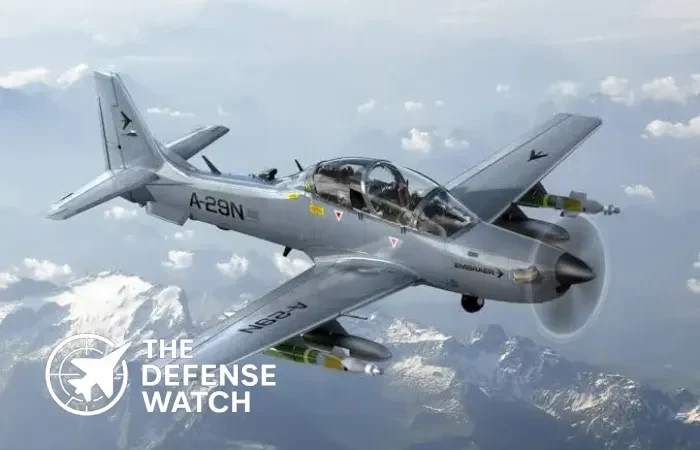
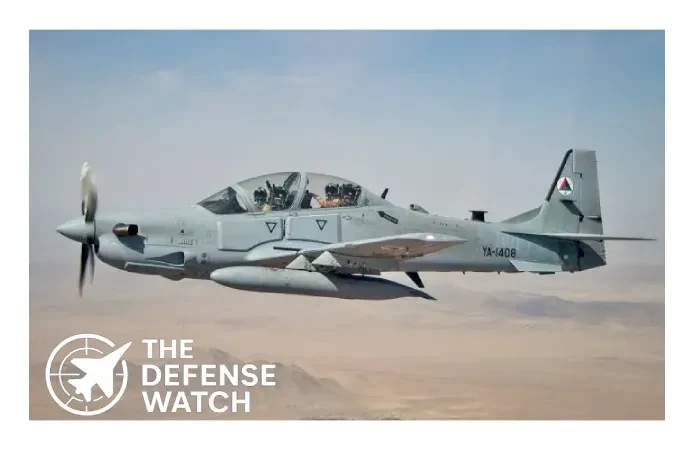
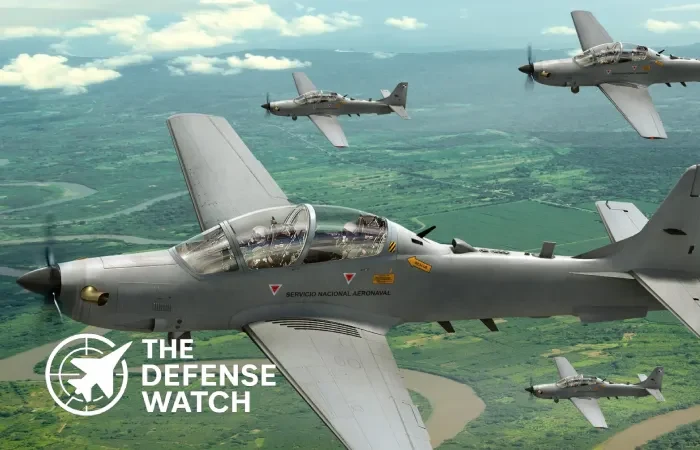
Full Specifications
1. General Information
| Name | A-29 Super Tucano |
| Manufacturer | Embraer Defense & Security |
| Country of Origin | Brazil |
| Introduction / In Service Since | 2003 |
| Status | Active |
| Category | Light Attack / Trainer |
| Crew | 1 or 2 |
| Unit Cost | ~$18 million |
2. Dimensions & Structure
| Length | 11.38 m (37.3 ft) |
| Wingspan | 11.14 m (36.6 ft) |
| Height | 3.97 m (13 ft) |
| Wing Area | 19.4 m² (209 ft²) |
| Empty Weight | 3,200 kg (7,050 lb) |
| Maximum Takeoff Weight (MTOW) | 5,400 kg (11,905 lb) |
3. Performance
| Maximum Speed | 320 knots (370 mph) |
| Range | 720 nm (1,330 km) |
| Combat Radius | 300 nm (556 km) |
| Service Ceiling | 35,000 ft |
| Rate of Climb | 3,300 ft/min |
4. Powerplant
| Engine Type | 1 × Pratt & Whitney PT6A-68C |
| Thrust (per engine) | 1,600 shp |
| Total Thrust | 1,600 shp |
5. Payload & Armament
| Internal Payload Capacity | 2 × .50-cal machine guns |
| Weapons Bay | None |
| Compatible Weapons | Rockets, smart bombs, gun pods |
| Hardpoints | 5 external |
6. Avionics & Systems
| Radar System | Optional mission radar |
| Navigation | GPS/INS |
| Electronic Warfare (EW) | Countermeasure suite |
| Stealth Features | None |
7. Operational History
| Primary Operator | Brazil, U.S., Colombia, Nigeria |
| Conflict Usage | COIN, border patrol, counter-narcotics |
| Notable Missions | Afghan Light Air Support missions |
8. Additional Information
| Variants | A-29B (two-seat), A-29A (single-seat) |
| Successor / Future Replacement | None planned |
| Notable Features | Night-vision cockpit, glass avionics |
| Estimated Operational Life | 12,000 flight hours |
PROS
- Proven combat record in multiple theaters
- Low operational and maintenance costs
- Excellent for COIN and CAS missions
- Advanced avionics and mission systems
- Rugged design suited for austere environments
CONS
- Limited top speed compared to jet aircraft
- Not suitable for high-intensity air combat
- Lower payload capacity
- Vulnerable to advanced air defenses
- Shorter range than medium jet bombers
A-29 Super Tucano: Light Attack and Training Powerhouse
The Embraer A-29 Super Tucano, also known as the EMB 314, is a Brazilian-built light attack and advanced trainer aircraft designed for close air support (CAS), counterinsurgency (COIN), intelligence, and pilot training. Developed by Embraer Defense & Security, it has become one of the most proven and cost-effective light combat aircraft in service worldwide, adopted by over 15 nations including the United States, Afghanistan, Colombia, and Nigeria.
Equipped with a Pratt & Whitney PT6A-68C turboprop engine, the A-29 delivers 1,600 shaft horsepower, achieving a maximum speed of 320 knots (370 mph) and a combat radius of around 300 nautical miles. The aircraft combines modern avionics, rugged performance, and low operational cost, making it an ideal platform for asymmetric warfare and training missions.
The Super Tucano can carry up to 1,500 kg (3,300 lb) of weapons on five external hardpoints, including machine guns, rockets, and precision-guided bombs. It features an advanced glass cockpit, Head-Up Display (HUD), night-vision compatibility, and mission systems compatible with NATO standards.
Operationally, the A-29 has proven itself in real combat scenarios — particularly in Latin America, Africa, and the Middle East — excelling in low-intensity conflicts where jets like the F-16 are overkill. The U.S. Air Force’s Light Air Support (LAS) program also selected the A-29 for Afghan and partner nation training, solidifying its global reputation as a reliable, multi-role aircraft.
A-29 Super Tucano Price in US
The A-29 Super Tucano costs approximately $18 million per unit (depending on configuration and mission equipment). Its low maintenance requirements and efficient fuel consumption make it significantly cheaper to operate than jet-powered counterparts, offering an affordable solution for nations prioritizing counterinsurgency and border security missions.
A-29 Super Tucano FAQs
The A-29 Super Tucano stands out for its versatility, rugged design, and low operating cost. It’s optimized for counterinsurgency (COIN), close air support (CAS), reconnaissance, and pilot training. Built to operate from short, unpaved runways, the aircraft combines advanced avionics, precision weapons, and long endurance, making it highly effective in low-intensity conflict environments.
Yes. The U.S. Air Force selected the A-29 Super Tucano under its Light Air Support (LAS) program to train pilots from allied nations such as Afghanistan, Nigeria, and Lebanon. The aircraft is used by the U.S. Air Force Special Operations Command (AFSOC) for training and light attack evaluations, emphasizing its interoperability and cost-effectiveness.
The A-29 Super Tucano and the A-10 Thunderbolt II serve very different missions. The A-10 is a heavy jet-powered CAS platform designed for high-threat environments, whereas the Super Tucano is ideal for low-intensity counterinsurgency operations. While the A-10 carries a much heavier payload and superior armor, the A-29 excels in efficiency, loiter time, and affordability, making it a better choice for smaller-scale operations or nations with limited defense budgets.
As of 2025, over 260 A-29 Super Tucano aircraft have been produced by Embraer Defense & Security, with deliveries spanning more than 15 countries, including Brazil, Colombia, the United States, and the Philippines. Production continues to meet international demand for light attack and training aircraft.
The A-29 Super Tucano belongs to the modern generation of turboprop light attack aircraft. It integrates fourth-generation avionics, glass cockpit displays, and smart-weapon compatibility, but is not classified among jet “fighter generations” like fifth or sixth-gen aircraft. It represents a new breed of COIN aircraft designed for endurance, versatility, and precision in modern asymmetric warfare.
Get real time update about this post category directly on your device, subscribe now.
Reviews
Disclaimer Note
The information provided on TheDefenseWatch.com is for general informational purposes only. While we strive to ensure the accuracy, completeness, and timeliness of our content regarding defense and aerospace products, technologies, and specifications, we cannot guarantee that all information is 100% accurate or up-to-date due to the evolving nature of military technology and classified data.TheDefenseWatch.com does not warrant the reliability, suitability, or availability of the information for any specific purpose. Users are advised to consult official sources, such as manufacturers, government publications, or defense agencies, for precise and verified data before making decisions based on our content.We are not affiliated with any defense manufacturers, governments, or military organizations mentioned. Opinions, reviews, and ratings reflect expert analysis but are subjective and should not be considered endorsements. TheDefenseWatch.com is not responsible for any errors, omissions, or consequences arising from the use of this website’s content.External links are provided for convenience and do not imply endorsement. TheDefenseWatch.com reserves the right to update or modify content without prior notice. By using this website, you agree to our Privacy & Cookies Policy.
New Arrivals


Popular Comparisons
-
 SIG XM7 Rifle vs M4: Key Differences and Performance Comparison
View Comparison →
SIG XM7 Rifle vs M4: Key Differences and Performance Comparison
View Comparison → -
Eurofighter Typhoon vs Rafale vs F-35: Fighter Jet Comparison
View Comparison →
-
J-20 vs F-22: Stealth Fighter Showdown Explained
View Comparison →
-
F-14 Tomcat vs Su-57: Can a Legend Challenge Russia’s Stealth Fighter?
View Comparison →
-
Su-35 vs Su-57: Russia’s Top Fighter Jets Compared
View Comparison →
-
Eurofighter Typhoon vs Su-57: Ultimate Fighter Jet Comparison
View Comparison →
-
Rafale vs Su-57: 4.5 Gen vs 5th Gen Fighter Jet Comparison
View Comparison →
-
Su-57 vs F-16 Fighting Falcon: Stealth vs Speed
View Comparison →
-
China vs Russia: J-20 Mighty Dragon vs Su-57 Felon Comparison
View Comparison →
-
Su-57 Felon vs F-22 Raptor: Stealth Air Superiority Face-Off
View Comparison →


- Pentagon Considers Second B-21 Raider Production Line To Accelerate U.S. Stealth Bomber Expansion

- France Unveils 78,000-Ton Nuclear Aircraft Carrier France Libre With 40-Aircraft Capacity
- L3Harris Wins $77.8M U.S. Navy Contract for Kineto Tracking Mount Sustainment
- US Navy Awards $15.38B Columbia-Class Submarine Contract To Strengthen Nuclear Deterrent
- China Surges Production Capacity For J-20 And J-35 Stealth Fighters As Beijing Expands Fifth-Generation Fleet
- Netanyahu Announces Elimination Of Senior Iranian Figures In Air Campaign
- US Bombers Avoid European Airspace On Iran Bombing Runs In Strategic Route Shift
- Japan’s EC-2 Electronic Warfare Jet Completes First Flight, Expanding Standoff Jamming Capabilities
- NASA’s X-59 Quiet Supersonic Jet Gears Up for Second Flight — A Giant Leap Toward Silent Boom AviationNASA X-59 Second Flight: Supersonic Aviation Reborn
- US Weapons Shipments to Taiwan Unaffected by Iran War, Officials Confirm