Does Iran Have Nuclear Weapons? The Short Answer
The most accurate answer in September 2026 is there is no publicly confirmed evidence that Iran possesses an assembled nuclear weapon, but international inspectors currently lack sufficient access to independently verify the status of Iran’s nuclear material and facilities.
- Does Iran Have Nuclear Weapons? The Short Answer
- Key Takeaways
- What Does It Mean to Be a Nuclear Threshold State?
- Iran’s 60 Percent Uranium Enrichment Capability
- Natanz, Fordow and Iran’s Underground Nuclear Infrastructure
- Iran Nuclear Breakout Time: Why the Number Is Difficult to Pin Down
- Uranium Enrichment Is Not the Same as Building a Nuclear Warhead
- Iran’s Ballistic Missile Force
- Does Iran Have ICBMs That Can Reach the United States?
- What Does the IAEA Say About Iran?
- What Does U.S. Intelligence Say?
- Is Iran a Nuclear Threshold State?
- Iran’s Nuclear Doctrine and the Question of a Fatwa
- The Strategic Question for the United States and Its Allies
- What Would It Take for Iran to Become a Nuclear Weapons State?
- Iran Nuclear Capability 2026: What Is Known and Unknown?
- FAQ: Does Iran Have Nuclear Weapons?
- Conclusion: Iran Has Nuclear Latency, Not a Publicly Confirmed Nuclear Arsenal
That distinction is critical.
Before the 2025 and 2026 attacks on Iranian nuclear infrastructure, Iran had accumulated a large stockpile of uranium enriched to 60 percent U-235, far above the enrichment level normally required for commercial nuclear power. The International Atomic Energy Agency had estimated that Iran possessed 440.9 kilograms of uranium enriched to 60 percent before the June 2025 attacks. That quantity, if further enriched to weapons grade and processed appropriately, represented enough material for multiple nuclear weapons.
However, the IAEA has not been able to establish what happened to all of that material following attacks on Iran’s nuclear infrastructure. As of September 2026, this verification gap is one of the most important issues in the entire Iran nuclear question.
Therefore, saying simply that Iran either “has a bomb” or “does not have a bomb” oversimplifies the available evidence.
The better assessment is that Iran has developed many of the capabilities associated with a nuclear threshold state, but there is no publicly verified Iranian nuclear weapon.
Key Takeaways
Iran has developed an advanced nuclear fuel cycle and accumulated uranium enriched to levels far above normal civilian requirements. The central uncertainty in 2026 is no longer simply how quickly Iran could enrich uranium, but what material survived the attacks and how much independent verification is possible.
What Does It Mean to Be a Nuclear Threshold State?
The term nuclear threshold state describes a country that possesses substantial parts of the technical infrastructure, scientific knowledge and industrial capacity required to develop a nuclear weapon, while not being publicly recognized as a nuclear weapons state.
It is important to note that nuclear threshold state is an analytical term, not an official IAEA designation for Iran.
Iran’s position can be understood through three broad areas:
1. Fissile Material Capability
A nuclear weapon requires fissile material, normally highly enriched uranium or plutonium. Iran has spent decades developing uranium conversion, enrichment and fuel cycle capabilities.
2. Weaponization Capability
Enriched uranium by itself is not a complete nuclear weapon. A state must also develop a weapon architecture capable of producing a nuclear detonation, together with appropriate safety, control and delivery systems.
Public reporting and historical investigations have raised questions about Iran’s pre-2003 nuclear weapons work, particularly the AMAD program. However, the existence of historical weapons research does not establish that Iran currently possesses an assembled nuclear weapon.
3. Delivery Capability
Iran has an extensive ballistic missile force. Its missiles were developed primarily for conventional strategic and regional deterrence, but their existence is relevant to nuclear proliferation analysis because ballistic missiles can potentially serve as nuclear delivery platforms if an appropriate warhead is developed.
Iran’s 60 Percent Uranium Enrichment Capability
The central technical issue is Iran’s uranium enrichment program.
Natural uranium contains only a small proportion of the isotope U-235. Civilian nuclear power reactors generally use uranium enriched to levels substantially below weapons grade, although requirements vary by reactor design.
Iran’s production of uranium enriched to 60 percent U-235 became a major international concern because the material is much closer to weapons grade than conventional civilian reactor fuel.
The distinction matters because enrichment is not a linear process.
Moving uranium from natural levels to low enrichment requires substantial separative work. Once material has already been enriched to 60 percent, reaching approximately 90 percent weapons grade requires substantially less additional separative work than enriching natural uranium all the way to weapons grade.
The IAEA’s pre-attack estimate of 440.9 kilograms of uranium enriched to 60 percent therefore represented a major proliferation concern.
But the 2026 situation is different.
The United States and Israel attacked several Iranian nuclear facilities during 2025 and 2026. The IAEA subsequently lost the ability to maintain complete knowledge of Iran’s nuclear material inventory. Reuters reported in September 2026 that inspectors had still not regained access to key Iranian nuclear sites and that the agency lacked updated information about the fate of the 60 percent stockpile.
This means that previously quoted breakout estimates should not be presented as a precise current countdown.
Natanz, Fordow and Iran’s Underground Nuclear Infrastructure
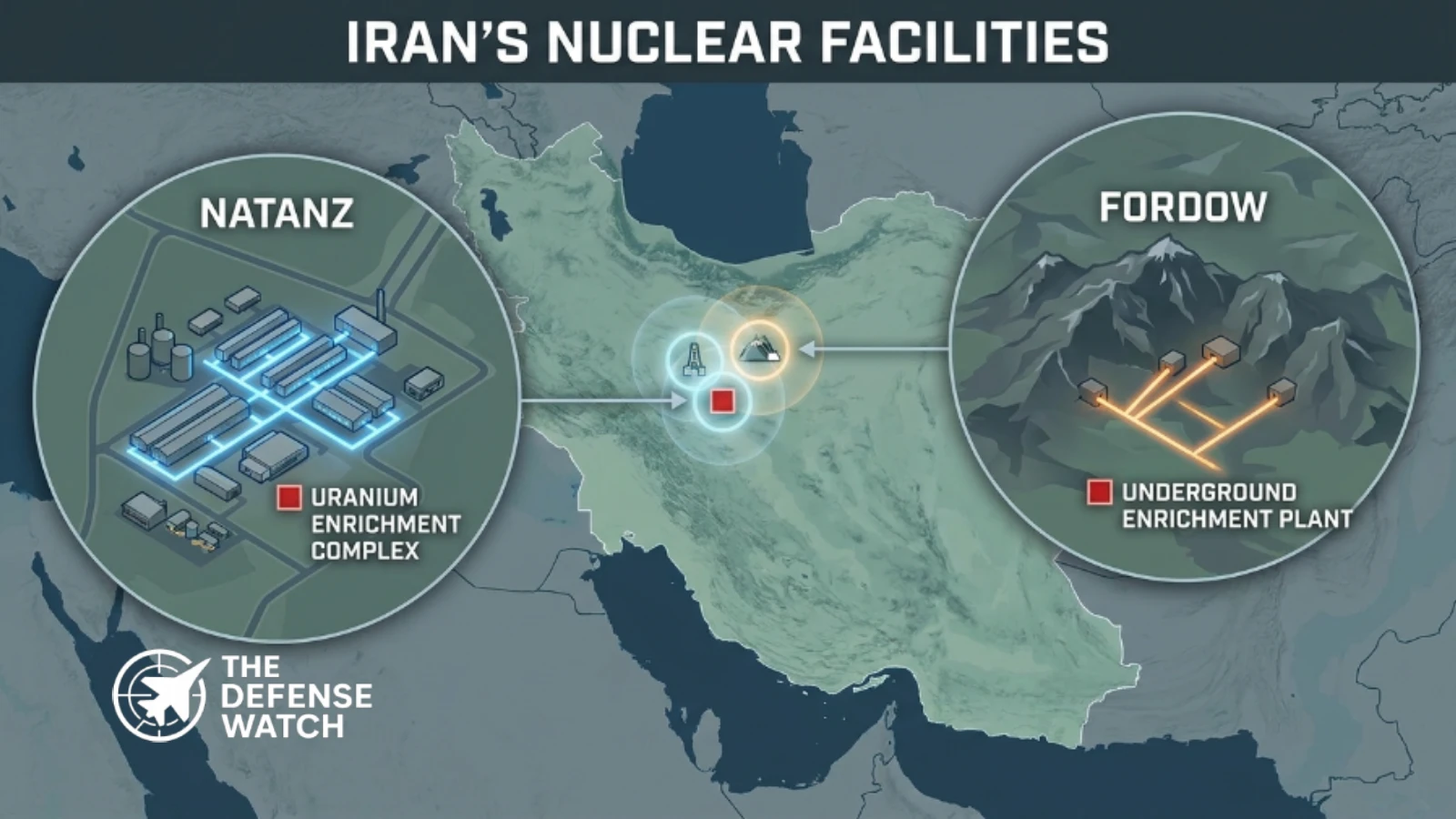
Iran’s enrichment architecture historically centered on facilities including Natanz and Fordow.
Natanz became Iran’s principal large scale enrichment complex, while Fordow was constructed as a deeply buried facility that provided additional protection against conventional attack.
The survival of underground infrastructure is strategically important because destroying visible enrichment infrastructure does not necessarily eliminate the scientific expertise, equipment, material or industrial knowledge required to rebuild the program.
Another facility that has received significant attention is the Pickaxe Mountain underground complex near Natanz. Reuters reported in September 2026 that the site consists of deeply buried tunnel complexes and remained a focus of U.S. military planning.
The key question is therefore not simply whether an individual enrichment plant was damaged.
The more important question is whether Iran retains enough equipment, material, trained personnel and underground infrastructure to reconstruct enrichment capacity.
Iran Nuclear Breakout Time: Why the Number Is Difficult to Pin Down
The phrase breakout time generally refers to the estimated time required for a state to produce enough weapons grade fissile material for a nuclear weapon, assuming a specific starting inventory and enrichment configuration.
It does not mean the time required to build and deploy a complete nuclear weapon.
That distinction is essential.
Earlier assessments frequently placed Iran’s theoretical fissile material breakout time at weeks or months under certain assumptions. But those calculations depended on known uranium inventories, functioning enrichment cascades and assumptions about the availability of centrifuges.
Those conditions changed after the attacks.
The IAEA currently lacks a complete accounting of Iran’s enriched uranium inventory. As a result, a precise claim such as “Iran can build a bomb in one to three months” would give readers a level of confidence that the available evidence does not support in September 2026.
A more defensible assessment is:
Iran previously had a very short theoretical path to weapons grade uranium, but its current breakout timeline cannot be reliably calculated without renewed verification of its material inventory and enrichment infrastructure.
Uranium Enrichment Is Not the Same as Building a Nuclear Warhead
One of the most common misconceptions in discussions about Iran is that producing 90 percent enriched uranium automatically means a nuclear bomb is ready.
It does not.
A nuclear weapon requires a much broader engineering effort. At a high level, that includes:
- Producing or acquiring sufficient fissile material
- Converting and processing nuclear material into a suitable weapons configuration
- Developing a reliable nuclear explosive design
- Developing conventional explosive and initiation systems
- Integrating safety and control mechanisms
- Designing a suitable delivery package
- Conducting sufficient validation and engineering testing
Some of these activities can occur without a nuclear explosive test.
Therefore, the claim that Iran would necessarily have to conduct an underground nuclear test before deploying a weapon is too absolute. A nuclear test could provide valuable design confidence, but a state with sufficiently advanced scientific and engineering capabilities could pursue a weapon without publicly conducting a nuclear test.
This is one reason intelligence assessments distinguish between fissile material production, weaponization and weapon deployment.
Iran’s Ballistic Missile Force
Iran already has a significant ballistic missile capability.
The U.S. intelligence community has described Iran as possessing the largest ballistic missile inventory in the region, while continuing to improve the accuracy, lethality and reliability of those systems.
Among Iran’s better known missile families are:
| Missile | Approximate Class | Publicly Reported Range | Status |
|---|---|---|---|
| Shahab-3 | MRBM | About 800 to 1,300 km | Operational |
| Emad | MRBM | About 1,700 km | Development / reported capability |
| Ghadr | MRBM | Up to about 1,950 km | Development / operational elements |
| Khorramshahr | MRBM | About 2,000 km | Development / reported capability |
| Sejjil | MRBM | About 2,000 km | Operational |
| Fateh-110 | SRBM | About 200 to 300 km | Operational |
The figures are approximate because missile performance varies according to configuration, payload and launch conditions. CSIS’s Missile Threat database lists the Shahab-3 as a road mobile medium range ballistic missile with a range of approximately 800 to 1,300 kilometers, depending on configuration and payload.
Iran’s missile force therefore gives Tehran a substantial regional strike capability.
However, it is incorrect to say that Iran currently possesses an operational nuclear missile force.
There is no publicly confirmed evidence that Iran has successfully mated an operational nuclear warhead to one of these missiles.
Does Iran Have ICBMs That Can Reach the United States?
No, Iran does not currently have a publicly confirmed operational intercontinental ballistic missile capable of striking the continental United States.
Iran does operate space launch vehicles, and the technologies used in space launch vehicles can overlap with technologies relevant to longer range ballistic missiles.
The U.S. intelligence community has previously assessed that Iranian work on space launch vehicles could shorten the technical timeline for developing an ICBM if Tehran chose to pursue one.
That is different from saying Iran currently possesses an ICBM.
Iran’s existing ballistic missile force is primarily designed around regional targets.
What Does the IAEA Say About Iran?
The IAEA is the most important international source for assessing Iran’s declared nuclear activities and safeguards obligations.
The current problem is verification.
Following attacks against Iranian nuclear facilities, the IAEA suspended much of its field verification work. A September 2025 IAEA report stated that the agency had not received nuclear material accountancy reports or updated design information from Iran and had not accessed safeguarded facilities other than the Bushehr Nuclear Power Plant.
By September 2026, the verification problem remained unresolved.
Reuters reported that the IAEA had made progress on nuclear questions in Syria but had made no comparable progress in Iran, leaving the status of Iran’s enriched uranium inventory unresolved.
This matters because safeguards are designed to provide confidence about where nuclear material is located and whether it has been diverted.
Without access, analysts must increasingly rely on satellite imagery, intelligence assessments and historical inventories.
That increases uncertainty.
What Does U.S. Intelligence Say?
The U.S. intelligence community has historically drawn a distinction between Iran’s ability to develop a weapon and an actual decision to build one.
An ODNI assessment published in 2024 stated that, as of September 2024, Iran was not building a nuclear weapon, while simultaneously developing capabilities that would better position it to produce one if Tehran chose to do so. The assessment highlighted Iran’s expanding stockpiles of 20 percent and 60 percent enriched uranium and its growing inventory of advanced centrifuges.
A later U.S. intelligence assessment likewise stated that Iran was not building a nuclear weapon and that its enriched uranium stockpile had reached unprecedented levels for a state without nuclear weapons.
However, those assessments were produced before the current verification gap became as severe as it is in 2026.
That is why current conclusions need to distinguish between what intelligence agencies previously assessed and what can currently be independently verified.
Is Iran a Nuclear Threshold State?
Iran is often described by analysts as a nuclear threshold state, although this is not an official IAEA classification.
The term reflects several realities:
- Iran has extensive uranium enrichment experience.
- It developed advanced centrifuge technology.
- It accumulated uranium enriched to 60 percent.
- It has operated protected underground nuclear facilities.
- It has a large scientific and industrial nuclear infrastructure.
- It possesses a substantial ballistic missile force.
- It has historically conducted nuclear related activities that generated international concern.
At the same time, there is no publicly confirmed evidence that Iran has assembled and deployed a nuclear weapon.
The distinction between nuclear latency and nuclear weapon possession is therefore central to understanding Iran’s strategic position.
Iran’s Nuclear Doctrine and the Question of a Fatwa
Iranian officials have repeatedly stated that the country’s nuclear program is peaceful.
A frequently cited component of Iran’s position is a religious decree, or fatwa, attributed to Supreme Leader Ayatollah Ali Khamenei that rejects nuclear weapons.
The political importance of that position has changed as Iran’s security environment has deteriorated.
U.S. intelligence assessments have noted an erosion of the long-standing taboo around public discussion of nuclear weapons inside Iran.
That does not establish a decision to build a bomb.
It does indicate that nuclear weapons have become more prominent in Iran’s strategic debate, particularly as Tehran faces pressure from Israel, the United States and other regional adversaries.
The Strategic Question for the United States and Its Allies
For Washington and its allies, the central concern is not simply whether Iran possesses a nuclear weapon today.
The larger concern is whether Iran can maintain or rebuild a nuclear infrastructure that allows it to move rapidly toward a weapon if its leadership makes that decision.
That creates several strategic challenges.
Regional Deterrence
A nuclear capable Iran could fundamentally change deterrence calculations across the Middle East.
Israel already maintains a sophisticated conventional military and missile defense architecture. Gulf states such as Saudi Arabia and the United Arab Emirates would also have to reassess their security strategies.
Missile Defense
Iran’s ballistic missile force creates a separate challenge even without nuclear warheads.
The United States, Israel and Gulf partners have invested heavily in layered missile defenses, including systems such as Patriot, THAAD and Israel’s Arrow architecture.
Nuclear Proliferation
If Iran were eventually to acquire a nuclear weapon, other regional states could reassess their own nuclear options.
That could create a much wider proliferation challenge.
Verification
The immediate international priority is therefore restoring credible IAEA verification.
Without reliable information about Iran’s nuclear material and facilities, it becomes harder to distinguish between reconstruction, concealment, civilian nuclear activity and weapons related preparations.
What Would It Take for Iran to Become a Nuclear Weapons State?
The transition from nuclear threshold capability to an operational nuclear weapons state would involve several major steps.
At a broad level, analysts would look for evidence of:
- Sufficient weapons usable fissile material
- A dedicated nuclear weapons design effort
- Evidence of weaponization activity
- A reliable nuclear explosive device
- A suitable delivery system
- Command, control and security arrangements
- A political decision to deploy the weapon
Public evidence does not currently establish that Iran has completed this chain.
The greatest uncertainty concerns the first element because international inspectors cannot fully account for Iran’s previous enriched uranium inventory.
Iran Nuclear Capability 2026: What Is Known and Unknown?
| Question | Assessment in September 2026 |
|---|---|
| Does Iran have a confirmed nuclear weapon? | No publicly verified evidence |
| Does Iran have advanced enrichment capability? | Yes, historically demonstrated |
| Has Iran enriched uranium to 60 percent? | Yes |
| Did Iran possess a large 60 percent stockpile before the attacks? | Yes, IAEA estimated 440.9 kg |
| Can the current uranium inventory be independently verified? | Not fully |
| Does Iran have ballistic missiles? | Yes |
| Does Iran have operational ICBMs? | No publicly confirmed operational ICBM |
| Is Iran a nuclear threshold state? | Common analytical description, not an official IAEA designation |
| Can a current breakout time be stated with confidence? | No, because key material and infrastructure remain difficult to verify |
FAQ: Does Iran Have Nuclear Weapons?
There is no publicly confirmed evidence that Iran possesses an assembled nuclear weapon. However, the IAEA cannot currently provide complete verification of Iran’s nuclear material inventory, making the situation more uncertain than before the attacks on its nuclear facilities.
There is no reliable single number for September 2026.
Earlier estimates focused primarily on how quickly Iran could produce enough weapons grade uranium from its existing stockpile. That is only one stage of nuclear weapons development. The current estimate is further complicated by damage to Iran’s enrichment infrastructure and the lack of complete IAEA access.
Before the 2025 attacks, the IAEA estimated that Iran possessed 440.9 kilograms of uranium enriched to 60 percent. If further enriched to weapons grade, that quantity represented enough material for multiple weapons under commonly used analytical assumptions. The current status of that stockpile is not fully verified.
There is no publicly verified evidence that Iran has an assembled atomic bomb.
No. Iran possesses short and medium range ballistic missiles, but it does not have a publicly confirmed operational ICBM capable of reaching the continental United States. Its space launch vehicle work could provide technologies relevant to a future longer range missile program.
Iran is widely described by analysts as a nuclear threshold or nuclear latency state because of its enrichment capability, nuclear infrastructure and missile force. The term is analytical rather than an official IAEA designation.
Not necessarily. The U.S. intelligence community has previously assessed that Iran was not building a nuclear weapon while simultaneously developing capabilities that could allow it to move toward one if its leadership made that decision.
Conclusion: Iran Has Nuclear Latency, Not a Publicly Confirmed Nuclear Arsenal
So, does Iran have nuclear weapons?
Based on publicly available evidence, the answer remains no confirmed Iranian nuclear weapon.
But that answer should not be interpreted as meaning Iran’s nuclear capability is insignificant.
Iran developed a sophisticated enrichment program, accumulated a substantial stockpile of uranium enriched to 60 percent and built protected nuclear infrastructure capable of supporting an advanced fuel cycle. It also possesses a large regional ballistic missile force.
The biggest change in 2026 is the uncertainty surrounding those capabilities.
Military strikes have damaged major Iranian nuclear facilities, while the IAEA has been unable to fully verify the status of Iran’s nuclear material. That makes the old question, “How many months from a bomb?” less useful than it once was.
The more important question for U.S., European and Middle Eastern policymakers is whether Iran can preserve enough material, equipment, expertise and infrastructure to reconstruct a rapid nuclear breakout capability.
Until inspectors regain reliable access and establish a credible accounting of Iran’s nuclear material, Iran’s exact nuclear status will remain uncertain.
For defense planners, that uncertainty is itself a strategic problem.