F‑35 Lightning II vs Sukhoi Su‑35: A Detailed Comparison
In an era where air dominance is more than raw speed or altitude, the confrontation between the U.S.-led fighter fleet and rival air forces carries broad geopolitical weight. The question of F-35 vs Su-35 is particularly compelling because it pits the American fifth-generation stealth multirole fighter against a Russian heavy-fighter design that, while not fully “fifth generation”, carries many advanced features and remains in service in significant numbers. For the U.S. and its allies—especially within NATO—understanding the strengths and limitations of both platforms is vital. The U.S. Air Force, Navy and Marine Corps are investing heavily in the F-35 series, while Russia markets the Su-35 to key export customers and sees it as a backbone of its own air-superiority strategy. This comparison matters both for force-planning and for alliance considerations.
In this article we will compare the F-35 vs Su-35 in detail: specifications, design/technology, firepower, performance, operational range/mobility, combat effectiveness, cost/export value—and then wrap up with an analytical assessment.
Specifications Table
Here is a side-by-side quick reference for the F-35 (specifically the baseline F-35A variant) and the Su-35 (Su-35S export/service version) based on publicly available data.
| Metric | F-35 Lightning II (F-35A) | Su-35 (Su-35S / Flanker-E) |
|---|---|---|
| Crew | 1 pilot | 1 pilot |
| Length | ~15.70 m | ~21.9 m |
| Wingspan | ~10.70 m | ~15.3 m |
| Empty / Typical Weight | ~13,290 kg (empty) | ~19,000 kg empty |
| Maximum Take-off / Gross Weight | ~29,900 kg (max typical for F-35A) | ~34,500 kg max take-off |
| Maximum Speed | ~Mach 1.6 (~1,960 km/h) | ~Mach 2.25 (≈2,400 km/h) |
| Service Ceiling / Altitude | ~50,000 ft (~15.2 km) ( | ~60,000 ft (~18 km) or higher |
| Combat / Ferry Range | ~2,200 km (range) ( | ~3,600 km (internal fuel) |
| Cost (unit flyaway) | ~US$82.5 million for F-35A (recent lots) | Not publicly standardized export cost; heavy Russian design with fewer export price benchmarks |
| Entry into Service | F-35A entered USAF service ~2016 | Su-35 entered Russian service ~2014-15 (the Su-35S variant) |
Note: Figures are approximate and derived from open-source data; real operational numbers may vary by variant, load-out or service upgrade.
F-35 Lightning II Fighter Jet vs Su-35 Flanker-E Fighter Jet
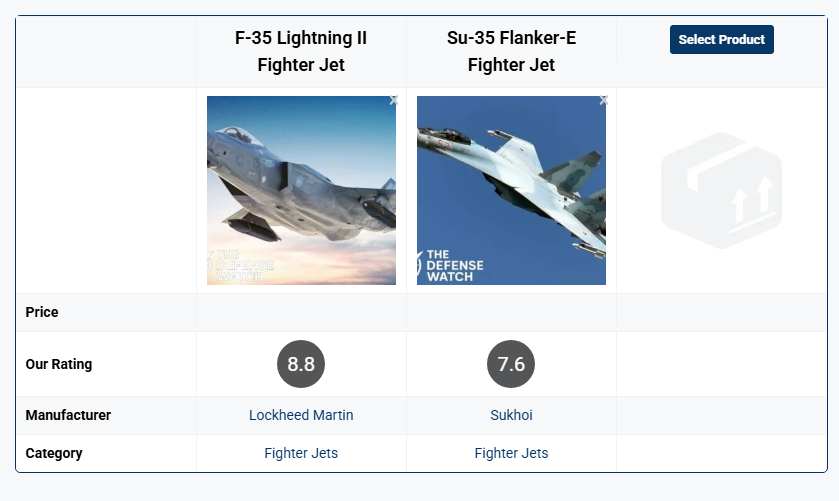
Design & Technology: Stealth, Sensors & Airframe
F-35 Design & Technology
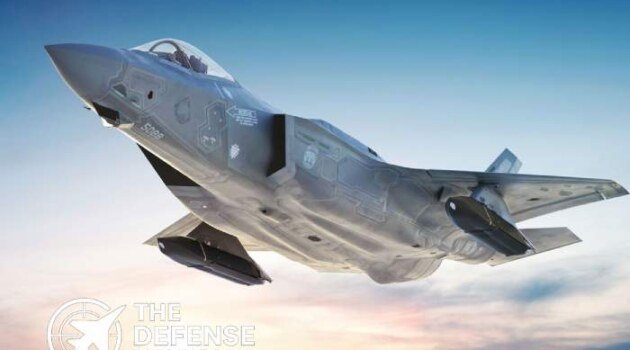
The F-35 is built around the concept of a fifth-generation fighter: low observability (stealth), advanced sensor fusion, network-centric connectivity and multirole flexibility. According to the manufacturer, the F-35 “combines advanced stealth, sensors and information fusion in a supersonic, highly maneuverable fighter.” Its airframe uses composite materials (about 35% of structure) and a single-engine layout (Pratt & Whitney F135), producing about 43,000 lb of thrust for the A variant. Internal weapons bays support the stealth effect. The avionics suite includes an AESA radar, Distributed Aperture System, Electro-Optical Targeting System and a Helmet-Mounted Display. In U.S. doctrine the F-35 also functions as a “data-node” linking air, sea and ground assets.
Su-35 Design & Technology
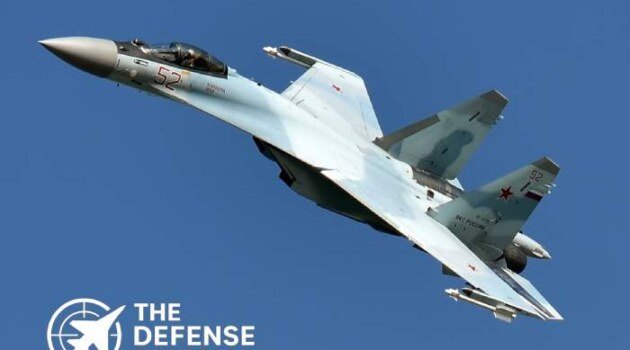
The Su-35 is often described as a 4++ generation fighter rather than a full 5th-generation design, but it incorporates many advanced features. It is essentially a deep modernization of the Su-27 airframe by the Sukhoi Design Bureau. The Su-35 features twin Saturn AL-41F1S (also called 117S) engines with thrust-vectoring nozzles, giving it exceptional maneuverability (post-stall, high angle-of-attack operations). Its N035 Irbis-E radar is a powerful PESA design capable of detection out to ~400 km and tracking multiple targets. While the Su-35 is not optimized for stealth in the way the F-35 is, some radar-absorbent and reduced frontal cross-section features have been applied (reportedly ~1-3 m² RCS).
Comparative Notes
- The F-35 emphasises stealth, sensor fusion and network integration; the Su-35 emphasises raw performance, manoeuvrability and heavy weapon payloads.
- In a contested air-defence environment, the F-35’s stealth gives it a foundational advantage in first-look/first-shot scenarios.
- Conversely, in a scenario where stealth is degraded (e.g., due to advanced sensors, electronic warfare or visual engagement), the Su-35’s manoeuvrability and twin-engine reliability provide a strong competitive edge.
- For U.S. military planners, the F-35’s integrated data-sharing and allied interoperability matter as much as raw kinematics.
Firepower & Performance: Weapons Load-out and Engagement Capabilities
F-35 Firepower & Performance
The F-35 carries a multirole weapons set, capable of air-to-air and air-to-ground missions. Internally, the weapons bays preserve stealth; externally, pylons can be used when stealth is less critical. Typical weapons include AIM-120 AMRAAM air-to-air missiles, Joint Air-to-Surface Standoff Missiles (JASSM/ JASSM-ER), and precision guided bombs. For example, the AGM-158 JASSM is slated for F-35 integration.
The F-35’s internal payload is around ~8,160 kg (≈18,000 lb) for some variants per manufacturer specs.
In U.S. service, the F-35 is often used for suppression of enemy air defenses (SEAD), close air support and strike missions—leveraging its networked sensors to detect and target threats at standoff.
Su-35 Firepower & Performance
The Su-35 boasts a heavy weapons load-out and a broad array of missiles. It can carry up to 8,000 kg of payload (depending on variant) and carries a 30 mm GSh-30-1 cannon for close-in engagements. It supports air-to-air missiles such as the R-77-1 (active radar homing), and has reportedly been cleared to carry the long-range R-37M (~400 km range) for standoff engagements. Its multiple external hard points allow heavy load-outs and flexibility, although external stores degrade radar cross-section and may reduce stealth.
The Su-35’s radar and missiles combination gives it strong beyond-visual-range (BVR) capability in good conditions.
Comparative Notes
- In an ideal “first-look, first-shot” scenario in contested airspace, the F-35’s stealth and sensor fusion give it a significant advantage in shoot-first posture.
- If stealth advantage is lost (e.g., by ground radar, EW, visual detection) and engagement moves to visual or close manoeuvring, the Su-35’s manoeuvrability and heavy missile load may favour it.
- Depth of weapons: the Su-35 may carry more heavy external missiles; the F-35 is limited by internal bay capacity for stealth, but its networked systems may pick targets earlier.
- U.S. doctrine emphasises stand-off and networked strike; Russian doctrine emphasises air-superiority, manoeuvre and missile dominance in closer ranges.
Operational Range & Mobility
F-35 Operational Range & Mobility
The F-35A has a range of approximately 2,200 km in internal-fuel configuration. Combat radius (operational mission radius) is often cited as ~1,093 km for internal fuel variant. With aerial refueling support, the F-35 can extend far beyond that. The single-engine design supports lower logistics footprint and carrier/ship/forward-base operations (especially the F-35B and F-35C variants).
The mobility of F-35 also benefits from its stealth, allowing it to penetrate contested airspace rather than rely solely on range.
Su-35 Operational Range & Mobility
The Su-35 has a longer unrefueled range: some sources list ~3,600 km internal fuel. Speed and twin-engine design mean it can sprint and reposition rapidly; its high power also supports heavy external load outs.
However, heavier load-outs and external stores may reduce mobility or increase fuel consumption. The twin engine gives redundancy (important in contested airspace where damage or malfunction are risks).
Comparative Notes
- If mission requires deep penetration into enemy territory and first-strike capability, the F-35’s stealth may allow closer operation despite somewhat shorter nominal range.
- If mission requires high speed, heavy missiles and long transit, the Su-35’s range and twin-engine design favour it.
- From a U.S. logistics perspective, the F-35’s global network of bases and aerial-refuelling support gives it strategic mobility. For export customers, Su-35 might offer less logistical burden (depending on region) and easier maintenance in some contexts.
Combat Effectiveness: Real-World Use, Training & Doctrine
F-35 in Operational Use
The F-35 is operational with the U.S. Air Force, Marine Corps and Navy, and with many allied nations. Its networked sensor systems, stealth features and role as a “fusioneer” in the cockpit provide a modern combat edge.
For U.S. defense planners, the F-35 is central to future air-dominance strategies, particularly in highly contested airspace (e.g., the Indo-Pacific or Eastern Europe). Its ability to integrate with allied platforms and share data is a major advantage.
Challenges remain: high operational cost, maintenance demands, and steep training requirements. But its combat-aircraft doctrine emphasizes beyond-visual-range engagements, minimal exposure, and networked strikes.
Su-35 in Operational Use
The Su-35 is actively used by the Russian Aerospace Forces and some export customers; it is sold in the international market (e.g., to China, Indonesia, Algeria). Its robustness, twin-engine layout and large missile load‐out make it formidable in the right scenario.
In real world operations, the Su-35’s maneuverability in close engagements and heavy weapon load provide credible threat potential. However, in high-end peer adversary scenarios with advanced sensor/EW coverage and stealth threats, the Su-35 may face limitations.
From a U.S. perspective, the Su-35 represents a serious “near-peer” challenge—especially for allied air forces or air-defense networks not overmatched by U.S. resources.
Comparative Notes
- If an engagement happens in degraded sensor/visibility conditions or at shorter ranges (<20 km), the Su-35 may hold the advantage due to agility and heavy missiles.
- If engagement occurs in contested, networked air space with long-range detection and stealth/first-look advantage, the F-35 holds the edge.
- U.S. forces and NATO allies emphasise integrated sensor nets, joint operations and stealth penetration; Russian doctrine emphasises mass, manoeuvre, missile weight and tactical flexibility.
Cost & Export Value
F-35 Cost & Export Value
Recent data show the average fly-away cost of the F-35A around US$82.5 million (Lots 15-17) with the F-35B and F-35C variants higher (~US$109 million, ~US$102 million respectively) for U.S. production.
For export customers, additional support, logistics, weapons and training packages add significant cost—a recent Swiss procurement cited variable pricing due to tariffs and inflation.
The F-35’s export value is not just the aircraft: it’s the broader industrial base, sustainment network, allied interoperability and long-term upgrade path. The U.S. sees the F-35 as a core pillar of allied air-power architecture.
Su-35 Cost & Export Value
Exact export unit cost figures for the Su-35 are harder to pin down in open sources. Russia markets the Su-35 as a heavy, high-performance fighter with advantages for export customers—including fewer restrictions, and sometimes lower procurement cost than top western jets. The Su-35’s heavy weapons load and twin-engine reliability are key selling points.
However, export customers may face issues such as sanctions, logistics of Russian supply chain, and less favorable allied integration compared to U.S. systems. For the U.S., the presence of Su-35 in export markets means a competitor to western aircraft sales—and a potential challenge if adversaries field it.
Comparative Notes
- From a U.S. defence-industry perspective, the F-35 is an investment in long-term allied capability and sustainment ecosystem.
- The Su-35 offers an attractive export alternative for nations seeking high performance without full stealth cost—but may lack the alliances, sensors and upgrade ecosystem of the F-35.
- Life-cycle costs matter: operating, maintaining, training and upgrading a networked stealth fleet (F-35) is expensive; Su-35 may have higher fuel/maintenance burden (twin-engine, external stores) but lower acquisition cost.
Analysis: Strengths, Weaknesses & U.S. Military Perspective
Strengths & Weaknesses
F-35 Strengths:
- Low observability (stealth) gives first-look/first-shot advantage in contested airspace.
- Advanced sensor fusion and connectivity make it a force multiplier in joint/coalition operations.
- Broad allied use means logistics, training and interoperability benefits for U.S. and partners.
F-35 Weaknesses:
- Single-engine design carries risk (though very reliable) compared to twin-engine fighters.
- Higher procurement and sustainment cost compared to older fighters.
- When stealth advantage is compromised (advanced sensors/EW), it may lose some qualitative edge.
Su-35 Strengths:
- Twin-engine power, high speed and manoeuvrability (including thrust-vectoring) make it extremely capable in visual/close-range engagements.
- Long range, heavy payload and robust design make it formidable in many scenarios.
- Export value for customers seeking high-performance fighter at relatively lower cost.
Su-35 Weaknesses:
- Not a full fifth-generation stealth design: radar cross-section is larger and may be detected earlier in contested environments.
- Reliance on external hard-points when fully loaded reduces stealth effectiveness.
- Less integrated in western allied architecture; upgrade trajectory and sustainment globally may lag U.S. equivalents.
How the U.S. Military Views Each System
For the U.S. military, the F-35 is a central pillar of future air-dominance strategy—especially in scenarios involving peer adversaries like China or Russia. Its stealth, sensor fusion and alliance interoperability make it central to U.S. defence planning. The F-35 is expected to operate in contested airspace, perform strike and interdiction missions, and network with allied forces.
The Su-35, while not the pre-eminent U.S. threat (compared to, say, the upcoming Su-57 or Chinese J-20), is nonetheless a serious fighter that U.S. and allied planners must consider. In regional conflicts, export customers or adversaries fielding the Su-35 mean that allied air forces must train and equip for engagements where a high-performance non-stealth fighter may operate. The U.S. likely views the Su-35 as a credible missile-truck and air-superiority platform in the hands of adversaries or potential adversaries.
In terms of procurement and export, the U.S. must consider that allies might opt for the Su-35 if cost or integration with U.S. systems is not a priority—which has broader implications for alliance cohesion and logistical interoperability.
Conclusion
In the “F-35 vs Su-35” debate, there is no definitive “one size fits all” winner. The edge depends on the engagement scenario:
- In highly contested airspace with advanced radar/EW, long-range detection and allied networking, the F-35 holds the clear advantage—stealth, sensor fusion and strike integration favour it.
- In more permissive environments, where stealth advantage is diminished, and where manoeuvrability, heavy missile loads and thrust-vectoring matter, the Su-35 may have the upper hand.
- From a cost-and-export perspective, the F-35 is more expensive but offers a complete ecosystem; the Su-35 offers high performance at lower cost but with trade-offs in stealth and alliance integration.
For U.S. defense planners, the F-35 remains the forward-looking choice. But the existence and export of the Su-35 mean allied and U.S. air forces must prepare to engage adversaries equipped with such fighters—so the comparison remains operationally relevant.
Which system has the overall edge? If forced to pick, in a peer-to-peer contest in contested airspace the F-35 holds the strategic advantage. But in a dynamic engagement where conditions reduce stealth value, the Su-35 cannot be discounted—and in fact may perform exceptionally well. The real answer: it depends on where, how, and against whom the fight occurs.
FAQs
In a pure visual dogfight, the Su-35’s maneuverability and twin-engine thrust-vectoring give it an edge. But if the F-35 uses its stealth and sensor/cockpit advantage first, it may engage from beyond visual range without entering dogfight.
No, the Su-35 is not a full stealth fighter. It has some radar-cross-section reduction features, but lacks the internal weapons bays, shaping and extensive composite/absorbent materials that the F-35 employs for very low observability.
Because the modern strategic environment emphasizes contested airspace, first-look/first-shot scenarios, networked situational awareness and alliance interoperability. The F-35 excels in those areas, while range or payload alone are not sufficient if you cannot survive to use them.
It depends on priorities. If the customer values stealth, integration with U.S./allied forces, and long-term upgrade path, the F-35 is compelling (though expensive). If the customer values high performance, heavy load and lower upfront cost—and can accept less stealth and less allied network integration—the Su-35 is a strong contender.
It is possible, especially in regional conflicts or as export versions of the Su-35 face allied F-35-equipped forces. That is why understanding the comparative strengths of each aircraft is crucial for U.S. defense planning and for allied air forces.
Get real time update about this post category directly on your device, subscribe now.
| |
| Price | |
| Our Rating | |
| Manufacturer | Lockheed Martin Sukhoi |
| Category | Fighter Jets Fighter Jets |
General Information
| Name | F-35 Lightning II Su-35 Flanker-E |
| Manufacturer | Lockheed Martin Sukhoi (United Aircraft Corporation) |
| Country of Origin | United States Russia |
| Type / Role | Multirole Stealth Fighter Multirole Air Superiority Fighter |
| Generation | 5th 4++ |
| Status | In Service Active Service |
| First Flight | December 15, 2006 February 19, 2008 |
| Introduction / In Service Since | 2015 2014 |
| Number Built | 1,200+ (as of 2025) 120+ |
| Operators | USA, UK, Japan, Israel, Italy, Australia, and others Russia, China, Egypt, Indonesia (pending) |
Dimensions & Structure
| Length | 51.2 ft (15.6 m) 21.9 m |
| Wingspan | 35 ft (10.7 m) 15.3 m |
| Height | 14.4 ft (4.38 m) 5.9 m |
| Wing Area | 460 sq ft (42.7 m²) 62 m² |
| Empty Weight | 29,300 lb (13,300 kg) 18,400 kg |
| Maximum Takeoff Weight (MTOW) | 70,000 lb (31,800 kg) 34,500 kg |
| Internal Weapons Bay | 2 (up to 5,700 lb payload) None |
| External Hardpoints | 6–10 (up to 18,000 lb total) 12 |
Performance
| Maximum Speed | Mach 1.6 Mach 2.25 (2,400 km/h) |
| Range | 1,380 mi (2,220 km) 3,600 km (ferry) |
| Combat Radius | ~670 mi (1,080 km) 1,500 km |
| Service Ceiling | 50,000 ft (15,240 m) 18,000 m |
| Rate of Climb | 45,000 ft/min 280 m/s |
| Thrust-to-Weight Ratio | 0.87 1.15 |
| G Limits | +9 +9 |
Powerplant
| Engine Type | Pratt & Whitney F135-PW-100 Saturn AL-41F1S (117S) |
| No. of Engines | 1 2 |
| Thrust (each) | 43,000 lbf 142 kN with afterburner |
| Thrust Vectoring | Yes (on F-35B variant) Yes (3D TVC) |
| Fuel Capacity | ~18,500 lb internal ~11,500 kg internal |
Armament
| Gun | GAU-22/A 25mm cannon (F-35A) 1× 30mm GSh-30-1 cannon |
| Missiles (Air-to-Air) | AIM-120 AMRAAM, AIM-9X R-77, R-27, R-73 |
| Missiles (Air-to-Ground) | AGM-154 JSOW, AGM-158 JASSM Kh-31, Kh-29, Kh-59 |
| Bombs | JDAM, Paveway II/III, SDB I/II FAB series, KAB precision-guided bombs |
| Hardpoints | 6 external + 2 internal 12 |
| Payload Capacity | ~18,000 lb 8,000 kg |
Avionics & Systems
| Radar | AN/APG-81 AESA Irbis-E PESA radar |
| Radar Range | ~150+ km 400 km (air targets) |
| Electronic Warfare (EW) System | AN/ASQ-239 suite Khibiny-M |
| Targeting System | EOTS (Electro-Optical Targeting System) OLS-35 IRST |
| Helmet Display | HMDS Gen III Yes |
| Navigation | GPS/INS with terrain-following GLONASS/INS |
| Autopilot / AI Assistance | Advanced flight management Digital flight control |
| Communication | MADL & Link 16 secure data links Secure data link, VHF/UHF radio |
Stealth & Technology
| Radar Cross Section (RCS) | ~0.001 m² ~1–3 m² |
| Stealth Features | RAM coating, internal weapons bay, edge alignment Radar-absorbent coatings, composite materials |
| Infrared Signature Reduction | Yes Moderate (engine shielding) |
| Sensor Fusion | Full 360° data integration Limited |
| Networking Capabilities | Distributed data-sharing with allied units Tactical data link |
Variants
| Special Export Versions | F-35I (Israel), F-35A (Japan), etc. Su-35SK (China), Su-35E (Egypt) |
Operational History
| Major Conflicts / Deployments | Middle East operations (Iraq, Syria) Syria, Ukraine (limited combat use) |
| Notable Operators | USAF, USN, USMC, RAF, IDF Russia, China, Egypt |
| Combat Proven? | Yes Yes |
| Mission Types | Air superiority, strike, SEAD, ISR Air superiority, interception, strike, escort |
Cost & Program
| Unit Cost | $80–100 million (variant-dependent) ~$85 million (export) |
| Development Cost | ~$400 billion (program total) Estimated $1.5 billion |
| Program Name | Joint Strike Fighter (JSF) Su-35 Development Program |
| Funding Countries | USA, UK, Italy, Netherlands, Canada, Australia, etc. Russia |
Additional Information
| Upgrades Planned | Block 4, Tech Refresh 3 Radar and cockpit modernization |
| Future Replacement | NGAD (2035+) Su-57 Felon |
| Export Restrictions | U.S. FMS approval required Russian arms control regulations |
| Notable Achievements | Widest global fighter program in history High agility and radar performance |
| Competitors | Su-57, J-20, Tempest, KF-21 F-15EX, Rafale, Eurofighter Typhoon |

|
Disclaimer Note
The information provided on TheDefenseWatch.com is for general informational purposes only. While we strive to ensure the accuracy, completeness, and timeliness of our content regarding defense and aerospace products, technologies, and specifications, we cannot guarantee that all information is 100% accurate or up-to-date due to the evolving nature of military technology and classified data.TheDefenseWatch.com does not warrant the reliability, suitability, or availability of the information for any specific purpose. Users are advised to consult official sources, such as manufacturers, government publications, or defense agencies, for precise and verified data before making decisions based on our content.We are not affiliated with any defense manufacturers, governments, or military organizations mentioned. Opinions, reviews, and ratings reflect expert analysis but are subjective and should not be considered endorsements. TheDefenseWatch.com is not responsible for any errors, omissions, or consequences arising from the use of this website’s content.External links are provided for convenience and do not imply endorsement. TheDefenseWatch.com reserves the right to update or modify content without prior notice. By using this website, you agree to our Privacy & Cookies Policy.
New Arrivals


Popular Comparisons
-
 SIG XM7 Rifle vs M4: Key Differences and Performance Comparison
View Comparison →
SIG XM7 Rifle vs M4: Key Differences and Performance Comparison
View Comparison → -
Eurofighter Typhoon vs Rafale vs F-35: Fighter Jet Comparison
View Comparison →
-
J-20 vs F-22: Stealth Fighter Showdown Explained
View Comparison →
-
F-14 Tomcat vs Su-57: Can a Legend Challenge Russia’s Stealth Fighter?
View Comparison →
-
Su-35 vs Su-57: Russia’s Top Fighter Jets Compared
View Comparison →
-
Eurofighter Typhoon vs Su-57: Ultimate Fighter Jet Comparison
View Comparison →
-
Rafale vs Su-57: 4.5 Gen vs 5th Gen Fighter Jet Comparison
View Comparison →
-
Su-57 vs F-16 Fighting Falcon: Stealth vs Speed
View Comparison →
-
China vs Russia: J-20 Mighty Dragon vs Su-57 Felon Comparison
View Comparison →
-
Su-57 Felon vs F-22 Raptor: Stealth Air Superiority Face-Off
View Comparison →


- Pentagon Considers Second B-21 Raider Production Line To Accelerate U.S. Stealth Bomber Expansion

- France Unveils 78,000-Ton Nuclear Aircraft Carrier France Libre With 40-Aircraft Capacity
- L3Harris Wins $77.8M U.S. Navy Contract for Kineto Tracking Mount Sustainment
- US Navy Awards $15.38B Columbia-Class Submarine Contract To Strengthen Nuclear Deterrent
- China Surges Production Capacity For J-20 And J-35 Stealth Fighters As Beijing Expands Fifth-Generation Fleet
- Netanyahu Announces Elimination Of Senior Iranian Figures In Air Campaign
- US Bombers Avoid European Airspace On Iran Bombing Runs In Strategic Route Shift
- Japan’s EC-2 Electronic Warfare Jet Completes First Flight, Expanding Standoff Jamming Capabilities
- NASA’s X-59 Quiet Supersonic Jet Gears Up for Second Flight — A Giant Leap Toward Silent Boom AviationNASA X-59 Second Flight: Supersonic Aviation Reborn
- US Weapons Shipments to Taiwan Unaffected by Iran War, Officials Confirm