Executive Summary
- Spain’s Paznic detachment conducted 15 real A-Scramble activations during its first month of NATO Enhanced Air Policing duty in Romania, maintaining a continuous 24-hour alert posture from Aug. 7.
- The deployment has already included a real drone interception. On Aug. 16, Spanish F-18Ms identified and destroyed an unmanned aircraft that entered Romanian airspace near the Danube Delta after receiving authorization to engage.
- The activity illustrates how NATO’s eastern-flank air-defense model increasingly combines fighter QRA, ground-based sensors, command and control, aerial refueling and multinational integration rather than relying on individual fighter detachments operating independently.
Spanish F-18s scramble 15 times over Romania
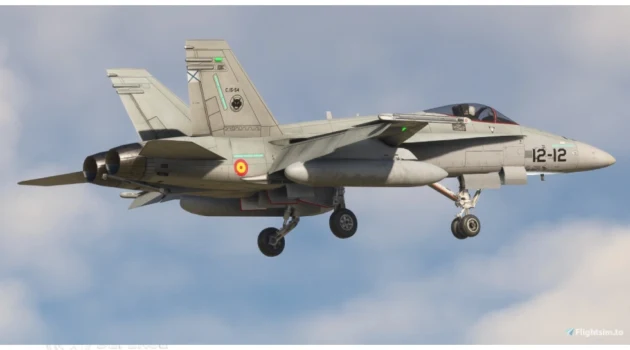
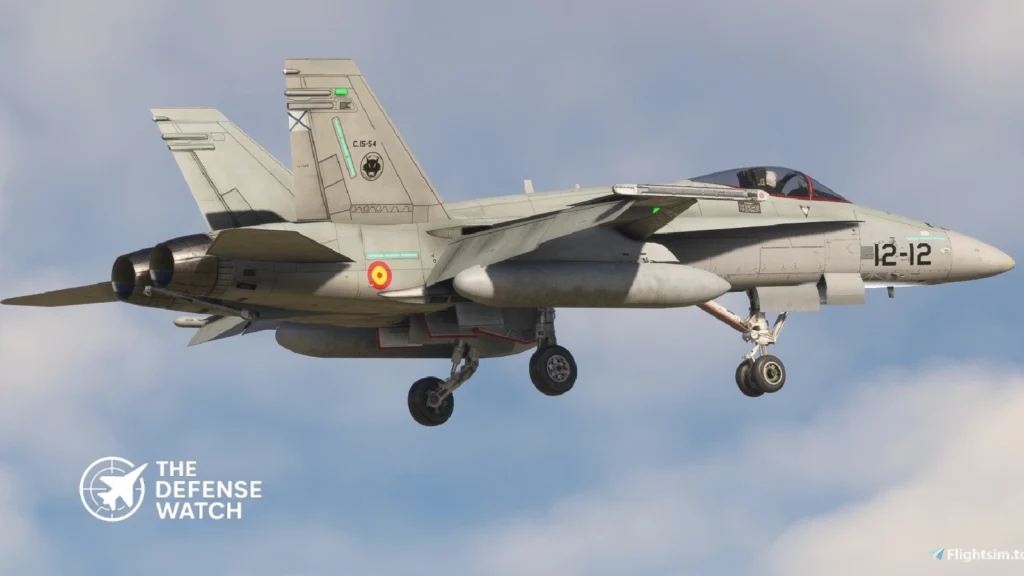
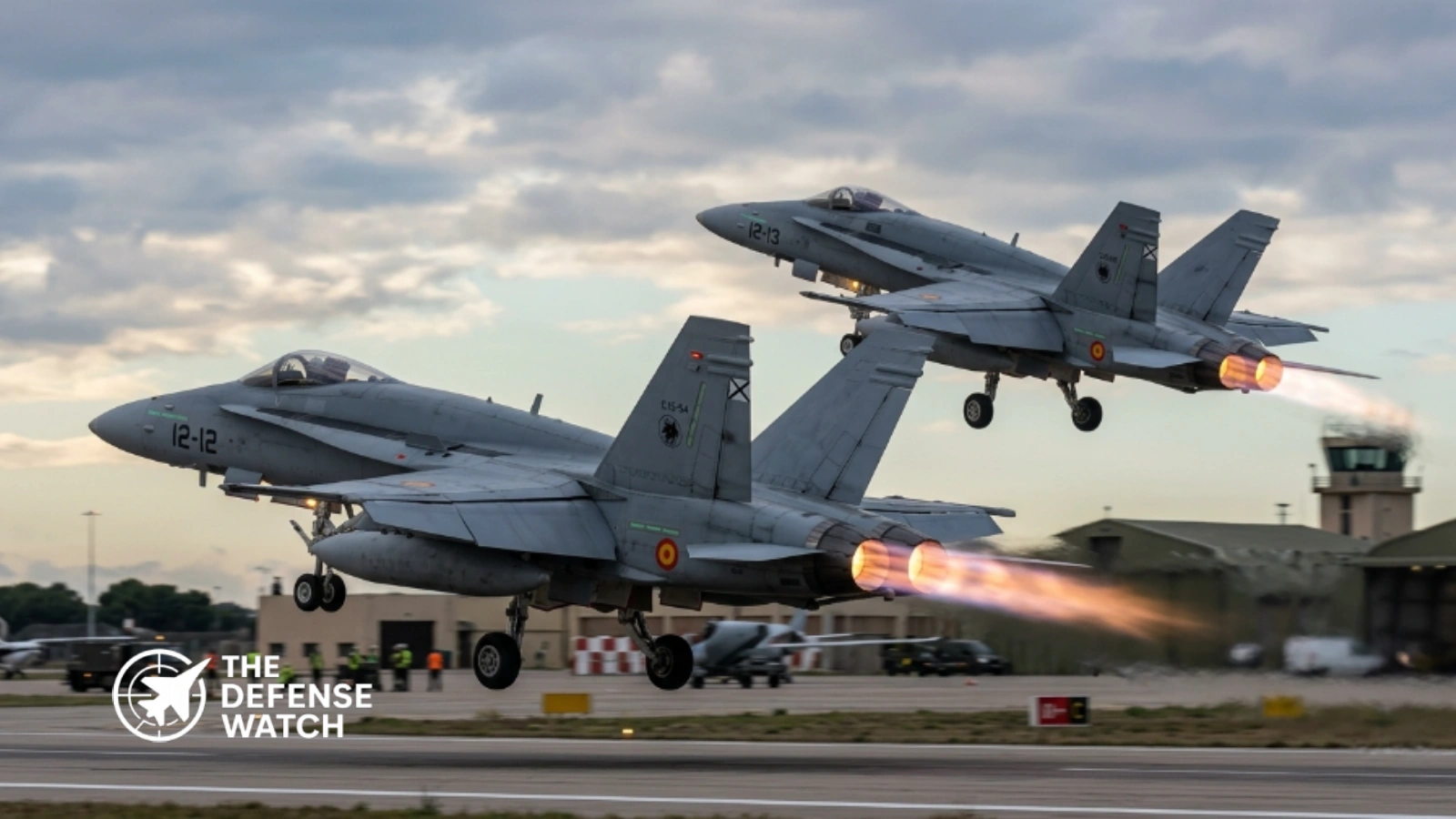
Spain’s F-18M fighters have conducted 15 real Quick Reaction Alert activations during their first month supporting NATO’s Enhanced Air Policing mission in Romania, according to Spain’s Defence Staff. The Paznic detachment began maintaining continuous alert coverage at Mihail Kogălniceanu Air Base on Aug. 7, with the first month also including the destruction of an unidentified drone that entered Romanian airspace.
The figure provides a useful measure of the operational tempo facing NATO’s eastern flank. The 15 activations were not simply training launches. Spain’s Defence Staff describes them as real A-Scrambles responding to unidentified aircraft and possible drones near NATO airspace. The deployment had also accumulated more than 190 flight hours by Sept. 2.
15 Real Scrambles in 30 Days
The Spanish Defence Staff said the Paznic detachment maintained uninterrupted response capability around the clock during its first month. Fifteen real activations occurred during that period, requiring the coordination of pilots, maintainers, weapons personnel, intelligence, communications, command and control and logistical support.
That distinction matters. A QRA fighter force is not simply a number of aircraft sitting on a runway. The effectiveness of the mission depends on keeping aircraft, crews, maintenance, weapons, sensors and command networks ready simultaneously.
Spain’s Defence Staff has specifically highlighted this wider support chain as a central part of the deployment. The F-18s operate within the NATO command-and-control architecture rather than functioning as an independent national interceptor force.
Operational Snapshot
Measure Reported figure Mission NATO Enhanced Air Policing Spanish detachment Paznic Location Mihail Kogălniceanu Air Base, Romania Alert period From Aug. 7, 2026 Real A-Scrambles in first month 15 Flight hours by Sept. 2 More than 190 Fighter type F-18M Air-refueling aircraft A400M Alert coverage 24 hours a day, 7 days a week The figures above come from Spain’s Defence Staff and Ministry of National Defence of Romania.
F-18M Responds to Drone Incursion
The most significant operational event came on Aug. 16.
A pair of Spanish F-18Ms from Ala 12 was placed on alert after Romanian surveillance systems detected an unidentified aerial track approaching from the Black Sea. The aircraft launched from Mihail Kogălniceanu, entered NATO’s command-and-control chain and intercepted the target at night.
The Spanish Defence Staff said the pilots visually identified the target as an unmanned aircraft of the type commonly used as an attack drone. Following authorization to engage, one F-18 used an air-to-air weapon to neutralize it.
Romania separately reported that the aircraft detected the aerial target entering national airspace from the direction of Moldova, and that the Spanish F-18 received authorization to engage before shooting it down.

Spain’s Defence Ministry subsequently described the incident as the first time an allied country other than Romania had shot down a drone over Romanian territory.
The incident also demonstrates the operational value of fighter aircraft against low-cost unmanned threats, but it should not be interpreted as evidence that fighters are a replacement for ground-based air defenses. A fighter is one layer in a wider architecture that depends on persistent surveillance, identification, command authorization and other defensive systems.
Why Romania’s Airspace Has Become a Higher-Tempo Mission
Romania occupies a particularly sensitive position on NATO’s eastern flank. Its territory borders Ukraine and provides access to the Black Sea, placing Romanian airspace close to an active combat zone.
Romanian authorities have reported several instances during August and September in which Spanish F-18s were scrambled following aerial activity near the country’s borders.
On Aug. 20, two Spanish F-18s were scrambled after Romanian military radar detected a group of aerial targets north of Tulcea. A drone subsequently entered Romanian airspace near Galați before crashing in an uninhabited area.
On Aug. 24, the Romanian Defence Ministry reported two aerial targets northwest of Snake Island moving toward the Romanian border. Spanish F-18s were scrambled, although Romania said there was no incursion into its airspace.
On Aug. 27, two Spanish F-18s again launched after Romanian radar detected a group of aerial targets near the Ukrainian border. A Romanian IAR-330 SOCAT helicopter was also deployed, while Romanian authorities reported no national airspace violation.
The pattern shows why NATO’s air-policing mission cannot be reduced to traditional interception of manned military aircraft. The operational picture now includes drones, uncertain radar tracks, activity associated with the war in Ukraine and the need to rapidly distinguish threats from aircraft or objects that do not require engagement.
NATO’s Layered Air-Defense Model
The F-18s are one component of a larger NATO Integrated Air and Missile Defence structure.
NATO describes Air Policing as a 24-hour, 365-day mission designed to protect the integrity and security of Allied airspace. Detection normally begins with Allied sensors, after which tracks of interest can be passed through NATO command structures for assessment and, when required, interception.
Romania also hosts other air-defense capabilities that contribute to the wider surveillance architecture. Spain’s own deployment includes the Tigru detachment, which provides an air-surveillance radar capability alongside the Paznic fighter deployment.
The significance is architectural rather than tied to one aircraft type. A fighter provides speed and flexibility, while radar systems provide detection and tracking. Command-and-control nodes connect those sensors with aircraft and other air-defense assets.
NATO has previously demonstrated this approach in Romania through the integration of deployable radar, fighter aircraft and command-and-control elements. Allied Air Command has described the Romanian mission as part of NATO’s Integrated Air and Missile Defence System.
A400M Adds Endurance and Flexibility
The Paznic deployment also includes a Spanish A400M air-refueling aircraft.
Spain’s Defence Staff said the tanker increases the autonomy, persistence and flexibility of the deployed fighters. The aircraft has supported training and operational activity while allowing the fighter detachment to operate with greater flexibility than a fighter-only deployment.
This is important for a QRA force operating over a large area. The immediate requirement is to launch quickly, but maintaining coverage also depends on the ability to sustain aircraft and crews over time.
The A400M therefore contributes to the force package beyond simple transportation. Its aerial-refueling role can support fighter endurance and reduce some of the constraints associated with operating from a forward base.
Cross-Border Air Defense Expands the Response Area
Another development during the current Spanish deployment is a trilateral agreement between Spain, Romania and Bulgaria.
The agreement allows Spanish fighters assigned to Paznic to conduct air-defense operations in Bulgarian airspace when required. Spain’s Defence Staff said the arrangement is the first agreement of this type within NATO’s framework for the Integrated Air and Missile Defence System.
Operationally, such arrangements can reduce the importance of national borders during a fast-moving air-defense response. An aerial track does not necessarily remain within one country’s airspace, particularly in the Black Sea region.
The arrangement also highlights an important distinction between sovereignty and operational coordination. The ability to cross a border for an authorized air-defense mission requires political and legal arrangements before the aircraft ever launches.
From Air Policing to Air Defense
The operational environment facing the Paznic detachment is broader than the traditional air-policing mission of identifying aircraft that fail to follow flight plans or communications procedures.
NATO’s Air Policing framework remains a peacetime defensive mission, but its eastern-flank deployments increasingly operate alongside broader air-defense activities. NATO has previously described Romanian Enhanced Air Policing as part of its Integrated Air and Missile Defence System, with fighter aircraft operating under NATO command structures and responding to potential threats close to Alliance airspace.
The distinction is particularly important with drones. A conventional air-policing interception may involve identifying an aircraft and establishing its intentions or compliance with aviation procedures. A small unmanned aircraft approaching from a combat zone creates a different identification and engagement problem.
The Aug. 16 engagement demonstrates that the fighter force can transition from surveillance and identification to kinetic action when the applicable authorization and threat assessment are satisfied. It does not, however, establish that every future drone track will be engaged by fighters.
What the 15 Scrambles Tell Us
The most important lesson from the first month is not simply that Spanish F-18s have flown 15 alerts. It is that the eastern-flank air-defense mission is placing sustained demands on readiness and integration.
Three elements stand out.
First, QRA readiness remains a core requirement. Fifteen real activations in roughly one month demonstrate that the aircraft are being used operationally rather than serving solely as a symbolic forward deployment. Spain has maintained a continuous alert capability since Aug. 7.
Second, drones are now part of the fighter interception problem. The Aug. 16 engagement shows that unmanned aircraft can trigger the same broader detection, identification, command and engagement chain used for other aerial threats.
Third, the network matters as much as the fighter. Radar surveillance, command and control, communications, air-refueling support and allied coordination determine how quickly an aircraft can move from detection to interception.
This is where the deployment offers a wider lesson for NATO force planning. Modern air defense requires a mix of sensors, command systems, aircraft and ground-based weapons rather than dependence on a single layer.
The F-18’s Role Within NATO’s Eastern Flank
The Spanish F-18M is not being deployed to Romania as an isolated fighter capability. Its operational value comes from its integration into a larger NATO system.
Spain’s current deployment includes seven F-18 aircraft and an A400M, supported by nearly 200 personnel, according to Spain’s Ministry of Defence. Three NH90 helicopters are scheduled to join the deployment from October.
The force package is therefore structured around persistent readiness rather than simply maximizing the number of fighters airborne at one time.
The 15 scrambles also demonstrate why aircraft availability is only one part of combat power. Every launch consumes maintenance capacity, weapons support, fuel, crew time and flying hours. Maintaining a high-tempo QRA mission requires those supporting functions to remain synchronized.
For NATO, the operational priority is consequently not just putting more fighters on the eastern flank. It is building an integrated system capable of detecting, identifying and responding to increasingly diverse aerial threats while maintaining sufficient depth to sustain the mission.
Outlook
Spain’s Paznic detachment is scheduled to remain in Romania through the current rotation, with its F-18s continuing QRA responsibilities from Mihail Kogălniceanu.
The first month has already produced a substantial operational record: 15 real A-Scrambles, more than 190 flight hours and one confirmed engagement against a drone that entered Romanian airspace.
For NATO, the significance extends beyond the Spanish contingent. Romania’s experience shows how the Alliance’s eastern air-defense posture is evolving around persistent surveillance, rapid fighter response and multinational command integration.
The F-18s provide the immediate response layer. The larger capability comes from the network connecting those fighters to sensors, command centers, refueling assets and other air-defense systems.
That networked structure will remain central as NATO manages the increasingly complex aerial environment around Romania and the Black Sea.