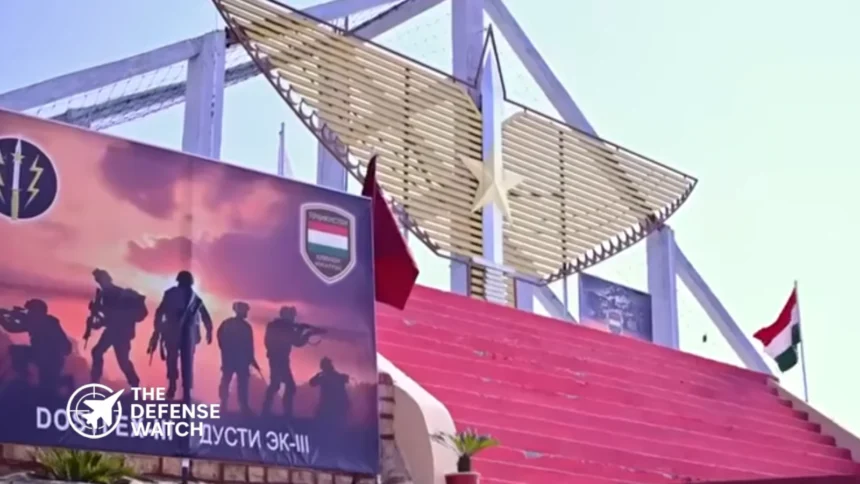
Pakistan and Tajikistan have completed the third edition of their bilateral counterterrorism military exercise, Dosti-III, at the Pakistan Army’s Special Operations School in Cherat, following nearly two weeks of joint training.
The exercise began on October 26, 2026, and concluded on November 6, according to the Inter-Services Public Relations (ISPR), Pakistan’s military media wing.
Dosti-III focused on improving counterterrorism capabilities through the exchange of operational experience, refinement of tactical procedures and joint training. Both armies used the exercise to share professional knowledge and improve combat skills through mutual learning.
Why the Exercise Matters for Both Armies
The value of Dosti-III lies primarily in professional military cooperation rather than the introduction of a new weapons system or a formal defense agreement.
Counterterrorism operations often require coordination between specialized units, particularly when forces operate in difficult terrain or respond to rapidly changing security situations. Joint exercises provide an opportunity to compare tactical approaches, practice procedures and identify differences in how participating forces conduct operations.
For Pakistan, hosting the exercise at Cherat provided a setting for direct engagement between its military training establishment and Tajik personnel. For Tajikistan, the exercise offered an opportunity to exchange experience with Pakistani forces that have conducted extensive counterterrorism operations.
However, ISPR has not disclosed the specific scenarios, participating unit designations, number of personnel, equipment used or individual training activities during Dosti-III. It would therefore be premature to describe the exercise as a test of a particular operational capability.
Building on the Dosti-II Exercise
Dosti-III continues an established bilateral training relationship.
The previous edition, Dosti-II, took place from August 4 to 9, 2025, at Fakhrobod Base in Tajikistan. According to Pakistan’s state broadcaster Radio Pakistan, the exercise involved two combat teams from the Pakistan Army’s Light Commando Battalion and four combat teams from Tajikistan’s Special Forces.
The earlier exercise also focused on improving counterterrorism drills, procedures and operational techniques through joint training.
The shift of the third edition to Cherat demonstrates that the two countries are continuing their military engagement through training activities hosted by both sides. It also provides a practical framework for maintaining contact between their respective military personnel.
Cherat’s Role in Pakistan’s Military Training Cooperation
The Special Operations School at Cherat is an important location for Pakistan’s military training activities. Hosting international exercises there allows visiting forces to engage with Pakistani training personnel and exchange operational practices in a structured environment.
The location also places Dosti-III within a wider pattern of Pakistan’s military engagement with foreign partners through bilateral training exercises.
These activities can support military-to-military communication and improve familiarity between participating forces. However, joint training alone does not establish that the two countries have agreed to conduct joint operations or created an integrated counterterrorism command structure.
Implications for Pakistan-Tajikistan Defense Relations
Pakistan and Tajikistan have an interest in maintaining security cooperation across Central and South Asia. Both countries face security challenges associated with terrorism and regional instability, although their geographic positions and specific security requirements differ.
For Islamabad and Dushanbe, bilateral military exercises provide a relatively practical way to maintain defense engagement without requiring a larger multilateral military arrangement.
Dosti-III also reinforces the value of recurring training exchanges. Repeating exercises can help participating forces maintain professional contacts, share lessons and develop a better understanding of each other’s operational procedures.
Nevertheless, neither ISPR’s announcement nor the available reporting establishes that Dosti-III involved a new defense agreement, permanent military deployment, intelligence-sharing arrangement or commitment to joint counterterrorism operations.
The exercise’s immediate significance is therefore best understood as continued military training cooperation between the two countries.
With Dosti-III concluded at Cherat, the next measure of progress will be whether Pakistan and Tajikistan continue their bilateral training program through further exercises and more detailed exchanges between their armed forces.