Executive Summary: A Spanish F-18 operating under NATO’s enhanced Air Policing mission shot down an unidentified drone after it entered Romanian airspace early August 16 near Galați, close to the Moldovan border. The engagement was the fourth drone shootdown reported over Romania this year and underscores the growing burden on NATO fighters and air-defense networks along the alliance’s eastern flank.
Spanish F-18 Shoots Down Drone Over Romania
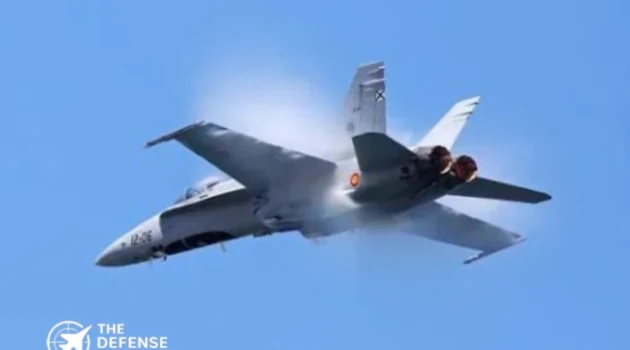
A Spanish F-18 fighter has shot down a drone that breached Romanian airspace, marking the latest confrontation involving an unmanned aircraft near NATO’s eastern frontier. Romania’s Ministry of National Defence said the target was detected early Sunday, August 16, and was intercepted after entering Romanian territory from the direction of Moldova.
The incident occurred near Galați, approximately 24 kilometers north of the city, according to Romanian authorities cited by Reuters. The drone was destroyed at about 5:01 a.m. local time, with debris falling in an uninhabited area between Băleni and Cudalbi in Galați County. No injuries or significant property damage were reported.
Romania has not publicly established the launcher’s identity for the latest drone. Early reporting has described it as suspected Russian, but the investigation remains underway. That distinction is important because drones operating around the Ukraine conflict have crossed NATO airspace for different reasons, including possible navigation disruption and loss of control.
Two Spanish F-18s Were Scrambled
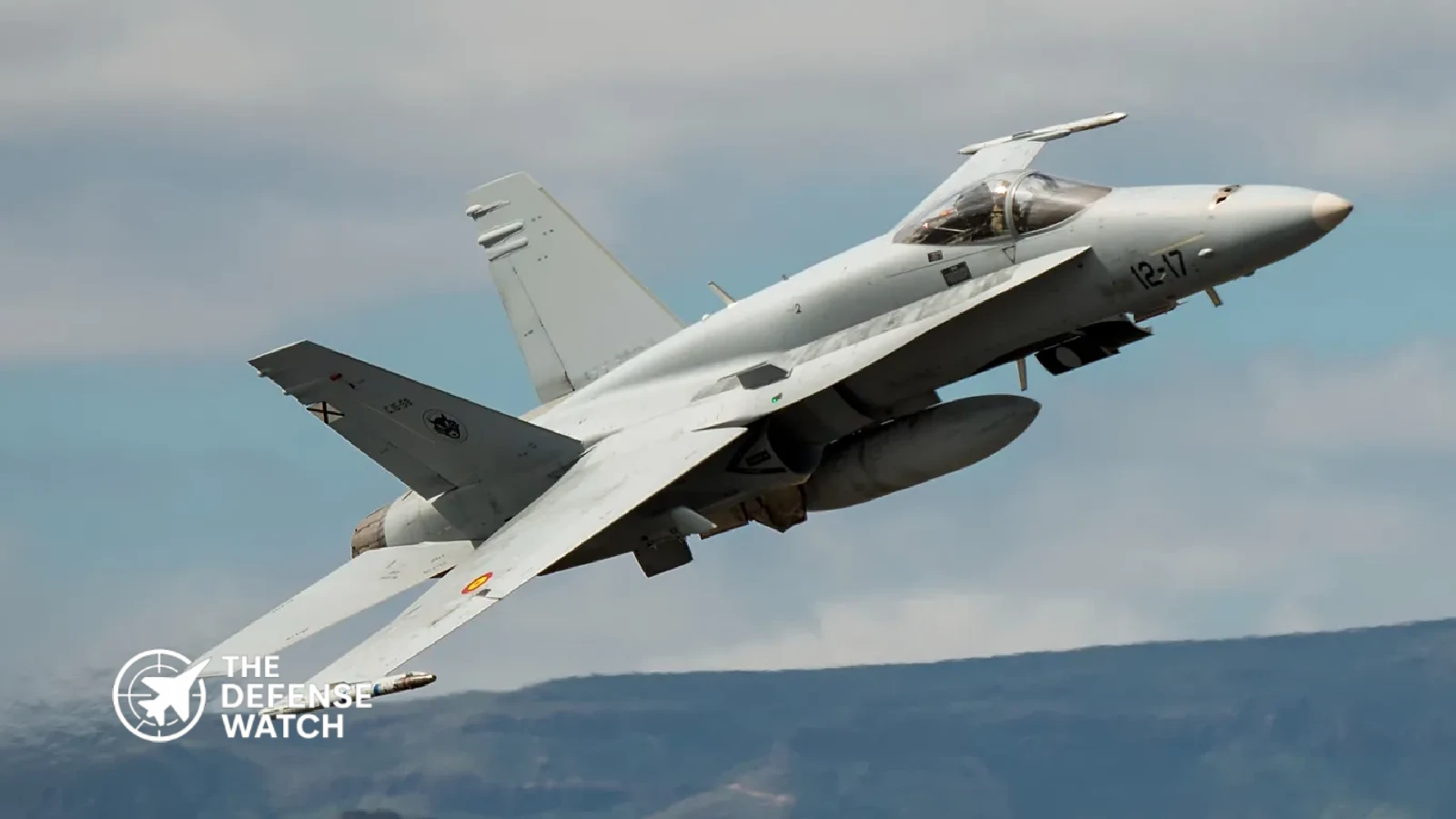
Two Spanish F-18s deployed to Romania were scrambled after the drone was detected. The aircraft were already assigned to NATO’s enhanced Air Policing mission and were operating from Mihail Kogălniceanu Air Base on Romania’s Black Sea coast.
Spain deployed its Paznic tactical air detachment to Romania in late July. The current deployment includes about 200 personnel, seven F-18M fighters, an A400M transport aircraft during the first part of the mission, and three NH-90 helicopters scheduled for the final phase, with the helicopters assigned in part to counter-uncrewed-aircraft missions.
The Spanish deployment is scheduled to support NATO’s enhanced Air Policing mission for four months. Its location at Mihail Kogălniceanu gives NATO a forward fighter presence close to the Black Sea and the Ukrainian border.
The choice to use a fighter against a drone also illustrates a difficult operational problem. A fast jet provides the speed, sensors and weapons needed for a rapid response, but routinely using high-end fighter aircraft against inexpensive unmanned systems can impose substantial costs in fuel, maintenance, flight hours and readiness.
How NATO’s Air Policing Command Chain Works
The interception was not simply a national Romanian response. It took place inside NATO’s Integrated Air and Missile Defence System, which connects surveillance sensors, command centers, national control facilities and Quick Reaction Alert aircraft.
NATO’s Allied Air Command, headquartered at Ramstein Air Base in Germany, oversees the alliance’s Air Policing mission. The mission operates around the clock and is ultimately conducted under the responsibility of the Supreme Allied Commander Europe.
For Romania, NATO’s command-and-control architecture has a particularly important role. The Combined Air Operations Centre at Torrejón, Spain, coordinates Air Policing activities in the southern part of NATO’s European airspace, while Romanian Control and Reporting Centres provide the local tactical picture and control aircraft operating in Romanian airspace.
NATO describes the CAOCs as responsible for planning, directing, coordinating, monitoring and reporting Air Policing operations. Quick Reaction Alert fighters remain ready to launch when surveillance systems identify an unknown, potentially unsafe or otherwise suspicious aircraft.
A previous NATO operation in Romania illustrates the process. In April 2025, the CAOC at Torrejón issued an Alpha-Scramble order after a potential threat was detected. Italian Eurofighters and Romanian F-16s subsequently operated under the direction of Romania’s Control and Reporting Centre.
That architecture matters because a drone crossing a national border can move faster than traditional political decision-making. NATO’s Air Policing system is designed to shorten the distance between detection, identification, authorization and interception.
Romania Has Faced Repeated Drone Incursions
The August 16 shootdown follows a series of increasingly serious drone incidents in Romanian airspace.
Romanian officials reported in May that a Russian Geran-2 drone entered Romanian territory and crashed onto an apartment building in Galați, injuring two people. A subsequent technical investigation identified the system as a Russian-made Geran-2, a one-way attack unmanned aircraft.
Romania has also used its own F-16 fighters during previous airspace incidents. In July, Romanian authorities reported two separate drone shootdowns within successive days, with Romanian F-16s and allied aircraft involved in the response.
The Romanian Defence Ministry said in May that 14 incidents involving Russian drones entering Romanian airspace had been recorded since the beginning of 2026 at that point, including three involving drones carrying explosive charges.
The August incident therefore represents more than an isolated encounter. It is part of a sustained air-defense challenge facing a NATO member positioned directly alongside the war zone.
The Eastern Flank Is Becoming a Counter-Drone Test
Romania is not facing this problem alone.
On August 14, an Italian NATO fighter shot down a drone that entered Latvian airspace. Italian Eurofighters and Turkish F-16s were involved in the response, while authorities investigated the origin of the unmanned aircraft.
Earlier incidents this year also involved drones entering the airspace of Estonia, Latvia, Lithuania and Finland. Some of those cases have been associated with Ukrainian military drones whose navigation may have been affected by Russian electronic warfare, although the circumstances differ from incident to incident.
Bulgaria has also experienced a recent incident. On August 8, a drone believed to be Ukrainian crossed from Romania into Bulgarian airspace and exploded near infrastructure associated with the Trans-Balkan gas pipeline. Bulgarian authorities said the incident appeared accidental and was not believed to have been intentional.
Taken together, these incidents demonstrate why NATO increasingly treats small unmanned aircraft as an air-defense problem rather than simply an aviation nuisance.
Why Fighter Interceptions Are Operationally Significant
The immediate advantage of using an F-18 is responsiveness. A fighter can cover substantial distances quickly, climb above low-altitude threats and use its onboard sensors to identify and engage an aircraft before it reaches populated areas.
The challenge is efficiency.
Small drones can be considerably cheaper than the fighter aircraft, air-to-air weapons and support infrastructure used to intercept them. NATO officials have therefore increasingly emphasized the need for dedicated counter-drone capabilities rather than relying exclusively on traditional fighter interceptors.
NATO Secretary General Mark Rutte highlighted this issue in June, saying the alliance needed to deploy more counter-drone technology so that it would become less dependent on expensive traditional interceptors. He also pointed to the Eastern Sentry effort as a mechanism for improving cooperation from the Black Sea and Türkiye through Romania and Bulgaria and toward the Baltic and High North regions.
This points toward a layered model for NATO’s eastern defenses.
Layer Primary Function Ground and airborne sensors Detect and track low-altitude targets Control and Reporting Centres Build the recognized air picture and direct aircraft NATO CAOCs Coordinate regional Air Policing and interception missions QRA fighters Rapid identification and engagement Ground-based air defenses Defend key areas against aircraft, missiles and drones Counter-UAS systems Provide lower-cost responses to smaller drones Electronic warfare Disrupt or defeat selected unmanned systems The objective is not to replace fighters. It is to ensure that expensive fighter aircraft remain available for threats that genuinely require their capabilities.
Why Romania Matters to NATO
Romania occupies a critical position on NATO’s southeastern flank. Its territory borders Ukraine, Moldova and the Black Sea region, putting Romanian airspace close to an active combat zone where Russian and Ukrainian forces conduct large-scale drone operations.
Mihail Kogălniceanu has consequently become an important hub for allied air operations in the region. NATO has used the base for enhanced Air Policing deployments involving several allied air forces, while Romania continues to operate its own F-16s.
The base also provides NATO with a forward location for surveillance and rapid response. Its importance extends beyond Romania because air incidents near the Black Sea can quickly become multinational problems.
For Washington and other NATO capitals, the lesson is straightforward. Eastern-flank air defense increasingly requires a network capable of detecting low-cost unmanned systems, determining whether they are hostile or accidentally diverted, and responding proportionally before they reach civilian areas or critical infrastructure.
What Happens Next
Romanian authorities are investigating the wreckage from the latest drone to establish its origin and characteristics. Until that investigation is complete, attributing the launch of the aircraft should be treated cautiously.
The broader pattern, however, is already clear. NATO aircraft are increasingly being called upon to respond to unmanned systems crossing the alliance’s borders, while member states are developing additional counter-drone measures to reduce the pressure on high-end fighter fleets.
The Spanish F-18 engagement therefore has significance beyond the individual drone. It demonstrates that NATO’s Air Policing architecture can move from detection to fighter interception in a matter of minutes, while also exposing a central challenge for European air defense: how to protect large areas of allied territory against growing numbers of relatively inexpensive unmanned threats without consuming disproportionate amounts of high-value combat aviation resources.
As drone warfare continues to shape the security environment around the Black Sea and Baltic regions, that balance between fighter readiness, ground-based defenses, electronic warfare and dedicated counter-UAS systems will remain a central issue for NATO’s eastern-flank posture.