

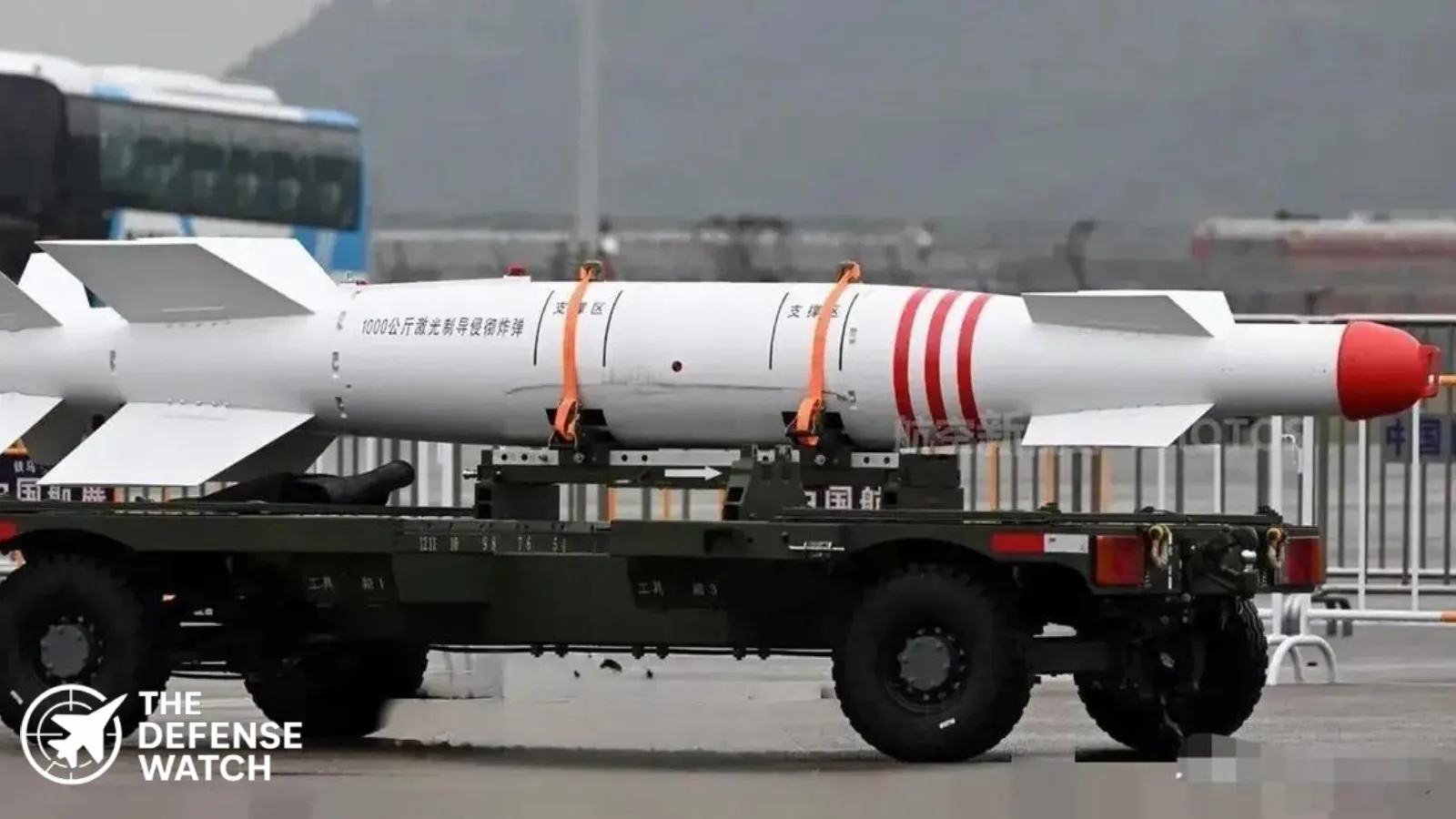
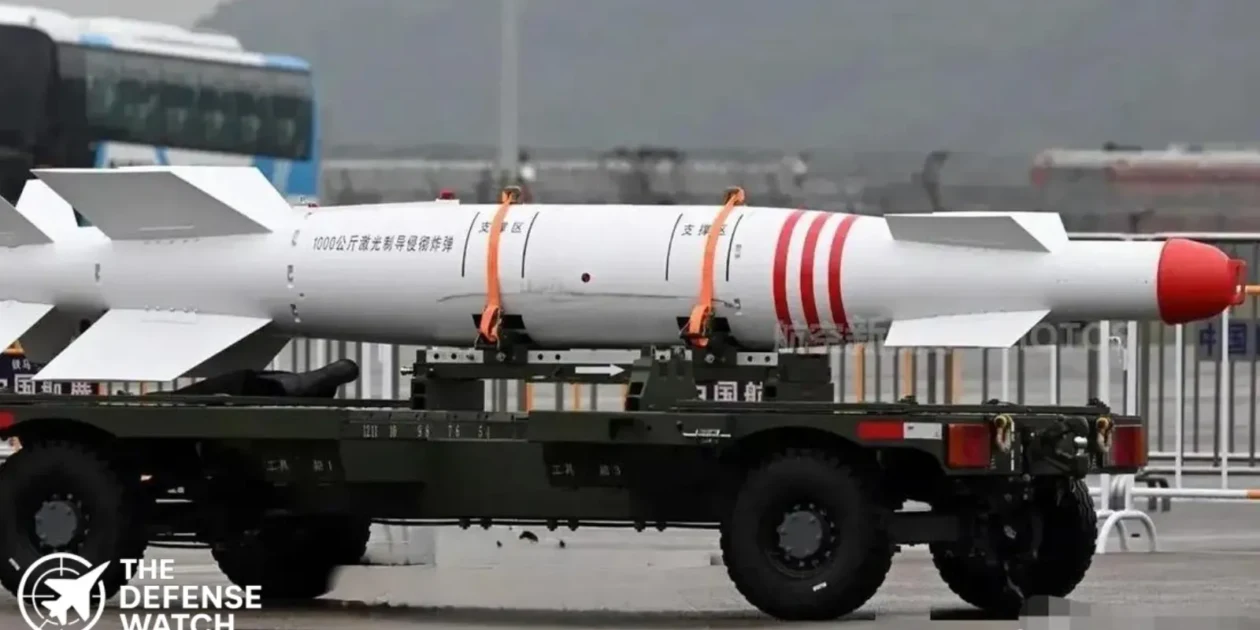
China YJ 1000 precision guided bomb is emerging as one of the heaviest air delivered strike weapons entering service with the People’s Liberation Army Air Force and Naval Aviation forces. Designed as a long range glide munition with a large penetrator warhead, the YJ 1000 reflects Beijing’s continued push to expand stand off strike options against hardened ground targets and high value naval assets.
The YJ 1000 bomb, reportedly developed by major Chinese defense groups under AVIC and CASIC, is believed to have entered limited service around 2024 to 2025. While Chinese authorities have not released a full official data package, public displays, industry briefings, and military reporting suggest the weapon fills a gap between smaller satellite guided bombs and cruise missiles.
With a claimed stand off range of up to 80 kilometers, the YJ 1000 allows Chinese combat aircraft to strike defended targets without entering the most dangerous layers of enemy air defenses. This capability aligns closely with China’s broader airpower modernization goals and its focus on anti access and area denial strategies.
What Is the YJ 1000 Bomb
Heavy Precision Guided Glide Munition
The YJ 1000 is assessed to be a 1,000 kilogram class precision guided bomb fitted with a glide kit rather than a powered engine. After release from altitude, deployable wings extend to provide lift and allow the bomb to travel significant distances toward its target.
Unlike cruise missiles, the YJ 1000 relies on gravity and aerodynamic glide rather than propulsion. This keeps costs lower while still offering extended reach compared to traditional free fall bombs.
Chinese military analysts describe the YJ 1000 as a penetrator munition optimized for hardened or semi hardened targets. Its large mass and reinforced casing are designed to punch through concrete, soil, or ship decks before detonation.
Guidance and Accuracy
Beidou and Inertial Navigation
The YJ 1000 uses a combination of China’s Beidou satellite navigation system and inertial navigation for midcourse guidance. This approach mirrors Western GPS guided bomb designs and supports fire and forget employment.
There is no terminal seeker reported on the weapon. Instead, it relies on pre programmed coordinates and satellite updates to maintain accuracy. Chinese sources claim a circular error probability of less than three meters under ideal conditions.
The lack of an imaging or radar seeker suggests the YJ 1000 is intended primarily for fixed or well located targets such as bunkers, command centers, airfield infrastructure, and large surface vessels.
Performance and Range
Stand Off Strike Capability
Chinese military publications estimate the YJ 1000 has a stand off range between 50 and 80 kilometers when released from high altitude. Actual range depends heavily on release speed, altitude, and flight profile of the launch aircraft.
Because it is a glide bomb, there is no fixed ceiling or altitude limit. Fighters and strike aircraft operating at higher altitudes can maximize glide distance while staying outside many short and medium range air defense systems.
The weapon travels at subsonic speed and follows a predictable glide path. This makes it less survivable than a cruise missile against advanced integrated air defenses, but far more capable than older gravity bombs.
Warhead and Lethality
Large Penetrator Payload
One of the most notable aspects of the YJ 1000 is its warhead size. Open source estimates suggest an 800 kilogram high explosive penetrator payload, making it one of the heaviest air launched guided bombs in China’s inventory.
The warhead is designed to detonate on impact or after a short delay, allowing it to penetrate reinforced structures before exploding. This makes it suitable for destroying underground bunkers, hardened aircraft shelters, ammunition depots, and port facilities.
Against naval targets, the YJ 1000 could be used to strike large surface combatants or support ships in port or at sea, particularly when combined with massed attacks.
Aircraft Compatibility
Integration With Frontline Chinese Fighters
The YJ 1000 is reported to be compatible with several frontline Chinese combat aircraft, including the J 10C multirole fighter, J 15 carrier based fighter, J 16 strike fighter, and the older JH 7 fighter bomber.
These platforms provide the payload capacity and avionics needed to carry and release a weapon of this size. The J 16, in particular, is seen as a key launch platform due to its range, payload, and strike focused mission profile.
Integration across both PLAAF and PLANAF aircraft suggests the YJ 1000 is intended for joint operations, supporting both land attack and maritime strike missions.
Role in Chinese Airpower Strategy
Filling the Gap Between Bombs and Missiles
The YJ 1000 sits between smaller precision guided bombs and long range cruise missiles in China’s strike arsenal. It offers greater reach and lethality than 250 or 500 kilogram satellite guided bombs, but at lower cost and complexity than powered missiles.
This balance is important for sustained operations. In a high intensity conflict, glide bombs like the YJ 1000 could be used in large numbers to overwhelm defenses and conserve more expensive missile inventories.
The weapon also reflects a shift toward stand off employment. Chinese aircraft can launch from outside the range of many point defense systems, reducing risk to pilots and platforms.
Comparison With Western Systems
Similarities to JDAM ER and SPICE
In concept, the YJ 1000 is comparable to Western extended range guided bombs such as the JDAM ER or the Israeli SPICE family. However, its size places it closer to the heaviest bunker buster class weapons rather than standard general purpose bombs.
While the United States relies heavily on powered cruise missiles and stealth aircraft for deep strike, China appears to be building a layered approach. Glide bombs like the YJ 1000 complement ballistic missiles, cruise missiles, and long range aviation.
The absence of a terminal seeker may limit flexibility against mobile targets, an area where some Western weapons offer more options.
Operational Status and Combat Use
No Confirmed Combat Employment
As of 2025, there is no confirmed combat use of the YJ 1000. The weapon has not been reported in real world strike operations, and its performance remains unproven outside of testing and exercises.
However, its reported entry into active service suggests production has begun and operational units are training with the system. Chinese military exercises increasingly emphasize long range precision strike, providing a likely testing ground for the weapon.
Industrial and Program Background
Chinese Defense Industry Role
Development of the YJ 1000 is attributed to major Chinese aerospace and missile organizations under AVIC and CASIC. These firms have been central to China’s rapid expansion of precision guided munitions over the past decade.
China has invested heavily in satellite navigation, guidance electronics, and mass production capabilities. The YJ 1000 benefits from these investments, particularly the widespread adoption of Beidou across Chinese weapons systems.
Analysis and Strategic Context
Strengthening Stand Off Strike Depth
The introduction of the YJ 1000 underscores China’s focus on creating depth in its air delivered strike options. Rather than relying on a single class of weapon, the PLAAF and PLANAF are fielding a mix of bombs, glide weapons, and missiles to suit different targets and threat environments.
This approach complicates enemy defense planning. Air defenses must account for both slow glide weapons and faster missiles, increasing the burden on interceptors and sensors.
Implications for Regional Air Defense
For regional militaries, the YJ 1000 highlights the need to strengthen layered air defenses around critical infrastructure. Hardened shelters, command facilities, and ports could face increased risk from heavy glide bombs launched from outside traditional engagement zones.
While not as difficult to intercept as stealthy cruise missiles, large glide bombs still pose a serious challenge when used in numbers or combined with electronic warfare and decoys.
FAQs
What is the main role of the YJ 1000 bombIt is designed for long range precision strikes against hardened ground targets and large naval assets.
How far can the YJ 1000 travelEstimated stand off range is between 50 and 80 kilometers depending on launch conditions.
Does the YJ 1000 have its own engineNo. It is a gravity delivered bomb with a glide kit and no propulsion.
Which aircraft can carry the YJ 1000Reported platforms include J 10C, J 15, J 16, and JH 7 aircraft.
Has the YJ 1000 been used in combatThere is no confirmed combat use as of 2025.
YJ-1000 Bomb

Defense Systems Full Specifications
1. General Information
Name / Designation YJ-1000 Type / Role Precision-Guided Bomb / Penetration Munition Country of Origin China Manufacturer AVIC / CASIC Service Entry / Year Introduced 2024–2025 (estimated) Operational Status Active / In Service 2. Performance & Range
Range 50–80 km (standoff range) Speed Subsonic / gravity-delivered Ceiling / Altitude Limit Depends on launch platform Accuracy (CEP) <3 meters Warhead Type Penetrator High-Explosive 3. Guidance & Targeting
Guidance System Beidou + INS Targeting Mode Fire-and-Forget Launch Platform Compatibility J-10C, J-15, J-16, JH-7 Seeker Type None (GPS/INS guided) 4. Physical Characteristics
Length Approx. 3.5 m Diameter 0.45 m Wingspan 0.8 m Launch Weight ~1,000 kg Propulsion None (gravity bomb with glide kit) 5. Warhead & Payload
Warhead Weight ~800 kg Explosive Type High-Explosive Penetrator Detonation Mechanism Impact or Delay Fuse Payload Options Conventional 6. Operational Use & Capabilities
Operational Range Type Medium Deployment Platform Air (Fighter / Bomber) Target Types Bunkers, Naval Ships, Airfields Combat Proven No (as of 2025) Users / Operators China (PLAAF / PLANAF) PROS
- High-precision guidance (Beidou/INS system)
- Compatible with multiple Chinese fighter jets
- Strong penetration capability against hardened targets
- Long standoff range enhances aircraft survivability
- Modular design allows flexible payload integration
CONS
- Limited publicly available performance data
- Heavier payload restricts smaller aircraft compatibility
- Dependent on satellite connectivity for optimal accuracy
- Lacks verified combat record
- Restricted export availability
YJ-1000 Precision Guided Bomb
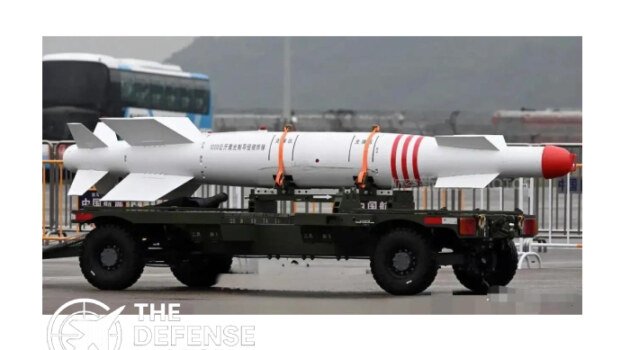
The YJ-1000 is a modern, 1-ton precision-guided bomb developed by China’s defense industry, likely under the state-run Aviation Industry Corporation of China (AVIC) or China Aerospace Science and Industry Corporation (CASIC). Introduced in the mid-2020s, the YJ-1000 is designed to deliver accurate, high-impact strikes against fortified ground and naval targets. Its debut signals China’s growing capability to equip fourth- and fifth-generation aircraft with advanced, long-range strike munitions.
Design and Capabilities
Weighing approximately 1,000 kilograms, the YJ-1000 employs a modular design compatible with a range of People’s Liberation Army Air Force (PLAAF) aircraft, including the J-10C, J-15, J-16, and JH-7. Its guidance suite combines satellite navigation (Beidou) and inertial navigation (INS) systems to achieve sub-meter accuracy, enabling precision attacks even in GPS-jammed environments.
The bomb’s aerodynamic casing and adjustable control fins support high-speed, standoff delivery, allowing aircraft to release it from significant altitudes and distances beyond enemy air defenses. It carries a penetrator-type warhead, optimized for destroying bunkers, runways, and hardened shelters.
While not officially disclosed, estimates place its effective range at 50–80 kilometers when deployed from altitude. The YJ-1000 integrates with China’s digital targeting pods, providing fire-and-forget capability once released.
Operational Role
The YJ-1000 enhances China’s precision-strike capability across contested zones such as the South China Sea or Taiwan Strait. It serves as a counterpart to Western systems like the U.S. GBU-31 JDAM, reflecting China’s continued modernization of its aerial strike arsenal.
YJ-1000 Bomb Price
Although not available for U.S. export, defense analysts estimate the YJ-1000’s unit cost to be around $150,000–$250,000, comparable to Western precision-guided munitions in its weight class.

11 comments
[…] said this capability brings 360 degree defensive coverage for maritime vessels and other platforms, expanding beyond traditional angled launch […]
[…] options could involve long range air strikes, maritime operations, or combined actions intended to degrade Iran’s ability to threaten US […]
[…] and shipbuilding experience. Babcock brings sustainment and lifecycle support expertise, including weapons launching and handling systems. Babcock Canada is positioned to lead localization efforts in Canada, covering in-service support, […]
[…] In previous high end strike scenarios, including operations against heavily defended targets, the United States relied on stealth aircraft such as the B 2 Spirit to penetrate airspace and deliver precision guided munitions. […]
[…] aligns with a shift in infantry tactics that places a premium on small, networked precision strike options. For the Marine Corps, providing squads with organic strike capability may improve responsiveness […]
[…] testing in 2025 included ten subsystem demonstrations covering seeker, guidance, warhead and launch systems. Those milestones helped mature critical components in advance of integrated […]
[…] New manufacturing facilities are expected to support small arms ammunition and potentially selected precision guided munitions. For Egypt, this aligns with broader efforts to localize consumables and sustainment items for its […]
[…] with evolving operational lessons from recent conflicts, where survivability against top attack and guided munitions has become […]
[…] the range of a precision rocket provides commanders a deeper stand-off strike option while retaining accuracy. The Alternative Warhead variant tested offers an area effects capability […]
[…] than supporting carrier air wings, these drones are designed to give individual ships independent strike options, even when operating far from air […]
[…] Unlike general purpose bombs, the GBU-57 Massive Ordnance Penetrator relies on precision guidance and a hardened casing to penetrate reinforced concrete or subterranean facilities before detonation. The KMU-612 E/B tailkit provides GPS guidance, converting the bomb into a precision guided munition. […]