Sentinel ICBM Reaches Major Ground Integration Milestone
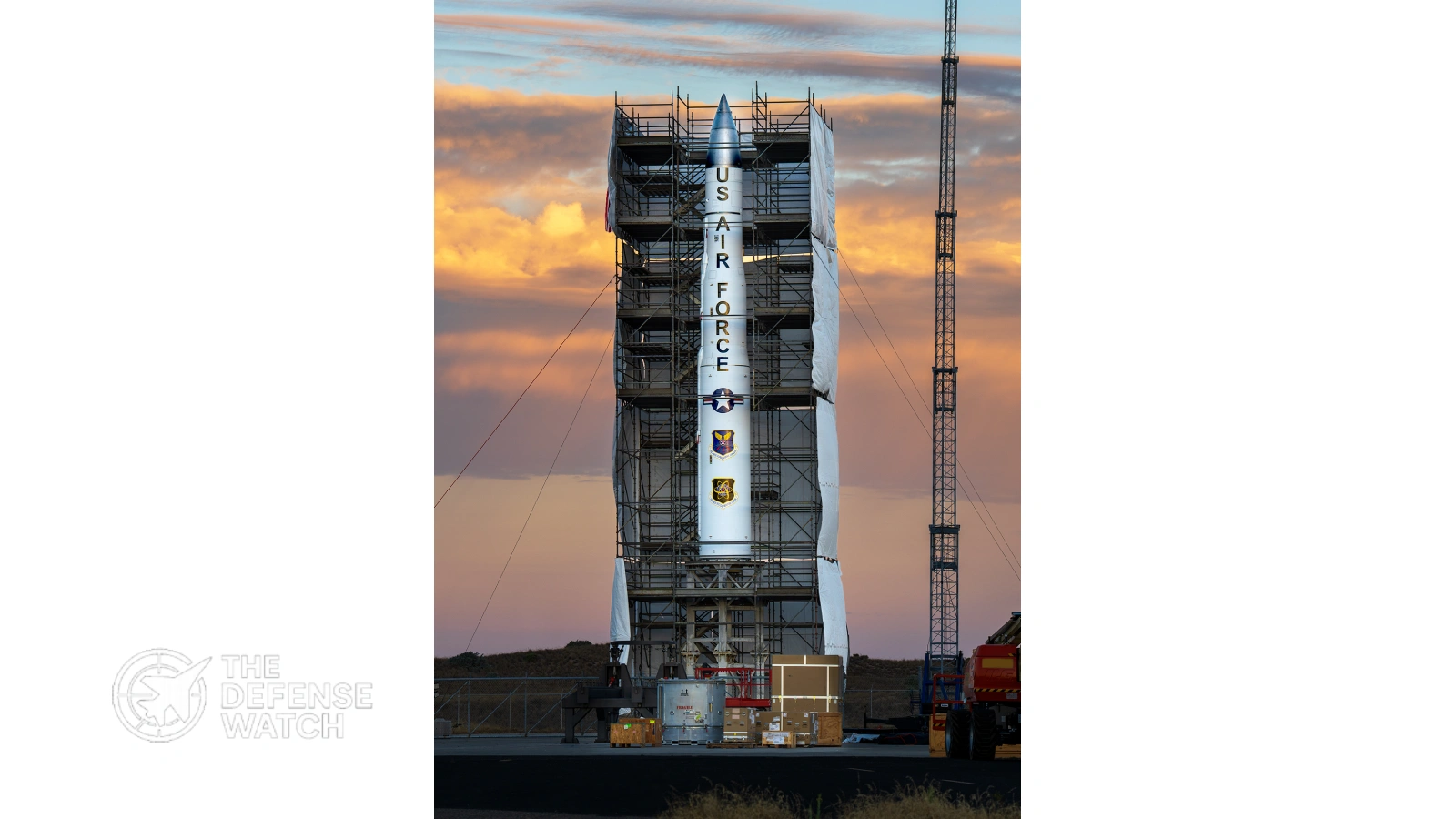
The Sentinel ICBM has moved closer to its planned 2027 flight-test campaign after the U.S. Air Force and Northrop Grumman completed the vertical assembly of an inert LGM-35A missile at Vandenberg Space Force Base, California. Northrop Grumman announced the milestone Sept. 14, describing the exercise as a major step toward demonstrating the missile’s design and integration before flight testing.
Takeaways
The Sentinel program has completed another major ground integration milestone as the United States prepares for the next-generation ICBM’s flight-test campaign.
The exercise, known as Pathfinder, was designed as a full-scale ground rehearsal rather than a missile launch. Engineers transported Sentinel components from locations across the United States and then tested the procedures needed to assemble the missile in its operational orientation on a test pad.
That distinction is important. A successful vertical assembly does not demonstrate flight performance by itself, but it does test whether the hardware, interfaces, handling equipment and procedures can be brought together as a complete missile configuration.
The latest event also comes as the Air Force continues a broader restructuring of the Sentinel acquisition program following major cost and schedule problems.
Pathfinder Tests the Processes Required Before Flight
According to Northrop Grumman, the inert missile was assembled with its stages, propulsion elements, shroud and associated components integrated into a single configuration. Engineers then de-stacked the missile after completing the planned ground procedures.
The Pathfinder exercise covered several practical operations that have to work before flight testing can proceed.
| Area | Pathfinder Activity |
|---|---|
| Missile transportation | Components moved from locations across the United States |
| Handling | Specialized transport vehicles and mobile cranes used |
| Vertical integration | Missile assembled in operational orientation |
| Interfaces | Mechanical and system interfaces verified |
| Test-pad operations | Assembly and de-stacking procedures demonstrated |
| Flight preparation | Ground processes evaluated ahead of flight testing |
The exercise therefore addresses a different class of risk from static motor testing. Rocket-motor tests establish confidence in propulsion hardware, while Pathfinder addresses the physical integration and handling processes needed to prepare a complete missile for a launch campaign.
Northrop Grumman said the exercise demonstrated that the required procedures for safely assembling the missile at the test pad could be executed.
Flight-Test Critical Design Review Adds Another Milestone
At the same time, Northrop Grumman and the Air Force’s 719th Test Squadron completed the first flight-test Critical Design Review.
The review examined whether the missile’s design maturity and hardware testing were sufficient to support the requirements for the planned flight test, including performance, safety and schedule considerations.
The combination of the design review and Pathfinder exercise is significant because it moves Sentinel beyond isolated component demonstrations toward testing the interaction of the complete weapon system.
The Air Force has already reported substantial progress on individual propulsion elements. Stage 1 and Stage 2 solid rocket motor testing was completed in 2025, while the program has also conducted testing of the Stage 3 propulsion system and post-boost propulsion hardware.
The service has described the flight-test campaign as a deliberate progression in which individual technologies and components are tested before increasingly complete system-level demonstrations.
Why the 2027 Flight Test Matters
The planned 2027 flight test represents a major transition point for Sentinel.
The Air Force said in February 2026 that the program was targeting a first missile pad launch in 2027 while completing its restructuring and working toward a new Milestone B decision. The service also set the early 2030s as the target for initial capability.
The flight campaign will ultimately provide information that cannot be obtained through ground testing alone. A flight test allows the government to evaluate the integrated missile under actual launch and flight conditions and generate data for subsequent developmental and operational decisions.
That makes the current Pathfinder exercise more than a logistics demonstration. It is part of the chain of evidence required to show that the program can move from component qualification to an integrated flight system.
Sentinel Is Replacing a More Than 50-Year-Old ICBM Force
Sentinel is intended to replace the Minuteman III, which has been in service for more than five decades.
The land-based ICBM force forms one leg of the U.S. strategic nuclear triad alongside ballistic-missile submarines and nuclear-capable bombers. The Sentinel program is consequently much larger than the development of a new missile alone.
The Air Force is replacing and modernizing associated launch facilities, command infrastructure, support equipment and other elements required to operate the weapon system.
GAO has described the transition as one of the most complex modernization efforts facing the Air Force. The existing Minuteman III infrastructure includes more than 600 facilities, including approximately 450 missile silos distributed across five states.
The scale of that infrastructure explains why missile development and facility construction have to progress together. A flight-ready missile cannot by itself complete the transition from Minuteman III to Sentinel.
The Program Still Faces Significant Cost and Schedule Pressure
The latest technical progress should not be confused with the resolution of Sentinel’s broader acquisition challenges.
In January 2024, the Air Force reported a critical Nunn-McCurdy cost breach. The subsequent Department of Defense review found problems including an unrealistic delivery schedule, weaknesses in systems engineering and incomplete basic system design, along with an industrial base that had lost capacity. The program was allowed to continue, but its previous Milestone B approval was rescinded and the program was restructured.
GAO has continued to identify Sentinel as a high-risk modernization program.
In its February 2026 assessment, GAO reported that the program’s original flight schedule had slipped substantially and identified continuing concerns involving software development, infrastructure and the transition from Minuteman III. GAO also noted that the Air Force was evaluating ways to reduce further cost and schedule growth.
The current Air Force schedule is more recent than those earlier assessments. In February, the service publicly stated that the first missile pad launch was planned for 2027. Northrop Grumman’s Sept. 14 announcement now says the program remains on pace for that 2027 flight-test objective.
That represents an important schedule marker, but the flight test itself will remain a significant technical and program-management checkpoint.
A New Architecture for the Land-Based Nuclear Leg
Sentinel is being developed as a new weapon system rather than a simple replacement missile.
The Air Force describes the program as a modernization of the entire land-based leg of the nuclear triad, including the missile, launch systems, command-and-control infrastructure and supporting facilities. The program also uses extensive digital engineering intended to model system behavior and identify problems before hardware testing.
The missile’s flight system includes a three-stage solid rocket booster, post-boost propulsion, guidance and navigation systems and a reentry system.
This architecture is intended to provide a modern foundation that can remain viable for decades rather than extending the service life of the Minuteman III indefinitely.
Northrop Grumman says the Sentinel weapon system is intended to remain viable through 2075. The company is leading a nationwide industrial team involving more than 500 partners, with more than 10,000 personnel supporting the program.
The Infrastructure Challenge Is Almost as Important as the Missile
One of the most consequential changes to the restructured program has involved the launch infrastructure.
The Air Force has moved toward constructing new standardized silos rather than relying primarily on extensive refurbishment of the existing Minuteman III structures. In March 2026, the service reported that a full-scale Sentinel silo prototype had begun construction in Utah to validate the new construction approach before wider fielding.
The change has operational significance because Sentinel requires a synchronized transition from an existing nuclear force to a new one.
The Air Force has also been developing new wing command centers and other facilities while work continues at Vandenberg to support flight testing.
The challenge is therefore not simply to build a new ICBM. The service has to create an integrated system of missiles, silos, command infrastructure, transportation equipment, communications, security and maintenance capabilities while keeping Minuteman III operational.
What Comes Next
The immediate objective is to complete the remaining preparations for Sentinel’s first missile pad launch and subsequent flight testing.
The Pathfinder exercise has demonstrated the physical process for transporting and vertically integrating the inert missile. The flight-test Critical Design Review provides another assessment of design maturity and readiness.
The next major test will move the program from a ground-based integrated configuration toward an actual flight environment.
If the 2027 schedule holds, Sentinel will enter one of the most consequential stages of its development. Flight-test results will help determine how quickly the Air Force can progress toward additional testing, production and eventual deployment.
The larger strategic objective remains the replacement of the aging Minuteman III force and preservation of the land-based component of the U.S. strategic deterrent into the 2030s and beyond.
For now, the Sept. 14 milestone provides evidence that Sentinel is progressing from digital designs and component testing toward a physically integrated flight-test system. It does not eliminate the program’s cost, infrastructure and schedule risks, but it represents a measurable step toward the 2027 launch objective.