







@2026 – All Right Reserved. TheDefenseWatch.com
- Home
- Defense Systems
- Bombs & Aerial Munitions
- Tsar Bomba (RDS-220)
Tsar Bomba (RDS-220)
Defense Systems Full Specifications
1. General Information
| Name / Designation | Tsar Bomba / RDS‑220 |
| Type | Nuclear Gravity Bomb |
| Manufacturer | VNIIEF (Soviet Union) |
| Country of Origin | Soviet Union (Russia) |
| Year Introduced | 1961 (tested) |
| Operational Status | Experimental, not operational |
2. Physical Characteristics
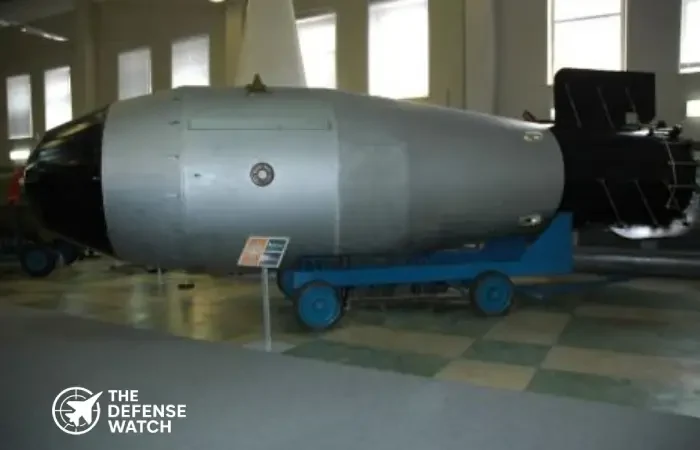
| Weight | Approx. 27,000 kg |
| Length | ~8 meters |
| Diameter | ~2.1 meters |
| Casing Type | Steel alloy casing |
3. Performance
| Yield | ~50 megatons (test configuration) |
| Guidance | None |
| Accuracy (CEP) | Unguided gravity release |
| Delivery Platforms | Modified Tu‑95 bomber |
| Penetration Capability | Not applicable |
4. Warhead / Explosive Details
| Warhead Type | Thermonuclear |
| Fuzing Options | Airburst |
| Explosive Composition | Not publicly disclosed |
5. Operational Use
| Primary Mission | Demonstration of nuclear capability |
| Operators | Soviet Union |
| Notable Deployments / History | Single test on Oct 30, 1961, Novaya Zemlya archipelago |
6. Variants
| Variants | None (unique device) |
PROS
- Demonstrated maximum theoretical nuclear capability
- Served as a strategic deterrence symbol
- Highlighted scientific and engineering achievements
- Influenced global arms‑control discourse
- Provided data for atmospheric test analysis
CONS
- Impractical for operational military use
- Excessive size and weight limited delivery options
- Destabilizing political impact during the Cold War
- Environmental and atmospheric consequences
- Never part of an active or sustainable arsenal
Tsar Bomba (RDS-220): The Largest Nuclear Device Ever Built
The Tsar Bomba, officially designated RDS‑220, stands as the most powerful nuclear device ever detonated in human history. Developed during the height of Cold War tensions, this Soviet superweapon became a symbol of extreme nuclear capability and geopolitical signaling. Tested on October 30, 1961, over Novaya Zemlya, the device demonstrated a scale of destructive power unmatched before or since.
Manufactured by the Soviet Union’s All-Russian Scientific Research Institute of Experimental Physics (VNIIEF), the Tsar Bomba was engineered as a thermonuclear gravity bomb primarily intended for strategic deterrence rather than practical battlefield deployment. The purpose was to showcase Soviet scientific strength and convey a clear strategic message to the international community. With a theoretical yield far exceeding its test configuration, the device served as a political tool more than an operational weapon.
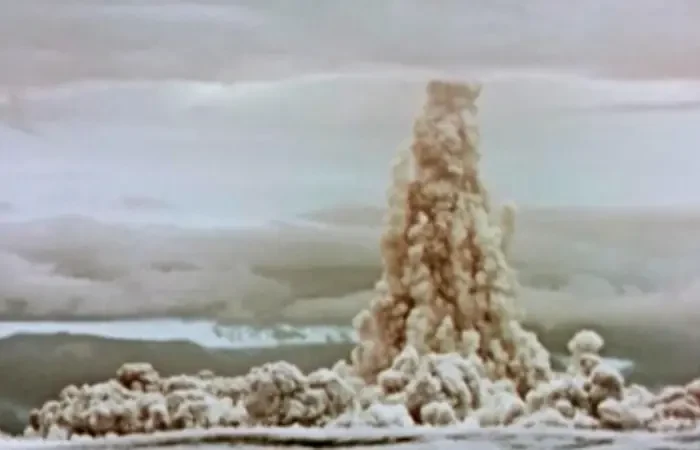
The bomb measured roughly 8 meters in length and weighed over 27 metric tons, requiring specially modified aircraft—principally the Tupolev Tu‑95—for delivery. Its unprecedented yield created a shockwave that circled the Earth and produced a mushroom cloud rising over 60 kilometers. Despite its scale, the Tsar Bomba was never introduced into an active arsenal, as its size, limited practicality, and destabilizing effects made it unsuitable for standard military planning.
In modern defense analysis, the Tsar Bomba remains a historical benchmark rather than a functional weapon system. It underscores the extremes of Cold War nuclear development and continues to inform discussions on strategic stability, arms control, and the limits of thermonuclear design.
Tsar Bomba Price
The Tsar Bomba is a historical, non‑commercial, and decommissioned experimental device. It has no price, as it was never available for procurement or defense export.
FAQs
Was the Tsar Bomba ever an operational weapon?
No. It was an experimental device tested once and never fielded.
How powerful was it compared to modern nuclear weapons?
It remains the most powerful nuclear device ever tested, far exceeding modern deployed warheads.
Why was it built?
Primarily for political signaling and to demonstrate Soviet thermonuclear capabilities.
Could it have been delivered in real combat?
Its size and weight made operational deployment highly impractical.
Is the Tsar Bomba still active today?
No. It was a one-time test device and no longer exists as a weapon.
Disclaimer Note
The information provided on TheDefenseWatch.com is for general informational purposes only. While we strive to ensure the accuracy, completeness, and timeliness of our content regarding defense and aerospace products, technologies, and specifications, we cannot guarantee that all information is 100% accurate or up-to-date due to the evolving nature of military technology and classified data.TheDefenseWatch.com does not warrant the reliability, suitability, or availability of the information for any specific purpose. Users are advised to consult official sources, such as manufacturers, government publications, or defense agencies, for precise and verified data before making decisions based on our content.We are not affiliated with any defense manufacturers, governments, or military organizations mentioned. Opinions, reviews, and ratings reflect expert analysis but are subjective and should not be considered endorsements. TheDefenseWatch.com is not responsible for any errors, omissions, or consequences arising from the use of this website’s content.External links are provided for convenience and do not imply endorsement. TheDefenseWatch.com reserves the right to update or modify content without prior notice. By using this website, you agree to our Privacy & Cookies Policy.
New Arrivals
Popular Comparisons
-
 Tejas Fighter Jet vs F-16 Fighting Falcon: Capability Compared
View Comparison →
Tejas Fighter Jet vs F-16 Fighting Falcon: Capability Compared
View Comparison → -
Rafale Fighter Jet vs F-16 Fighting Falcon : Which Fighter Has the Edge?
View Comparison →
-
Su-57 Fighter Jet vs J-20 Fighter Jet: Stealth and Air Combat Compared
View Comparison →
-
Mirage 2000 vs Tejas Mk1A: Legacy Combat Power vs Indigenous Modernization
View Comparison →
-
Rafale Fighter Jet vs F-22 Raptor: Which Air Dominance Fighter Has the Edge?
View Comparison →
-
Tejas Fighter Jet vs. Rafale Fighter Jet: India’s Indigenous Fighter Meets France’s Proven Multirole Combat Aircraft
View Comparison →
-
F-22 Raptor vs. F-35 Joint Strike Fighter: Which Fifth Generation Fighter Has the Edge?
View Comparison →
-
F-35A vs. F-22 Raptor: Which U.S. Stealth Fighter Dominates Modern Air Combat?
View Comparison →
-
AGM-114 Hellfire vs. AGM-179 JAGM: Which U.S. Precision Missile Is Better?
View Comparison →
-
Patriot (PAC-3) vs. THAAD: Complete Missile Defense System Comparison, Capabilities, Range, and Strategic Roles
View Comparison →
- USS Farragut Completes Task Force Exercise Ahead of Global Deployment

- Army Begins Replacing Legacy WIN-T Network With Modern C2 Baseline at III Armored Corps
- Coyote Storm 26.2 Tests Air Force Expeditionary Wing 2.0 Readiness at Davis-Monthan
- USS Stout Departs Norfolk for Deployment Operations
- Britain Invests £6 Billion to Double Nuclear Submarine Production Capacity
- Raytheon Awarded $105.6 Million AMRAAM Parts Contract
- Pentagon Energy Expo Puts Resilient Power at Center of Future U.S. Military Operations
- F-16 Crashes at Spangdahlem Air Base in Germany, Pilot Ejects Safely
- FQ-42 Vengeance Flies With F-35 and F-15E as Air Force Advances CCA Teaming
- Albania Secures $302 Million U.S. Defense Loan for Military Modernization