




















@2026 – All Right Reserved. TheDefenseWatch.com
- Home
- Defense Systems
- Missiles & Precision Weapons
- Palestine-2 Missile
Palestine-2 Missile

Defense Systems Full Specifications
1. General Information
| Name / Designation | Palestine-2 Missile |
| Type / Role | Tactical Ballistic Missile/Palestine-2 hypersonic missile |
| Country of Origin | Regional (Middle East) |
| Manufacturer | Regional Defense Consortium |
| Service Entry / Year Introduced | Not Publicly Disclosed |
| Operational Status | Limited/Unknown |
2. Performance & Range
| Range | 250–300 km |
| Speed | Estimated Mach 3+ |
| Ceiling / Altitude Limit | Not Publicly Disclosed |
| Accuracy (CEP) | Estimated <50 m |
| Warhead Type | HE/Fragmentation/Penetration |
3. Guidance & Targeting
| Guidance System | INS/GPS Hybrid |
| Targeting Mode | Semi-autonomous |
| Launch Platform Compatibility | Mobile Ground Launchers |
| Seeker Type | Optional Terminal Guidance |
4. Physical Characteristics
| Length | Approx. 6–7 m |
| Diameter | ~0.8 m |
| Wingspan | N/A (Ballistic Missile) |
| Launch Weight | 2,000–3,000 kg (Estimated) |
| Propulsion | Solid-fuel Rocket Motor |
5. Warhead & Payload
| Warhead Weight | 300–500 kg |
| Explosive Type | HE/Fragmentation/Penetrator |
| Detonation Mechanism | Impact/Delay Fuse |
| Payload Options | Conventional |
6. Operational Use & Capabilities
| Operational Range Type | Short–Medium |
| Deployment Platform | Ground |
| Target Types | Infrastructure, Vehicles, Fortifications |
| Combat Proven | Unknown |
| Users / Operators | Regional (Non-Export) |
PROS
- Mobile launch capability enhances survivability
- Solid-fuel propulsion enables rapid launch readiness
- Modular warhead options for diverse mission profiles
- Improved accuracy through INS/GPS guidance
- Suitable for tactical precision strikes
CONS
- Limited verified operational data
- Restricted export availability
- Vulnerable to advanced missile defense systems
- Range shorter than modern medium-range systems
- Dependent on stable GPS environment for peak accuracy
Palestine-2 Hypersonic Missile
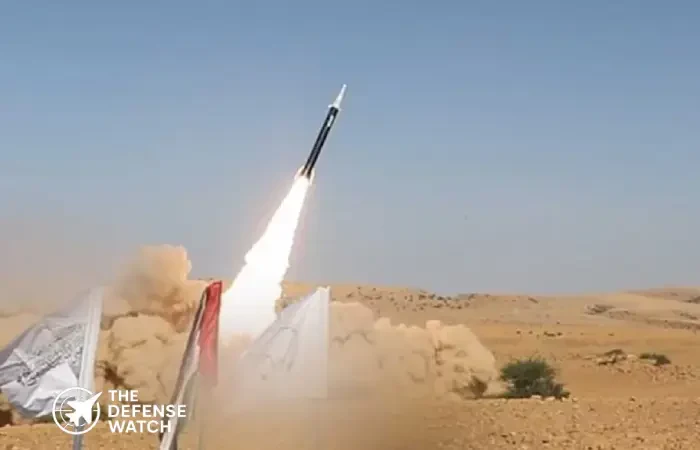
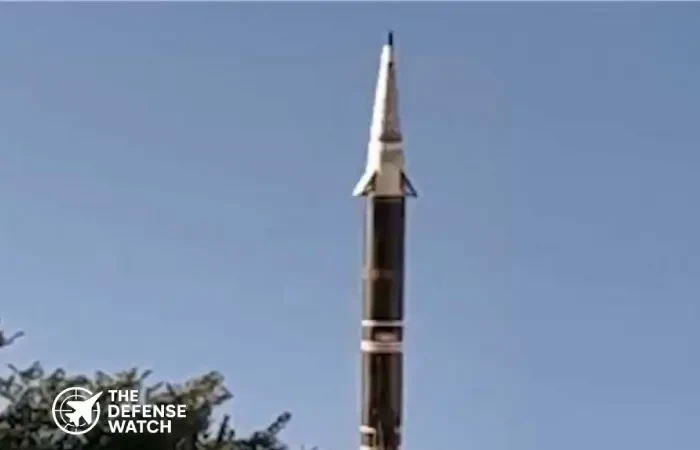
The Palestine-2 Missile is a next-generation short- to medium-range tactical ballistic missile developed for precision strike missions against high-value military targets. Designed for regional deterrence and rapid-response engagements, the system reflects a continued evolution of indigenous missile capabilities in contested environments. Its primary role includes counter-force operations, infrastructure suppression, and battlefield interdiction.
Manufactured by a regional defense industry consortium, the missile is believed to integrate modern navigation technologies such as INS/GPS hybrid guidance, enabling improved accuracy compared to earlier variants. The Palestine-2 features a streamlined aerodynamic body, solid-fuel propulsion, and a modular warhead architecture, giving operators flexibility across different mission profiles.
With an estimated range of 250–300 km, the missile is tailored for mobile launch platforms, allowing rapid deployment and shoot-and-scoot survivability. Its solid-fuel motor delivers high launch readiness and reduced maintenance requirements, while a possible terminal guidance update enhances precision against hardened targets. The missile’s warhead is expected to fall within the 300–500 kg class, offering options such as high-explosive, penetration, or fragmentation payloads depending on mission demands.
Although operational details remain limited, open-source assessments suggest that the Palestine-2 is optimized for engagements against command centers, logistics nodes, air-defense sites, and critical military infrastructure. Its performance profile places it among emerging tactical ballistic missile systems designed to operate in high-threat, GPS-denied, or contested air-defense environments.
Overall, the Palestine-2 represents a significant upgrade in regional strike capability, emphasizing mobility, survivability, and precision. It adds to the growing suite of tactical missile platforms developed for asymmetric and conventional deterrence roles.
Palestine-2 Missile Price in United State
Because the Palestine-2 is not an internationally exported weapon and has no formal procurement pathway involving the United States, no official U.S. market price exists. However, comparable tactical ballistic missiles generally fall within a broad cost range of $1.5 million to $4 million per unit, depending on guidance package, warhead configuration, and platform integration.
Disclaimer Note
The information provided on TheDefenseWatch.com is for general informational purposes only. While we strive to ensure the accuracy, completeness, and timeliness of our content regarding defense and aerospace products, technologies, and specifications, we cannot guarantee that all information is 100% accurate or up-to-date due to the evolving nature of military technology and classified data.TheDefenseWatch.com does not warrant the reliability, suitability, or availability of the information for any specific purpose. Users are advised to consult official sources, such as manufacturers, government publications, or defense agencies, for precise and verified data before making decisions based on our content.We are not affiliated with any defense manufacturers, governments, or military organizations mentioned. Opinions, reviews, and ratings reflect expert analysis but are subjective and should not be considered endorsements. TheDefenseWatch.com is not responsible for any errors, omissions, or consequences arising from the use of this website’s content.External links are provided for convenience and do not imply endorsement. TheDefenseWatch.com reserves the right to update or modify content without prior notice. By using this website, you agree to our Privacy & Cookies Policy.
New Arrivals
Popular Comparisons
-
 Tejas vs Gripen: Key Differences and Capabilities
View Comparison →
Tejas vs Gripen: Key Differences and Capabilities
View Comparison → -
Tejas vs MiG-21 Bison: How India Replaced Its Iconic Supersonic Fighter
View Comparison →
-
F-35 vs F-16: Stealth, Sensors and Combat Roles
View Comparison →
-
Tejas Fighter Jet vs F-16 Fighting Falcon: Capability Compared
View Comparison →
-
Rafale Fighter Jet vs F-16 Fighting Falcon : Which Fighter Has the Edge?
View Comparison →
-
Su-57 Fighter Jet vs J-20 Fighter Jet: Stealth and Air Combat Compared
View Comparison →
-
Mirage 2000 vs Tejas Mk1A: Legacy Combat Power vs Indigenous Modernization
View Comparison →
-
Rafale Fighter Jet vs F-22 Raptor: Which Air Dominance Fighter Has the Edge?
View Comparison →
-
Tejas Fighter Jet vs. Rafale Fighter Jet: India’s Indigenous Fighter Meets France’s Proven Multirole Combat Aircraft
View Comparison →
-
F-22 Raptor vs. F-35 Joint Strike Fighter: Which Fifth Generation Fighter Has the Edge?
View Comparison →
- U.S. Navy Funds SM-6 Block IAU Transition as Production Expands

- Rheinmetall Gives Germany Direct Access to Dedicated SAR Satellites
- NASA Sets Oct. 9 Departure for Northrop Grumman CRS-24 Cygnus
- NASA’s SpaceX Crew-12 Closes Dragon Hatch Ahead of ISS Departure
- Indonesia Expects Chinese J-10 Fighters Within Six Months
- Pakistan Tests Extended-Range Fatah-4 Cruise Missile
- U.S. Marines Rehearse NMESIS Anti-Ship Tactics in Hawaii
- U.S. Navy Uses Gray Flag to Test E-2D Hawkeye Tactics and Integration
- Trump, Hegseth Announce $6.6 Billion Arsenal-2 Shipyard in Maryland
- At Least 81 U.S. Military Aircraft Lost or Damaged in Iran War : Report