














@2026 – All Right Reserved. TheDefenseWatch.com
- Home
- Defense Systems
- Bombers & Strategic Aircraft
- CL-415 Bombardier Aircraft
CL-415 Bombardier Aircraft


Defense Systems Full Specifications
1. General Information
| Name | Bombardier CL-415 |
| Manufacturer | Bombardier Canadair |
| Country of Origin | Canada |
| Introduction / In Service Since | 1994 |
| Status | Active (limited production) |
| Category | Aerial Firefighting Aircraft |
| Crew | 2 |
| Unit Cost | $35–40 million |
2. Dimensions & Structure
| Length | 19.82 m |
| Wingspan | 28.60 m |
| Height | 9.13 m |
| Wing Area | 100 m² |
| Empty Weight | 12,880 kg |
| Maximum Takeoff Weight (MTOW) | 19,890 kg |
3. Performance
| Maximum Speed | 224 mph (360 km/h) |
| Range | 1,300 mi (2,092 km) |
| Combat Radius | N/A |
| Service Ceiling | 15,000 ft |
| Rate of Climb | 1,223 ft/min |
4. Powerplant
| Engine Type | 2 × PW123AF |
| Thrust (per engine) | 2,380 shp |
| Total Thrust | 4,760 shp |
5. Payload & Armament
| Internal Payload Capacity | 6,137 L water |
| Weapons Bay | None |
| Compatible Weapons | None |
| Hardpoints | None |
6. Avionics & Systems
| Radar System | Civilian navigation radar |
| Navigation | GPS/INS suite |
| Electronic Warfare (EW) | None |
| Stealth Features | None |
7. Operational History
| Primary Operator | Canada, France, Italy, Greece |
| Conflict Usage | Wildfire suppression |
| Notable Missions | Major wildfire responses globally |
8. Additional Information
| Variants | CL-415, CL-415EAF, CL-415GR |
| Successor / Future Replacement | DHC-515 (planned) |
| Notable Features | Amphibious scooping, rugged design |
| Estimated Operational Life | 30+ years |
PROS
- Highly effective amphibious firefighting capability
- Fast water-scooping time for rapid mission cycles
- Strong low-speed maneuverability
- Proven reliability in global wildfire operations
- Versatile for additional missions like SAR and patrol
CONS
- High operating and maintenance costs
- Limited production numbers
- Requires access to large bodies of water
- Not suitable for extreme weather turbulence
- Aging fleet, depending on operator
Bombardier CL-415 Aerial Firefighter Aircraft
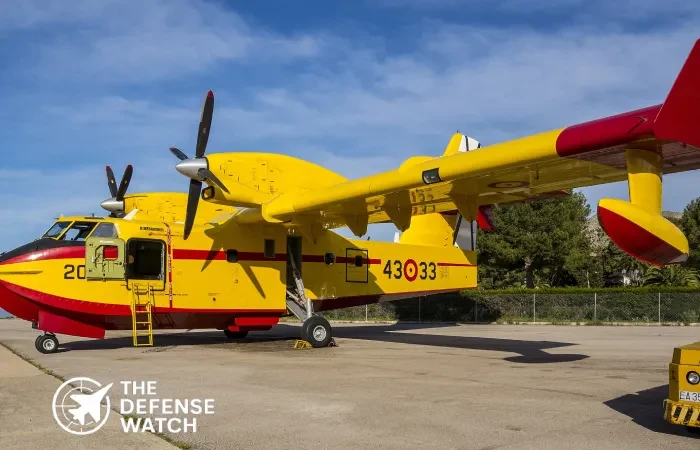
The Bombardier CL-415 stands as one of the world’s most iconic and purpose-built aerial firefighting aircraft. Manufactured originally by Bombardier Aerospace (Canadair division), the CL-415 was developed as an upgraded successor to the widely used CL-215. Tailored for high-risk wildfire operations, it remains a cornerstone capability for several nations requiring rapid-response aerial firefighting platforms.
Designed specifically for amphibious “scooper” missions, the CL-415 can land on water, scoop up to 6,137 liters (1,621 gallons) of water in just 12 seconds, and deploy it directly onto fire zones. Its reinforced hull and excellent low-speed handling allow it to operate effectively in rugged, mountainous environments where wildfires often intensify. Powered by two Pratt & Whitney PW123AF turboprop engines, the aircraft achieves a maximum speed of 224 mph (360 km/h) and offers strong climb performance even in high-temperature conditions.
The CL-415’s operational range and endurance enable repeated water-drop cycles, making it invaluable during extended wildfire emergencies. With a crew of two, the aircraft integrates modern avionics, improved flight controls, and enhanced visibility for low-altitude, high-precision operations. While the CL-415 carries no weapons—given its civilian and disaster-response focus—it serves in additional support roles including search and rescue and maritime patrol in some countries.
Its global operators include Canada, France, Italy, Greece, and Croatia, each leveraging the aircraft’s reliability during peak wildfire seasons. Although Bombardier discontinued production, the program was transferred to Viking Air (De Havilland Canada), which continues to maintain and support the fleet under an updated version known as the CL-415EAF.
Bombardier CL-41 Price
The Bombardier CL-415 typically ranges from $35 million to $40 million USD, depending on configuration, refurbishment level (for used units), and support packages. Newer upgraded variants, such as the CL-415EAF, may exceed this price range.
Disclaimer Note
The information provided on TheDefenseWatch.com is for general informational purposes only. While we strive to ensure the accuracy, completeness, and timeliness of our content regarding defense and aerospace products, technologies, and specifications, we cannot guarantee that all information is 100% accurate or up-to-date due to the evolving nature of military technology and classified data.TheDefenseWatch.com does not warrant the reliability, suitability, or availability of the information for any specific purpose. Users are advised to consult official sources, such as manufacturers, government publications, or defense agencies, for precise and verified data before making decisions based on our content.We are not affiliated with any defense manufacturers, governments, or military organizations mentioned. Opinions, reviews, and ratings reflect expert analysis but are subjective and should not be considered endorsements. TheDefenseWatch.com is not responsible for any errors, omissions, or consequences arising from the use of this website’s content.External links are provided for convenience and do not imply endorsement. TheDefenseWatch.com reserves the right to update or modify content without prior notice. By using this website, you agree to our Privacy & Cookies Policy.
New Arrivals
Popular Comparisons
-
 Tejas Fighter Jet vs F-16 Fighting Falcon: Capability Compared
View Comparison →
Tejas Fighter Jet vs F-16 Fighting Falcon: Capability Compared
View Comparison → -
Rafale Fighter Jet vs F-16 Fighting Falcon : Which Fighter Has the Edge?
View Comparison →
-
Su-57 Fighter Jet vs J-20 Fighter Jet: Stealth and Air Combat Compared
View Comparison →
-
Mirage 2000 vs Tejas Mk1A: Legacy Combat Power vs Indigenous Modernization
View Comparison →
-
Rafale Fighter Jet vs F-22 Raptor: Which Air Dominance Fighter Has the Edge?
View Comparison →
-
Tejas Fighter Jet vs. Rafale Fighter Jet: India’s Indigenous Fighter Meets France’s Proven Multirole Combat Aircraft
View Comparison →
-
F-22 Raptor vs. F-35 Joint Strike Fighter: Which Fifth Generation Fighter Has the Edge?
View Comparison →
-
F-35A vs. F-22 Raptor: Which U.S. Stealth Fighter Dominates Modern Air Combat?
View Comparison →
-
AGM-114 Hellfire vs. AGM-179 JAGM: Which U.S. Precision Missile Is Better?
View Comparison →
-
Patriot (PAC-3) vs. THAAD: Complete Missile Defense System Comparison, Capabilities, Range, and Strategic Roles
View Comparison →
- Bell Boeing Wins $19.8M V-22 Tactical Software Support Contract

- Honeywell Wins $53.9M Navy Contract for WSN-7 Gyro Components
- Lockheed Martin Wins $76.6M Trident II D5LE2 Development Contract
- Lockheed Martin Gets $871.2M F-35 Site Support Contract Increase
- Pete Hegseth Texas Enlistment Ceremony: Hegseth Tells Military Families, We Have Their Back
- U.S., Denmark and Greenland Reach Security Agreement to Expand American Military Presence
- SpaceX Wins Three More NASA Crew Missions in $946 Million ISS Contract
- U.S. Clears Potential $24.3 Billion F-35 Sale to Saudi Arabia
- Type 99B Tank Training Shows China’s Shift Toward Networked Armored Warfare
- JRC Integrated Systems Gets $47.4M SLCM-N Support Contract