
















@2026 – All Right Reserved. TheDefenseWatch.com
- Home
- Defense Systems
- Fighter Jets
- F-15C/D Eagle Fighter Jet
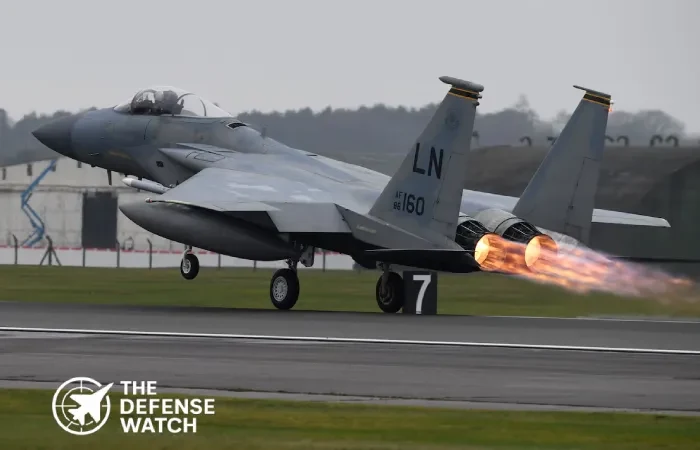
F-15C/D Eagle Fighter Jet
Defense Systems Full Specifications
General Information
| Name | F-15C/D Eagle |
| Manufacturer | McDonnell Douglas / Boeing |
| Country of Origin | United States |
| Type / Role | Air Superiority Fighter |
| Generation | 4th |
| Status | In Service |
| First Flight | July 27, 1972 |
| Introduction / In Service Since | 1979 |
| Number Built | 478 (C/D variants) |
| Operators | United States Air Force |
Dimensions & Structure
| Length | 63 ft 9 in (19.43 m) |
| Wingspan | 42 ft 10 in (13.05 m) |
| Height | 18 ft 6 in (5.64 m) |
| Wing Area | 608 sq ft (56.5 m²) |
| Empty Weight | 28,000 lb (12,700 kg) |
| Maximum Takeoff Weight (MTOW) | 68,000 lb (30,844 kg) |
| Internal Weapons Bay | None |
| External Hardpoints | 11 |
Performance
| Maximum Speed | Mach 2.5+ |
| Range | 3,450 mi (5,550 km) ferry |
| Combat Radius | 1,061 mi (1,708 km) |
| Service Ceiling | 65,000 ft (19,812 m) |
| Rate of Climb | 50,000 ft/min (254 m/s) |
| Thrust-to-Weight Ratio | 1.09 |
| G Limits | +9 |
Powerplant
| Engine Type | Pratt & Whitney F100-PW-220 |
| No. of Engines | 2 |
| Thrust (each) | 23,770 lbf (105.7 kN) |
| Thrust Vectoring | No |
| Fuel Capacity | 13,455 lb (6,100 kg) internal |
Armament
| Gun | M61A1 Vulcan 20mm |
| Missiles (Air-to-Air) | AIM-7 Sparrow, AIM-120 AMRAAM, AIM-9 Sidewinder |
| Missiles (Air-to-Ground) | Limited |
| Bombs | None (Air Superiority) |
| Hardpoints | 11 |
| Payload Capacity | 23,000 lb (10,430 kg) |
Avionics & Systems
| Radar | AN/APG-63 / AN/APG-70 |
| Radar Range | 100+ miles |
| Electronic Warfare (EW) System | ALQ-135 |
| Targeting System | Radar-guided |
| Helmet Display | Compatible |
| Navigation | INS / GPS |
| Autopilot / AI Assistance | Partial |
| Communication | UHF/VHF secure |
Stealth & Technology
| Radar Cross Section (RCS) | Medium |
| Stealth Features | None |
| Infrared Signature Reduction | Partial |
| Sensor Fusion | Limited |
| Networking Capabilities | Link-16 |
Variants
| Special Export Versions | F-15E Strike Eagle (multi-role) |
Operational History
| Major Conflicts / Deployments | Gulf War, Operation Allied Force, Iraq War |
| Notable Operators | USAF |
| Combat Proven? | Yes |
| Mission Types | Air superiority, interception |
Cost & Program
| Unit Cost | $29.5 million (1970s USD) |
| Development Cost | $1.5 billion |
| Program Name | F-X Program |
| Funding Countries | United States |
Additional Information
| Upgrades Planned | Radar modernization, digital cockpit |
| Future Replacement | F-15EX Eagle II |
| Export Restrictions | U.S. ITAR |
| Notable Achievements | 104 air-to-air kills, unmatched service record |
| Competitors | Su-35, Eurofighter Typhoon, F-22 |
PROS
- Exceptional air superiority capabilities
- High speed and maneuverability (Mach 2.5+)
- Advanced radar and avionics systems
- Combat-proven and reliable
- Flexible weapons loadout
CONS
- Non-stealth platform
- Limited air-to-ground strike capability
- Aging airframe (requires upgrades)
- High maintenance costs
- Vulnerable to modern integrated air defenses
F-15C/D Eagle Fighter Jet – US Air Superiority
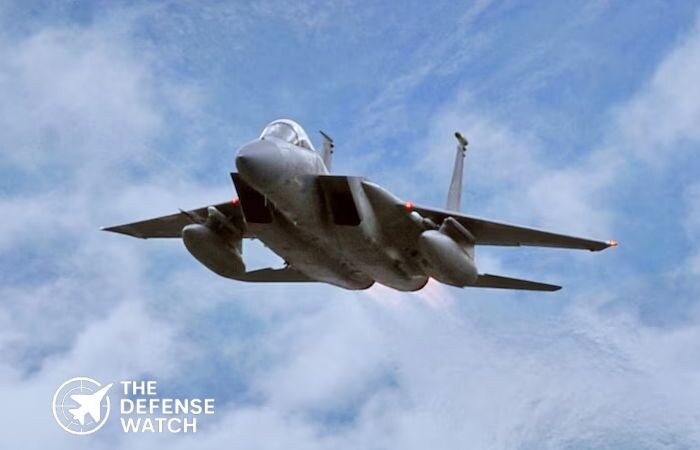
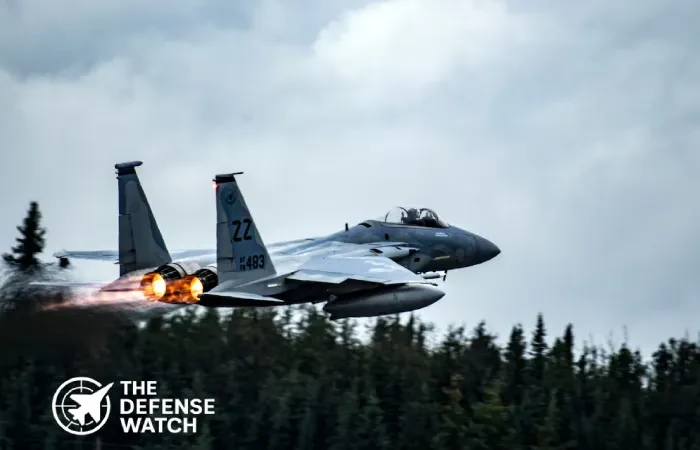
The F-15C/D Eagle remains one of the most formidable air superiority fighters in the U.S. Air Force arsenal. Developed by McDonnell Douglas (now Boeing), this twin-engine, supersonic fighter was designed for unmatched aerial combat performance. Since its introduction in the 1970s, the F-15C/D has been the backbone of U.S. air dominance, providing unparalleled speed, maneuverability, and weapons capability.
Originating from the United States, the F-15C is a single-seat variant, while the F-15D serves as a two-seat trainer and combat variant. Both models are purpose-built for air superiority missions, equipped with state-of-the-art radar and avionics systems, advanced electronic warfare (EW) suites, and a formidable weapons array. With a maximum speed exceeding Mach 2.5 and a combat radius of over 1,061 miles, the Eagle can intercept enemy aircraft rapidly while maintaining dominance in high-threat environments.
The fighter’s armament includes the M61A1 Vulcan 20mm cannon, AIM-7 Sparrow, AIM-120 AMRAAM, and AIM-9 Sidewinder missiles, providing multi-role air combat capability. Its twin Pratt & Whitney F100-PW-220 engines deliver exceptional thrust-to-weight ratio, enabling rapid climbs, tight turns, and superior dogfighting performance. Modern upgrades, including radar enhancements and network-centric warfare integration, keep the F-15C/D competitive in contemporary air combat scenarios.
Operationally, the F-15C/D Eagle has been deployed in numerous U.S. operations, consistently demonstrating combat reliability and effectiveness. Despite newer fifth-generation fighters entering service, the F-15C/D remains indispensable due to its proven performance, maintainability, and cost-effective operational footprint.
FAQs
Is the F-15 Eagle the fastest fighter jet?
No, the F-15 Eagle is extremely fast, capable of speeds over Mach 2.5, but it is not the fastest fighter jet in the world. Aircraft like the SR-71 Blackbird (Mach 3+) and experimental interceptors such as the MiG-25 Foxbat surpass it in raw top speed. The F-15’s strength lies in its balanced combination of speed, maneuverability, and air superiority capabilities, rather than outright velocity.
What happened to the F-15 Streak Eagle?
The F-15 Streak Eagle was a specialized record-breaking variant of the F-15 designed in the 1970s to set time-to-climb records. It had most of its combat equipment removed and some engines modified for maximum performance. Between 1975 and 1976, the Streak Eagle set 15 world time-to-climb records, some of which still stand. After the record attempts, the aircraft was retired from active testing and is now part of historical aviation archives.
Which country has the F-15 Eagle?
The United States is the primary operator of the F-15 Eagle, with both the F-15C single-seat and F-15D two-seat trainer/combat variants in service with the US Air Force. Other countries operate export variants, including Japan, Saudi Arabia, Qatar, and South Korea, but these are generally based on older or modified F-15C/D and F-15E Strike Eagle models.
Disclaimer Note
The information provided on TheDefenseWatch.com is for general informational purposes only. While we strive to ensure the accuracy, completeness, and timeliness of our content regarding defense and aerospace products, technologies, and specifications, we cannot guarantee that all information is 100% accurate or up-to-date due to the evolving nature of military technology and classified data.TheDefenseWatch.com does not warrant the reliability, suitability, or availability of the information for any specific purpose. Users are advised to consult official sources, such as manufacturers, government publications, or defense agencies, for precise and verified data before making decisions based on our content.We are not affiliated with any defense manufacturers, governments, or military organizations mentioned. Opinions, reviews, and ratings reflect expert analysis but are subjective and should not be considered endorsements. TheDefenseWatch.com is not responsible for any errors, omissions, or consequences arising from the use of this website’s content.External links are provided for convenience and do not imply endorsement. TheDefenseWatch.com reserves the right to update or modify content without prior notice. By using this website, you agree to our Privacy & Cookies Policy.
New Arrivals
Popular Comparisons
-
 Tejas Fighter Jet vs F-16 Fighting Falcon: Capability Compared
View Comparison →
Tejas Fighter Jet vs F-16 Fighting Falcon: Capability Compared
View Comparison → -
Rafale Fighter Jet vs F-16 Fighting Falcon : Which Fighter Has the Edge?
View Comparison →
-
Su-57 Fighter Jet vs J-20 Fighter Jet: Stealth and Air Combat Compared
View Comparison →
-
Mirage 2000 vs Tejas Mk1A: Legacy Combat Power vs Indigenous Modernization
View Comparison →
-
Rafale Fighter Jet vs F-22 Raptor: Which Air Dominance Fighter Has the Edge?
View Comparison →
-
Tejas Fighter Jet vs. Rafale Fighter Jet: India’s Indigenous Fighter Meets France’s Proven Multirole Combat Aircraft
View Comparison →
-
F-22 Raptor vs. F-35 Joint Strike Fighter: Which Fifth Generation Fighter Has the Edge?
View Comparison →
-
F-35A vs. F-22 Raptor: Which U.S. Stealth Fighter Dominates Modern Air Combat?
View Comparison →
-
AGM-114 Hellfire vs. AGM-179 JAGM: Which U.S. Precision Missile Is Better?
View Comparison →
-
Patriot (PAC-3) vs. THAAD: Complete Missile Defense System Comparison, Capabilities, Range, and Strategic Roles
View Comparison →
- Bell Boeing Wins $19.8M V-22 Tactical Software Support Contract

- Honeywell Wins $53.9M Navy Contract for WSN-7 Gyro Components
- Lockheed Martin Wins $76.6M Trident II D5LE2 Development Contract
- Lockheed Martin Gets $871.2M F-35 Site Support Contract Increase
- Pete Hegseth Texas Enlistment Ceremony: Hegseth Tells Military Families, We Have Their Back
- U.S., Denmark and Greenland Reach Security Agreement to Expand American Military Presence
- SpaceX Wins Three More NASA Crew Missions in $946 Million ISS Contract
- U.S. Clears Potential $24.3 Billion F-35 Sale to Saudi Arabia
- Type 99B Tank Training Shows China’s Shift Toward Networked Armored Warfare
- JRC Integrated Systems Gets $47.4M SLCM-N Support Contract