














@2026 – All Right Reserved. TheDefenseWatch.com
- Home
- Defense Systems
- Bombers & Strategic Aircraft
- EA-18G Growler
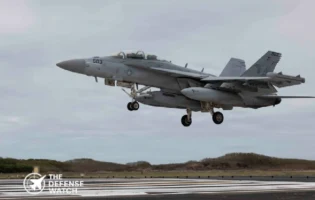
EA-18G Growler


Defense Systems Full Specifications
1. General Information
| Name | EA-18G Growler |
| Manufacturer | Boeing (with Northrop Grumman for EW suite) |
| Country of Origin | United States |
| Introduction / In Service Since | 2006 / 2009 |
| Status | In service |
| Category | Electronic warfare aircraft |
| Crew | 2 |
| Unit Cost | $67 million |
2. Dimensions & Structure
| Length | 60.2 ft (18.3 m) |
| Wingspan | 44.9 ft (13.7 m) |
| Height | 16 ft (4.9 m) |
| Wing Area | 500 sq ft (46.5 m²) |
| Empty Weight | 33,094 lb (15,011 kg) |
| Maximum Takeoff Weight (MTOW) | 66,000 lb (29,964 kg) |
3. Performance
| Maximum Speed | Mach 1.8 (1,030 kn at 40,000 ft) |
| Range | 1,275 nmi (ferry: 1,800 nmi) |
| Combat Radius | 390 nmi (interdiction) |
| Service Ceiling | 50,000 ft |
| Rate of Climb | Not specified (approx. 50,000 ft/min equivalent from Super Hornet baseline) |
4. Powerplant
| Engine Type | 2 × General Electric F414-GE-400 turbofans |
| Thrust (per engine) | 22,000 lbf (98 kN) with afterburner |
| Total Thrust | 44,000 lbf (196 kN) |
5. Payload & Armament
| Internal Payload Capacity | N/A (external focus) |
| Weapons Bay | None (external hardpoints) |
| Compatible Weapons | AIM-120 AMRAAM, AGM-88 HARM, ALQ-99 pods, AGM-154 JSOW |
| Hardpoints | 9 (6 under-wing, 3 under-fuselage) |
6. Avionics & Systems
| Radar System | AN/APG-79 AESA |
| Navigation | Integrated GPS/INS with TTNT datalink |
| Electronic Warfare (EW) | ALQ-218 receivers, ALQ-99 pods, NGJ upgrade |
| Stealth Features | None (relies on jamming for low observability) |
7. Operational History
| Primary Operator | U.S. Navy (VAQ squadrons) |
| Conflict Usage | Operation Odyssey Dawn (Libya, 2011), Inherent Resolve (Iraq/Syria), Prosperity Guardian (Red Sea) |
| Notable Missions | First Growler air-to-air kill (Houthi drone, 2024); No-fly zone enforcement in Libya |
8. Additional Information
| Variants | Block II (with ACS and NGJ-MB) |
| Successor / Future Replacement | None planned; service life to 2046 |
| Notable Features | Interference Cancellation System (INCANS) for jammed comms |
| Estimated Operational Life | 6,000+ flight hours per airframe |
PROS
- Spectrum Dominance: Full-spectrum jamming disrupts enemy radars and communications, enabling safe passage for allied strikes.
- Platform Commonality: Over 90% shared parts with F/A-18F Super Hornet simplify logistics, training, and upgrades.
- Self-Protection: Carries AIM-120 missiles for air-to-air defense, blending EW with fighter agility.
- Networked Operations: Tactical Targeting Network Technology (TTNT) allows real-time data sharing among multiple Growlers.
- Proven Combat Record: Extensive deployments in Libya, Iraq, Syria, and the Red Sea validate reliability in high-threat environments.
CONS
- Pod Reliability Issues: ALQ-99 jamming pods suffer frequent failures, necessitating undetected fault missions and increased maintenance.
- Performance Trade-offs: Heavy EW loads reduce top speed and increase crew workload during radar interference.
- Crew Reduction: Two-person cockpit (vs. four in EA-6B) limits multitasking in complex EW scenarios.
- Vulnerability to Advanced Threats: Legacy pods may struggle against next-gen digital radars without full NGJ integration.
- High Sustainment Costs: Electronic systems demand specialized technicians, elevating operational expenses over basic fighters.
EA-18G Growler: Navy’s EW Powerhouse
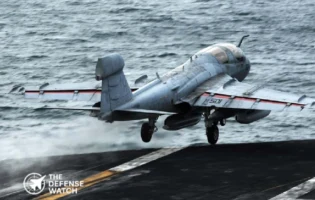
In the high-stakes arena of modern aerial combat, where radar signals and communications can mean the difference between victory and vulnerability, the EA-18G Growler emerges as a silent guardian. This carrier-based electronic warfare (EW) aircraft doesn’t seek direct confrontation; instead, it disrupts enemy defenses from afar, clearing paths for strike packages and protecting allied forces. Derived from the battle-proven F/A-18F Super Hornet, the Growler transforms a multirole fighter into a precision tool for spectrum dominance, embodying the U.S. Navy’s commitment to technological edge in contested airspace.
Manufactured by Boeing in St. Louis, Missouri, with key contributions from Northrop Grumman for the EW suite, the EA-18G traces its origins to a 2001 U.S. Navy requirement to replace the aging EA-6B Prowler. First flying in 2006, it achieved initial operational capability in 2009 and entered full production shortly after. Its primary purpose is airborne electronic attack (AEA), including radar jamming, communications disruption, and electronic protection for joint forces. The Growler excels in standoff and escort roles, using a full-spectrum EW suite to detect, geolocate, and neutralize threats.
Key capabilities include a top speed of Mach 1.8 (1,030 knots at 40,000 feet), enabling rapid repositioning in dynamic battlespaces. Its combat radius reaches approximately 390 nautical miles for interdiction missions, extendable to 850+ nautical miles with external tanks and optimized loads. Powered by two General Electric F414-GE-400 turbofans delivering 44,000 pounds of total thrust, it achieves a service ceiling of 50,000 feet. Armament focuses on self-defense and secondary strikes: up to two AIM-120 AMRAAM air-to-air missiles, two AGM-88 HARM anti-radiation missiles, and three ALQ-99 tactical jamming pods, with a total external payload of 17,750 pounds across nine hardpoints. Advanced avionics, such as the AN/APG-79 AESA radar and AN/ALQ-218 receivers, provide superior situational awareness, while the Next Generation Jammer (NGJ) upgrade enhances mid-band jamming against evolving threats.
Operationally, the Growler has proven indispensable since its combat debut in Operation Odyssey Dawn over Libya in 2011, where it enforced no-fly zones by suppressing air defenses. It supported Operations Inherent Resolve in Iraq and Syria, and more recently, Operation Prosperity Guardian in the Red Sea, achieving the first air-to-air kill by a Growler against a Houthi drone in 2024. Primarily operated by U.S. Navy squadrons at Naval Air Station Whidbey Island— with one forward-deployed to Japan—and the Royal Australian Air Force’s No. 6 Squadron, it underscores America’s export of cutting-edge EW technology to allies.
EA-18G Growler Price in US
The EA-18G Growler’s unit cost stands at approximately $67 million per aircraft, reflecting its integration of the robust F/A-18F airframe with specialized EW systems like the ALQ-99 pods and ALQ-218 receivers. This pricing accounts for production efficiencies from shared Super Hornet components, which exceed 90% commonality, reducing long-term sustainment expenses. Recent contracts, such as Australia’s 2022 replacement purchase at up to $125 million, highlight inflation and upgrade factors, but U.S. Navy procurements benefit from multi-year deals that stabilize costs around the $67 million baseline. For defense analysts and procurement specialists, this investment yields unmatched return in electromagnetic superiority, with lifecycle support extending operational readiness through 2046.
Disclaimer Note
The information provided on TheDefenseWatch.com is for general informational purposes only. While we strive to ensure the accuracy, completeness, and timeliness of our content regarding defense and aerospace products, technologies, and specifications, we cannot guarantee that all information is 100% accurate or up-to-date due to the evolving nature of military technology and classified data.TheDefenseWatch.com does not warrant the reliability, suitability, or availability of the information for any specific purpose. Users are advised to consult official sources, such as manufacturers, government publications, or defense agencies, for precise and verified data before making decisions based on our content.We are not affiliated with any defense manufacturers, governments, or military organizations mentioned. Opinions, reviews, and ratings reflect expert analysis but are subjective and should not be considered endorsements. TheDefenseWatch.com is not responsible for any errors, omissions, or consequences arising from the use of this website’s content.External links are provided for convenience and do not imply endorsement. TheDefenseWatch.com reserves the right to update or modify content without prior notice. By using this website, you agree to our Privacy & Cookies Policy.
New Arrivals
Popular Comparisons
-
 Tejas Fighter Jet vs F-16 Fighting Falcon: Capability Compared
View Comparison →
Tejas Fighter Jet vs F-16 Fighting Falcon: Capability Compared
View Comparison → -
Rafale Fighter Jet vs F-16 Fighting Falcon : Which Fighter Has the Edge?
View Comparison →
-
Su-57 Fighter Jet vs J-20 Fighter Jet: Stealth and Air Combat Compared
View Comparison →
-
Mirage 2000 vs Tejas Mk1A: Legacy Combat Power vs Indigenous Modernization
View Comparison →
-
Rafale Fighter Jet vs F-22 Raptor: Which Air Dominance Fighter Has the Edge?
View Comparison →
-
Tejas Fighter Jet vs. Rafale Fighter Jet: India’s Indigenous Fighter Meets France’s Proven Multirole Combat Aircraft
View Comparison →
-
F-22 Raptor vs. F-35 Joint Strike Fighter: Which Fifth Generation Fighter Has the Edge?
View Comparison →
-
F-35A vs. F-22 Raptor: Which U.S. Stealth Fighter Dominates Modern Air Combat?
View Comparison →
-
AGM-114 Hellfire vs. AGM-179 JAGM: Which U.S. Precision Missile Is Better?
View Comparison →
-
Patriot (PAC-3) vs. THAAD: Complete Missile Defense System Comparison, Capabilities, Range, and Strategic Roles
View Comparison →
- Type 99B Tank Training Shows China’s Shift Toward Networked Armored Warfare

- JRC Integrated Systems Gets $47.4M SLCM-N Support Contract
- GE Aerospace Says CPP Deal Is Not a Blueprint for Broader Integration
- Lockheed Martin Receives First PAC-3 MSE Components From GM Defense
- NORAD F-16s Deploy From Alaska to High North Under Arctic Vanguard
- Lockheed Martin and U.S. move to accelerate AIM-260 production
- Operation Epic Fury Exposes U.S. Munitions Shortfalls and Industrial Bottlenecks
- General Dynamics Wins $13.8M Navy Undersea Warfare Contract
- Lockheed Martin Wins $19.3M H-1 Helicopter Electronics Contract
- Saab Secures $51.45 Million U.S. Navy Deal For Multi-Mode Radar