








@2026 – All Right Reserved. TheDefenseWatch.com
- Home
- Defense Systems
- Future / Concept Weapons
- MQ-28 Ghost Bat
MQ-28 Ghost Bat
Defense Systems Full Specifications
1) Basic / Identification
| Name | MQ-28 Ghost Bat (Loyal Wingman) |
| Designation | MQ-28A |
| Manufacturer / Developer | Boeing Defence Australia |
| Country / Lead partner | Australia (with U.S. collaboration) |
| Type / Role | Autonomous Combat Drone / Loyal Wingman |
| Status | Prototype / Early Production |
| Program Start | 2019 |
| Estimated unit cost | est. $10–15 million USD |
| Public Source / Reference | Boeing, RAAF Press Releases |
2) Performance & Capabilities
| Operational Concept | Manned-unmanned teaming, air escort, ISR, EW |
| Effective Range / Engagement Envelope | ~3,700 km |
| Speed / Response Time | Subsonic (~Mach 0.8) |
| Endurance / Sustained Operation | ~6–8 hours |
| Precision / Accuracy | AI-assisted targeting |
| Mobility / Basing | Airfield / runway operations |
3) Propulsion / Power / Energy
| Power Source | Jet turbine |
| Power Output | Classified |
| Propulsion Type | Conventional turbojet |
| Fuel / Energy Storage | Jet fuel (internal tanks) |
4) Payload / Kill Mechanism
| Primary Effect | Kinetic strike or electronic warfare |
| Payload Mass / Warhead | ~500 kg (modular) |
| Guidance / Targeting | AI, EO/IR, RF, data-linked |
| Multi-mode Capability | ISR + EW + Strike |
5) Sensors, Avionics & Autonomy
| Sensors | AESA radar, EO/IR suite |
| Autonomy Level | Supervised autonomy |
| AI Features | Threat ID, route optimization, swarm coordination |
| Communications & Datalinks | SATCOM, Link-16 compatible, anti-jamming mesh network |
6) Survivability & Countermeasures
| Signature Reduction | Stealth shaping, radar-absorbent materials |
| Defensive Systems | EW suite, decoys |
| Resilience | Cyber hardening, redundant systems |
7) Integration & Interoperability
| Integration | Manned fighters, AWACS, C2 networks |
| Suitable Platforms | F-35, F/A-18, EA-18G |
| Interoperability Standards | Link-16, NATO compatible |
| Upgrade Path | Open architecture, modular avionics |
8) Legal / Ethical / Policy Notes
| Export Control | Subject to U.S. ITAR and Australian restrictions |
| Legal/Ethical Flags | Autonomous lethal engagement review |
| Policy Implications | AI use in combat, arms race acceleration |
9) Operational / Program Notes
| Notable Tests / Milestones | First flight 2021; RAAF integration testing 2023–2024 |
| Expected IOC (if given) | 2025 (est.) |
| Partners / Contractors | Boeing, RAAF, DST Group |
| Remarks | May influence USAF’s Collaborative Combat Aircraft (CCA) program |
PROS
- AI-driven autonomous operations
- Modular payload configuration
- Stealth and low-RCS design
- Cost-effective alternative to manned jets
- Manned-unmanned teaming capability
CONS
- Still in prototype stage
- Limited proven combat record
- Payload capacity constraints
- Dependent on secure datalink integrity
- Regulatory hurdles for autonomous missions
MQ-28 Ghost Bat Loyal Wingman Combat Drone
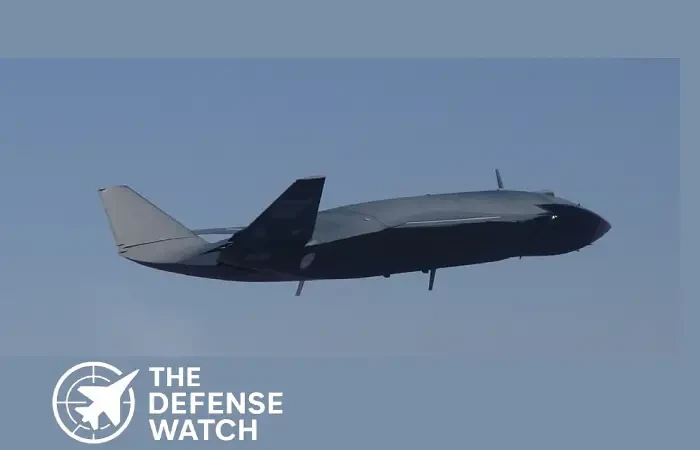
Developed by Boeing Defence Australia in partnership with the Royal Australian Air Force (RAAF), the MQ-28 Ghost Bat, also known as the Loyal Wingman, represents a new era of autonomous air combat. Designed to operate alongside manned aircraft such as the F-35, F/A-18F, or EA-18G, it enhances mission survivability, extends sensor coverage, and delivers flexible strike options.
The MQ-28 features stealth shaping, AI-driven autonomy, and modular payload bays, enabling diverse missions — from surveillance and electronic warfare to precision strike. Its range exceeds 2,000 nautical miles (3,700 km), and it can reach subsonic speeds while maintaining a radar-evading profile.
Powered by a single jet engine, the Ghost Bat is capable of semi-independent operations, coordinating with human pilots through secure data links and machine learning algorithms. The aircraft can carry sensor pods, jamming modules, or precision munitions, depending on mission requirements.
The RAAF’s Loyal Wingman project achieved its first flight in 2021, marking Australia’s first domestically developed combat aircraft in over 50 years. Its open architecture design allows for rapid reconfiguration, supporting allied integration under U.S. and Five Eyes defense cooperation frameworks.
The MQ-28 Ghost Bat is not only a technological leap for unmanned teaming but also a template for the U.S. Air Force’s Collaborative Combat Aircraft (CCA) initiative, potentially shaping future air dominance strategies.
MQ-28 Ghost Bat Price in US
The estimated unit cost of the MQ-28 Ghost Bat Loyal Wingman is projected between $10–15 million (USD), depending on configuration and payload systems. This cost makes it a cost-effective force multiplier compared to traditional fighter jets, offering high capability at a fraction of the price.
Disclaimer Note
The information provided on TheDefenseWatch.com is for general informational purposes only. While we strive to ensure the accuracy, completeness, and timeliness of our content regarding defense and aerospace products, technologies, and specifications, we cannot guarantee that all information is 100% accurate or up-to-date due to the evolving nature of military technology and classified data.TheDefenseWatch.com does not warrant the reliability, suitability, or availability of the information for any specific purpose. Users are advised to consult official sources, such as manufacturers, government publications, or defense agencies, for precise and verified data before making decisions based on our content.We are not affiliated with any defense manufacturers, governments, or military organizations mentioned. Opinions, reviews, and ratings reflect expert analysis but are subjective and should not be considered endorsements. TheDefenseWatch.com is not responsible for any errors, omissions, or consequences arising from the use of this website’s content.External links are provided for convenience and do not imply endorsement. TheDefenseWatch.com reserves the right to update or modify content without prior notice. By using this website, you agree to our Privacy & Cookies Policy.
New Arrivals
-
 PAC-2 Patriot Missile System
-
Patriot PAC-3 Missile Defense System
-
EA-18G Growler
-
J-50 Fighter Jet
-
Northrop Grumman GHOST-R GEO Recon Satellite
-
A-50 Mainstay Aircraft
-
Spanish EF-18 Hornet Fighter
-
Trident II D5 Missile
-
B-21 Raider Bomber
-
F-47 Fighter Jet
-
F-35i Adir Fighter Jet
-
Type 99B Main Battle Tank
Popular Comparisons
-
 Tejas Fighter Jet vs F-16 Fighting Falcon: Capability Compared
View Comparison →
Tejas Fighter Jet vs F-16 Fighting Falcon: Capability Compared
View Comparison → -
Rafale Fighter Jet vs F-16 Fighting Falcon : Which Fighter Has the Edge?
View Comparison →
-
Su-57 Fighter Jet vs J-20 Fighter Jet: Stealth and Air Combat Compared
View Comparison →
-
Mirage 2000 vs Tejas Mk1A: Legacy Combat Power vs Indigenous Modernization
View Comparison →
-
Rafale Fighter Jet vs F-22 Raptor: Which Air Dominance Fighter Has the Edge?
View Comparison →
-
Tejas Fighter Jet vs. Rafale Fighter Jet: India’s Indigenous Fighter Meets France’s Proven Multirole Combat Aircraft
View Comparison →
-
F-22 Raptor vs. F-35 Joint Strike Fighter: Which Fifth Generation Fighter Has the Edge?
View Comparison →
-
F-35A vs. F-22 Raptor: Which U.S. Stealth Fighter Dominates Modern Air Combat?
View Comparison →
-
AGM-114 Hellfire vs. AGM-179 JAGM: Which U.S. Precision Missile Is Better?
View Comparison →
-
Patriot (PAC-3) vs. THAAD: Complete Missile Defense System Comparison, Capabilities, Range, and Strategic Roles
View Comparison →
- X-Planes in the Drone Era: Why Experimental Aircraft Still Matter

- France to Deploy Troops, Radar and Air Defense to Protect Saudi Yanbu Oil Hub
- Greek-Operated Patriot Intercepts Ballistic Missile and Drone Over Saudi Arabia
- Raytheon Wins $50.1 Million Navy Order for EA-18G Next Generation Jammer Repairs
- Stark Aerospace Wins $114 Million MK 41 VLS Canister Contract
- Northrop Grumman Wins $123.8M F-35 APG-85 Lot 7 Radar Contract
- Leonardo, Fincantieri Win €3.7B Contract for Two Italian Navy DDX Destroyers
- Finnish President Urges Musk to Expand Starlink Access for Ukraine to Target Russian Missile Launchers
- MV-22B Osprey Completes First Navy Sonobuoy Acceptance Test
- Saab expands Swedish space role through new partnerships with SSC Space, OHB Sweden and Ericsson