










@2026 – All Right Reserved. TheDefenseWatch.com
- Home
- Defense Systems
- Fighter Jets
- F-14 Tomcat Fighter Jet
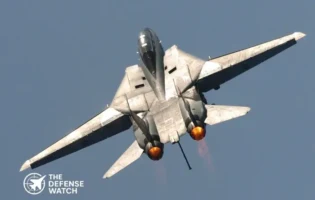
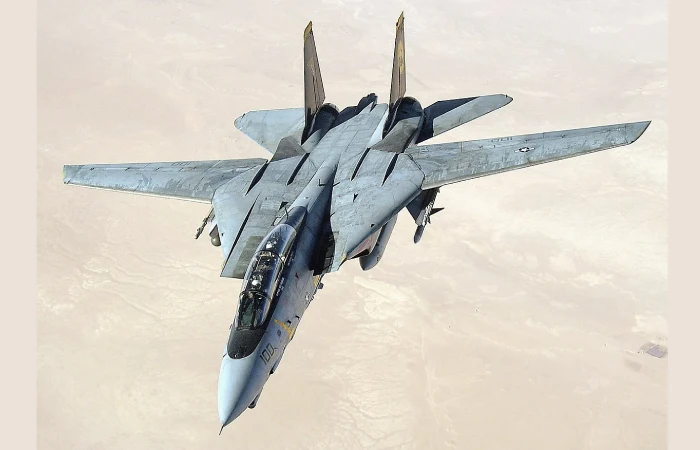
F-14 Tomcat Fighter Jet
Defense Systems Full Specifications
General Information
| Name | F-14 Tomcat |
| Manufacturer | Grumman Aerospace |
| Country of Origin | United States |
| Type / Role | Carrier-based air superiority & fleet defense fighter |
| Generation | 3rd–4th generation |
| Status | Retired (U.S.), Active (Iran) |
| First Flight | 1970 |
| Introduction / In Service Since | 974 |
| Number Built | 712 |
| Operators | U.S. Navy (retired), Iran |
Dimensions & Structure
| Length | 62 ft 8 in |
| Wingspan | 38–64 ft (variable) |
| Height | 16 ft |
| Wing Area | 565 sq ft |
| Empty Weight | ~43,735 lbs |
| Maximum Takeoff Weight (MTOW) | 74,350 lbs |
| Internal Weapons Bay | No dedicated bay |
| External Hardpoints | 10 |
Performance
| Maximum Speed | Mach 2.34 |
| Range | 1,600+ miles |
| Combat Radius | ~500 miles |
| Service Ceiling | 50,000+ ft |
| Rate of Climb | ~45,000 ft/min |
| Thrust-to-Weight Ratio | Up to 0.91 (F110 engines) |
| G Limits | +7.5 |
Powerplant
| Engine Type | Turbofan |
| No. of Engines | 2 |
| Thrust (each) | 20,900 lbf (F110 engines) |
| Thrust Vectoring | No |
| Fuel Capacity | ~16,200 lbs internal |
Armament
| Gun | 20mm M61A1 Vulcan |
| Missiles (Air-to-Air) | AIM-54 Phoenix, AIM-7 Sparrow, AIM-9 Sidewinder |
| Missiles (Air-to-Ground) | LANTIRN-guided bombs (late service) |
| Bombs | JDAM, LGBs (late variants) |
| Hardpoints | 10 |
| Payload Capacity | ~14,500 lbs |
Avionics & Systems
| Radar | AN/AWG-9 |
| Radar Range | 200+ miles |
| Electronic Warfare (EW) System | ALR-67 RWR, ALQ-126 |
| Targeting System | LANTIRN (F-14B/D) |
| Helmet Display | Basic HUD (no HMD) |
| Navigation | INS/GPS (later upgrades) |
| Autopilot / AI Assistance | Basic autopilot |
| Communication | UHF/VHF, data link (later) |
Stealth & Technology
| Radar Cross Section (RCS) | Large (non-stealth) |
| Stealth Features | None |
| Infrared Signature Reduction | Minimal |
| Sensor Fusion | Limited |
| Networking Capabilities | Upgraded in later variants |
Variants
| Special Export Versions | Limited; Iran received F-14A only |
Operational History
| Major Conflicts / Deployments | Desert Storm, Southern Watch, Enduring Freedom, Iraqi Freedom |
| Notable Operators | U.S. Navy |
| Combat Proven? | Yes |
| Mission Types | Air superiority, fleet defense, escort, strike |
Cost & Program
| Unit Cost | ~$38 million (1998 dollars) |
| Development Cost | ~$1.9 billion |
| Program Name | Naval Fighter Experimental (VFX) |
| Funding Countries | United States |
Additional Information
| Upgrades Planned | None (retired) |
| Future Replacement | F/A-18E/F Super Hornet |
| Export Restrictions | Strict; only Iran received exports |
| Notable Achievements | Longest-range AAM capability of its era |
| Competitors | MiG-23/25, Su-27, F-15 |
PROS
- Superior long-range air interception capability
- Advanced radar and missile systems for its era
- Iconic variable-sweep wing design
- Excellent speed and climb rate
- Proven carrier-based reliability
CONS
- High maintenance requirements
- Fuel-hungry engines
- Limited multirole flexibility
- Aging avionics by modern standards
- Complex flight systems increased operational costs
F-14 Tomcat: Iconic US Navy Fleet Defense Fighter
The Grumman F-14 Tomcat remains one of the most recognizable fighter jets in aviation history. Designed for the U.S. Navy as a carrier-based air superiority and fleet defense aircraft, it first flew in 1970 and entered service in 1974. The F-14’s distinct variable-geometry wings, powerful twin Pratt & Whitney TF30 (later GE F110) engines, and advanced radar system made it a cornerstone of American naval aviation throughout the Cold War and beyond.
Developed by Grumman Aerospace Corporation, the F-14 was conceived to replace the F-4 Phantom II and counter Soviet long-range bombers and cruise missiles. It was the first fighter equipped with the AN/AWG-9 radar and capable of firing the AIM-54 Phoenix missile, enabling it to engage multiple targets at ranges exceeding 100 miles.
The aircraft’s maximum speed of Mach 2.34, operational range of 1,600 miles, and combat radius of 500 miles made it ideal for long-range interception. Its two-seat configuration allowed the pilot and radar intercept officer (RIO) to manage complex radar and weapons systems effectively.
The Tomcat served as the primary naval air defense fighter until its retirement in 2006, replaced by the F/A-18E/F Super Hornet. Despite its withdrawal, the F-14 remains operational with the Islamic Republic of Iran Air Force, showcasing its enduring legacy.
F-14 Tomcat Price in United States
The final unit cost of the F-14 Tomcat in U.S. service averaged around $38 million (1990s value). Adjusted for inflation, the estimated cost would exceed $70 million today, reflecting the aircraft’s complex systems and pioneering technology that defined an era of American naval dominance.
Disclaimer Note
The information provided on TheDefenseWatch.com is for general informational purposes only. While we strive to ensure the accuracy, completeness, and timeliness of our content regarding defense and aerospace products, technologies, and specifications, we cannot guarantee that all information is 100% accurate or up-to-date due to the evolving nature of military technology and classified data.TheDefenseWatch.com does not warrant the reliability, suitability, or availability of the information for any specific purpose. Users are advised to consult official sources, such as manufacturers, government publications, or defense agencies, for precise and verified data before making decisions based on our content.We are not affiliated with any defense manufacturers, governments, or military organizations mentioned. Opinions, reviews, and ratings reflect expert analysis but are subjective and should not be considered endorsements. TheDefenseWatch.com is not responsible for any errors, omissions, or consequences arising from the use of this website’s content.External links are provided for convenience and do not imply endorsement. TheDefenseWatch.com reserves the right to update or modify content without prior notice. By using this website, you agree to our Privacy & Cookies Policy.
More Defense Systems from Grumman Aerospace Corporation
New Arrivals
Popular Comparisons
-
 Tejas Fighter Jet vs F-16 Fighting Falcon: Capability Compared
View Comparison →
Tejas Fighter Jet vs F-16 Fighting Falcon: Capability Compared
View Comparison → -
Rafale Fighter Jet vs F-16 Fighting Falcon : Which Fighter Has the Edge?
View Comparison →
-
Su-57 Fighter Jet vs J-20 Fighter Jet: Stealth and Air Combat Compared
View Comparison →
-
Mirage 2000 vs Tejas Mk1A: Legacy Combat Power vs Indigenous Modernization
View Comparison →
-
Rafale Fighter Jet vs F-22 Raptor: Which Air Dominance Fighter Has the Edge?
View Comparison →
-
Tejas Fighter Jet vs. Rafale Fighter Jet: India’s Indigenous Fighter Meets France’s Proven Multirole Combat Aircraft
View Comparison →
-
F-22 Raptor vs. F-35 Joint Strike Fighter: Which Fifth Generation Fighter Has the Edge?
View Comparison →
-
F-35A vs. F-22 Raptor: Which U.S. Stealth Fighter Dominates Modern Air Combat?
View Comparison →
-
AGM-114 Hellfire vs. AGM-179 JAGM: Which U.S. Precision Missile Is Better?
View Comparison →
-
Patriot (PAC-3) vs. THAAD: Complete Missile Defense System Comparison, Capabilities, Range, and Strategic Roles
View Comparison →
- Raytheon Wins $50.1 Million Navy Order for EA-18G Next Generation Jammer Repairs

- Stark Aerospace Wins $114 Million MK 41 VLS Canister Contract
- Northrop Grumman Wins $123.8M F-35 APG-85 Lot 7 Radar Contract
- Leonardo, Fincantieri Win €3.7B Contract for Two Italian Navy DDX Destroyers
- Finnish President Urges Musk to Expand Starlink Access for Ukraine to Target Russian Missile Launchers
- MV-22B Osprey Completes First Navy Sonobuoy Acceptance Test
- Saab expands Swedish space role through new partnerships with SSC Space, OHB Sweden and Ericsson
- Russian Mi-8 Briefly Enters Polish Airspace, Prompting Fighter Scramble
- Last A-10 Warthog Departs Nellis, Closing a 49-Year Close Air Support Era
- British Arms Broker Jailed 16 Years Over Illegal Missile and Fighter Jet Deals