

Takeaways
Key facts from the contract announcement
1. $20.7 Billion Multi-Year Agreement
Raytheon has been awarded a five-year AMRAAM multi-year contract with two option years valued at up to $20.7 billion.
2. AMRAAM Production to Reach at Least 1,900 Annually
RTX says the agreement supports annual production of at least 1,900 AMRAAM missiles, representing a major expansion of manufacturing capacity.
Raytheon Awarded $20.7B AMRAAM Multi-Year Contract
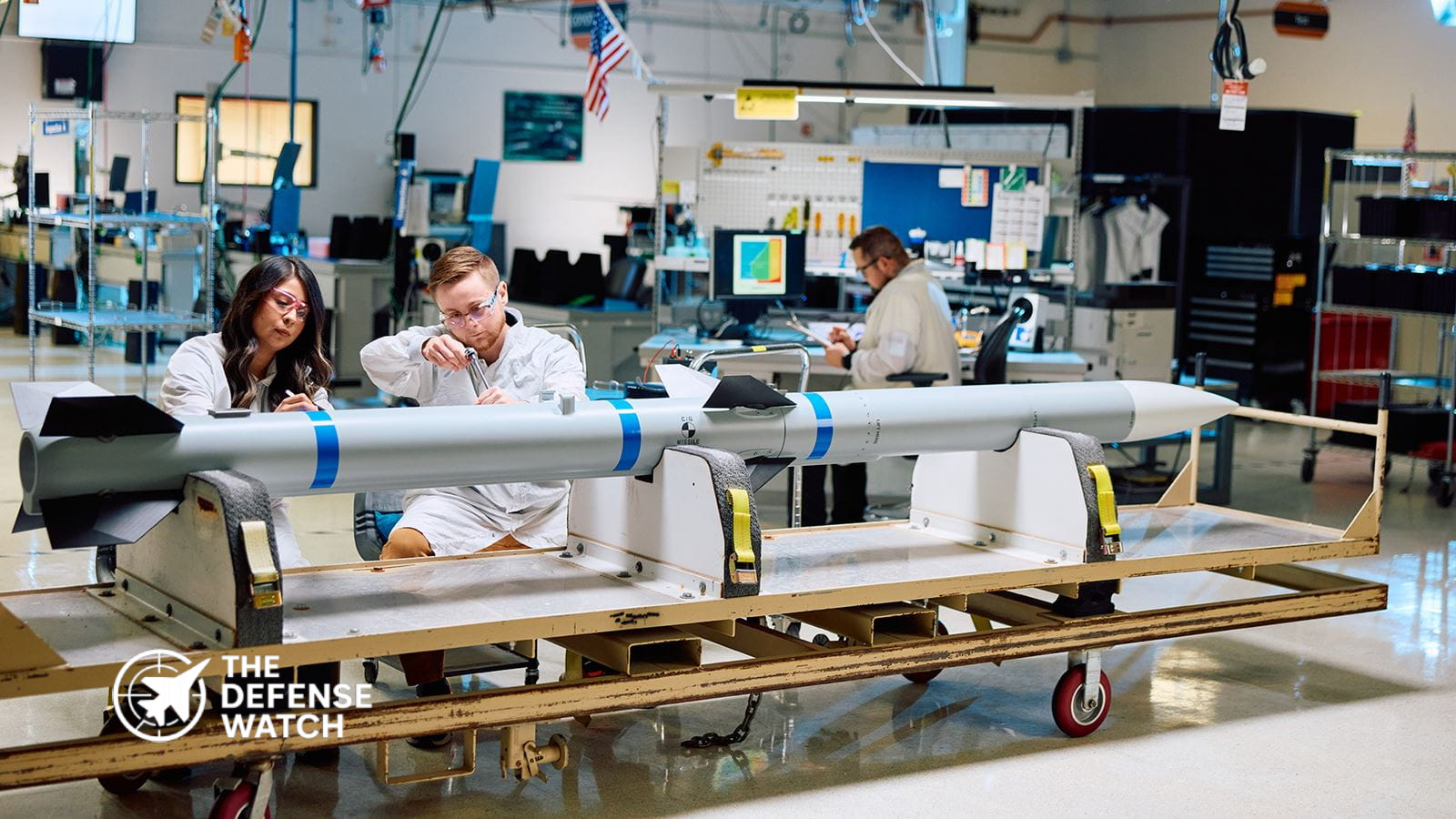
Raytheon, an RTX business, has been awarded a five-year multi-year contract with two option years valued at up to $20.7 billion to accelerate production of the Advanced Medium-Range Air-to-Air Missile, or AMRAAM.
RTX announced the agreement on Sept. 28, 2026, describing it as part of the Department of War’s Arsenal of Freedom initiative. The company said the contract supports an annual production rate of at least 1,900 AMRAAM missiles.
The announcement came from RTX and Raytheon. The announcement did not disclose a specific amount of funding obligated at award, a detailed delivery schedule, or a missile quantity associated with the full $20.7 billion value.
Scope of the Raytheon AMRAAM Contract
The agreement is intended to expand and sustain AMRAAM production over a multi-year period. RTX said the five-year contract includes two option years, giving the agreement a potential seven-year duration if all options are exercised. The stated value is up to $20.7 billion.
The contract follows a framework agreement announced by Raytheon and the Department of War in February 2026. That earlier agreement established a plan to raise annual AMRAAM production to at least 1,900 missiles. RTX said the latest contract turns that production framework into a multi-year procurement arrangement.
The $20.7 billion figure should therefore be understood as the maximum stated value of the multi-year arrangement, including its option years, rather than money already spent by the U.S. government.
AMRAAM Technical and Operational Context
AMRAAM is a radar-guided, beyond-visual-range air-to-air missile used by both the U.S. Air Force and U.S. Navy. The U.S. Department of Defense describes it as a joint Air Force and Navy program led by the Air Force and identifies its mission as engaging low- and high-altitude, high-speed targets in electronic countermeasures environments.
The current AMRAAM family includes the AIM-120D, which incorporates improvements including a two-way data link, GPS-enhanced inertial navigation, an expanded no-escape envelope and increased range compared with earlier variants.
RTX said the fifth-generation AMRAAM is deployed on 14 platforms and is fielded by 44 countries. The company also reported more than 7,000 successful live fires in testing and combat. Those figures are company-reported and are not independently established by the contract announcement.
AMRAAM also has a ground-based air defense role. It serves as the primary interceptor for the NASAMS air defense system, extending the missile’s role beyond aircraft-launched air-to-air engagements.
Operational Impact on U.S. Air Force and U.S. Navy Air Combat
For the U.S. Air Force and Navy, higher AMRAAM production provides a mechanism for expanding inventories of a weapon already integrated with existing fighter fleets and air defense systems.
The Defense Department’s FY2026 weapons budget identified AMRAAM as a continuing multi-year procurement program supporting both the Air Force and Navy. That budget planned procurement of 534 missiles in FY2026, including 483 procurement missiles in the displayed Air Force and Navy procurement totals.
The new production target of at least 1,900 missiles annually is substantially larger than those annual quantities shown in the FY2026 budget documentation. The difference reflects the shift from individual annual procurement planning toward the much larger production expansion described by RTX.
From an acquisition perspective, a multi-year arrangement can provide industry with greater visibility into future demand than isolated annual purchases. That can support investments in manufacturing capacity, tooling, suppliers and workforce. However, the announcement does not establish that every option will be exercised or that the full $20.7 billion value will ultimately be obligated.
Contract Breakdown: Raytheon AMRAAM Award Details
Contract Value
The agreement is valued at up to $20.7 billion and covers a five-year multi-year contract with two option years.
Contractor
The contractor is Raytheon, an RTX business.
Contract Type
RTX describes the award as a five-year multi-year contract with two option years. The company announcement does not provide the full Federal Acquisition Regulation contract-type classification, such as firm-fixed-price or cost-plus structure.
Work Locations
RTX’s February 2026 framework announcement identified production activities associated with its critical-munitions expansion at Raytheon facilities in Tucson, Arizona; Huntsville, Alabama; and Andover, Massachusetts.
The September announcement did not provide a project-specific percentage breakdown of work among those locations.
Performance Period
The base agreement covers five years, with two option years, for a potential total period of seven years.
The announcement did not disclose specific contract start and completion dates.
Funding
The announcement did not disclose the amount of funds obligated at award or provide a detailed funding breakdown by fiscal year, service or customer.
Options Or Follow-On Work
The contract contains two option years. Exercising those options would extend the agreement beyond the five-year base period. The announcement does not state that the options have already been exercised.
Raytheon Defense Industrial Base and Acquisition Impact
The award places AMRAAM production within a broader U.S. effort to increase output of critical precision weapons.
Raytheon said it nearly doubled AMRAAM production in 2025 compared with 2024 and has been investing in its workforce, supply chain and manufacturing facilities. The company also said it is working with hundreds of small and midsized suppliers and exploring international co-production.
The February 2026 framework agreements covering AMRAAM and other Raytheon-produced weapons were presented by the company as part of a broader effort to expand production capacity and shorten delivery timelines. RTX said those agreements could extend for up to seven years.
The industrial-base significance of the AMRAAM award therefore extends beyond the missile itself. Sustaining a production rate of at least 1,900 missiles annually requires continued access to components, manufacturing capacity, engineering resources and qualified labor.
The scale of the contract also reflects continued demand from both U.S. services and international customers. Previous AMRAAM procurement has included Foreign Military Sales, with the Defense Department’s 2024 award for Production Lots 39 and 40 identifying multiple international customers alongside U.S. procurement.
Program Milestones and Next Steps
The immediate milestone is the transition to the higher annual production level established under the new multi-year agreement. RTX said the contract will accelerate AMRAAM production to at least 1,900 missiles per year.
The company has not disclosed a detailed delivery calendar for the $20.7 billion agreement. The announcement also does not specify how production will be divided among U.S. services, Foreign Military Sales customers, training requirements or other users.
Earlier Defense Department procurement records show that AMRAAM production has already been supported through multi-year procurement mechanisms, while the latest agreement represents a significantly larger production expansion.
For the U.S. defense industrial base, the key issue over the coming years will be whether Raytheon and its supplier network can sustain the announced production rate while maintaining quality, component availability and delivery performance.
