Takeaways
Key facts from the contract announcement
1. $26.2 Million F-15E Upgrade
Boeing received a $26.22 million firm-fixed-price modification to migrate Windows-based subsystem computers in the F-15E Mission Training Center program to Windows 11.
2. Cybersecurity Compliance
The work is intended to bring the F-15E MTC computer systems into compliance with Department of Defense cybersecurity requirements.
The Boeing Co. has received a $26.22 million contract modification from the U.S. Air Force to migrate Windows-based subsystem computers supporting the F-15E Mission Training Center (MTC) program to Windows 11.
The contract action, announced by the Department of Defense, is a modification to Boeing’s existing FA8621-21-C-0001 contract. The work is intended to bring Windows-based computers across the F-15E MTC program into compliance with Department of Defense cybersecurity requirements.
The modification increases the cumulative face value of the contract from $237.26 million to $263.48 million. Work is scheduled to continue through March 30, 2030.
Scope of the Boeing F-15E MTC Contract
The modification covers the migration of all Windows-based subsystem computers within the F-15E Mission Training Center program to Windows 11.
The announcement does not identify individual computers, software applications, hardware configurations, or the specific cybersecurity controls that will be implemented. It also does not disclose whether the migration involves replacement of computer hardware at individual training sites.
The immediate objective is compliance with Department of Defense cybersecurity requirements. This makes the contract a modernization and sustainment activity for an existing training infrastructure rather than a new F-15E aircraft procurement.
The contract is structured as a firm-fixed-price modification, meaning the government is obligated to pay the agreed price for the defined scope of work, subject to the terms of the existing contract.
F-15E Mission Training Center Technical and Operational Context
The F-15E MTC program provides ground-based training infrastructure for F-15E Strike Eagle aircrews. Air Force Life Cycle Management Center material describes the F-15E MTC sites as supporting formal training unit qualification, operational unit training and maintenance engine run training.
The existing F-15E training architecture includes high-fidelity cockpits for pilots and weapon systems officers, instructor operating stations, brief and debrief systems, a 360-degree Constant Resolution Visual System and a synthetic combat environment. The program operates at Mountain Home Air Force Base, Idaho; Seymour Johnson Air Force Base, North Carolina; Nellis Air Force Base, Nevada; and RAF Lakenheath in the United Kingdom.
The MTC infrastructure is also associated with distributed training. Air Force documentation states that F-15E MTC systems can operate with other Distributed Missions Operations Network sites and weapons system simulators.
That architecture makes computer and network security an important part of maintaining the training environment. The current contract announcement, however, does not provide enough information to determine the precise cybersecurity architecture or the individual vulnerabilities addressed by the Windows 11 migration.
Operational Impact on U.S. Air Force F-15E Training
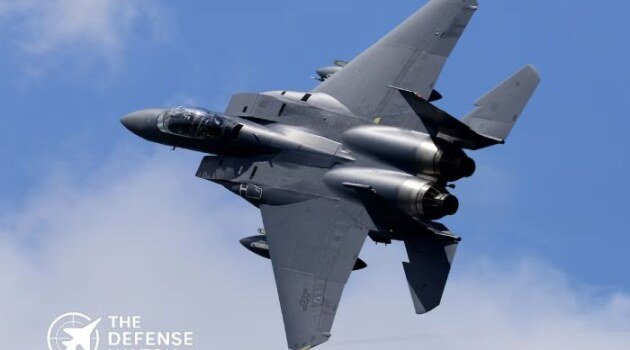
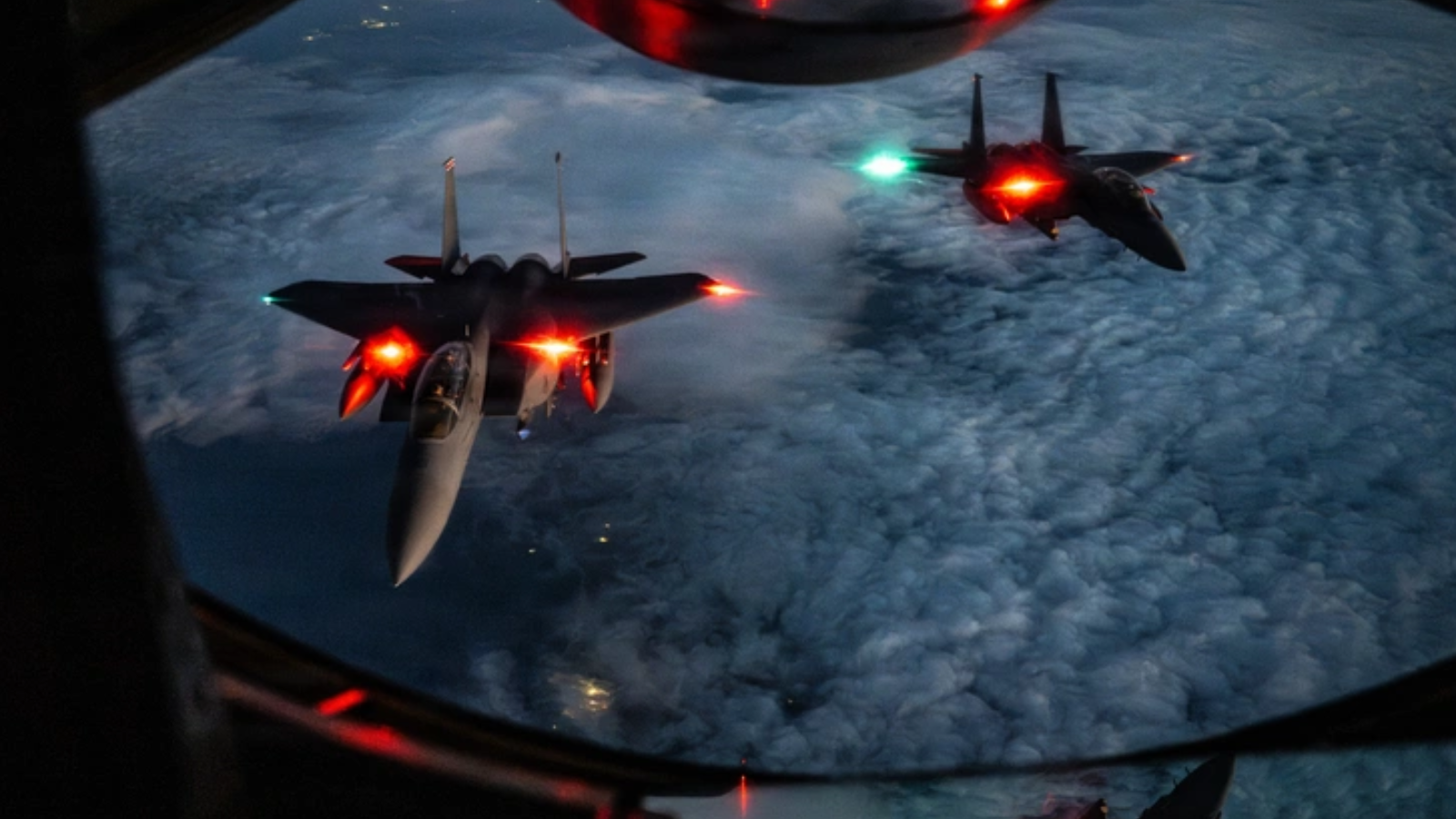
The F-15E Strike Eagle remains a dual-role fighter used for air-to-air and air-to-ground missions. Air Force training guidance includes simulator-based evaluation and training activities for F-15E crews, while Air Force units use the aircraft for missions including close air support and other combat training.
Modernizing the operating systems supporting the MTC environment can help maintain compatibility with current security requirements and software support standards. From an acquisition perspective, the award shows that cybersecurity compliance extends beyond operational aircraft and into the ground-based systems used to train their crews.
The announcement does not state that the Windows 11 migration will add new F-15E combat capabilities, improve aircraft performance, or change the simulator’s training functions.
Contract Breakdown: Boeing F-15E MTC Award Details
Contract Value
The modification is valued at $26,218,950.
It increases the cumulative face value of the existing contract from $237,264,803 to $263,483,753.
The current modification amount should not be confused with the entire cumulative contract value. The $263.48 million figure represents the total face value of the contract after this modification, while $26.22 million is the value of the current action.
Contractor
The Boeing Co., St. Louis, Missouri, is the contractor.
Contract Type
The action is a firm-fixed-price modification, designated P00040, to contract FA8621-21-C-0001.
This is therefore an alteration to an existing contract rather than a separately announced new contract.
Work Locations
Work will be performed at:
- St. Louis, Missouri
- Seymour Johnson Air Force Base, North Carolina
- Nellis Air Force Base, Nevada
- Mountain Home Air Force Base, Idaho
- RAF Lakenheath, Suffolk, United Kingdom
Performance Period
The work is expected to be completed by March 30, 2030.
Funding
The Air Force is obligating $26,218,950 in fiscal 2026 operations and maintenance funds at the time of award.
Options or Follow-On Work
The announcement does not identify additional options or separate follow-on work associated with this modification.
Boeing Defense Industrial Base and Acquisition Implications
The award illustrates how long-running military training programs require continuing technology refresh as their underlying computing environments age.
For the Air Force, the F-15E MTC is part of a broader distributed training infrastructure. Air Force Life Cycle Management Center documentation says the F-15E MTC program has supported more than 80,225 Air Force sorties, including more than 4,000 distributed missions through the Distributed Missions Operations Network since October 2007.
Migrating the Windows-based subsystem computers therefore affects infrastructure that supports recurring aircrew training rather than a standalone information technology environment.
The cybersecurity requirement is also significant because simulator networks increasingly rely on interconnected computing, visualization, instructor and mission systems. The announcement does not disclose whether the modification includes network segmentation, hardware replacement, software recertification, or other security measures beyond the Windows 11 migration.
Program Milestones and Next Steps
Boeing’s work under the modification is expected to continue through March 30, 2030.
The immediate milestone is the migration of Windows-based subsystem computers throughout the F-15E MTC program. The contract announcement does not provide a site-by-site migration schedule or identify when each training location is expected to complete the transition.
The four principal F-15E MTC operating locations identified by Air Force documentation are Mountain Home AFB, Seymour Johnson AFB, Nellis AFB and RAF Lakenheath.
The modernization will therefore remain closely tied to the sustainment of the Air Force’s existing F-15E training infrastructure.