Executive Summary
- The War Department says GenAI.mil has reached about 1.7 million unique users, representing more than half of the department’s approximately 3 million personnel, while Gemini, Grok for Government and ChatGPT are available through the enterprise platform.
- Officials cited productivity applications ranging from document analysis and administrative work to software development. One Navy example involved three developers using GenAI.mil to modernize software work in about 30 days compared with an earlier estimate of two to three years of manual development.
- The next major challenge is moving beyond unclassified enterprise use. The department says it intends to extend AI capabilities into SIPRNet and JWICS, raising additional requirements for security, accreditation, data governance and human oversight.
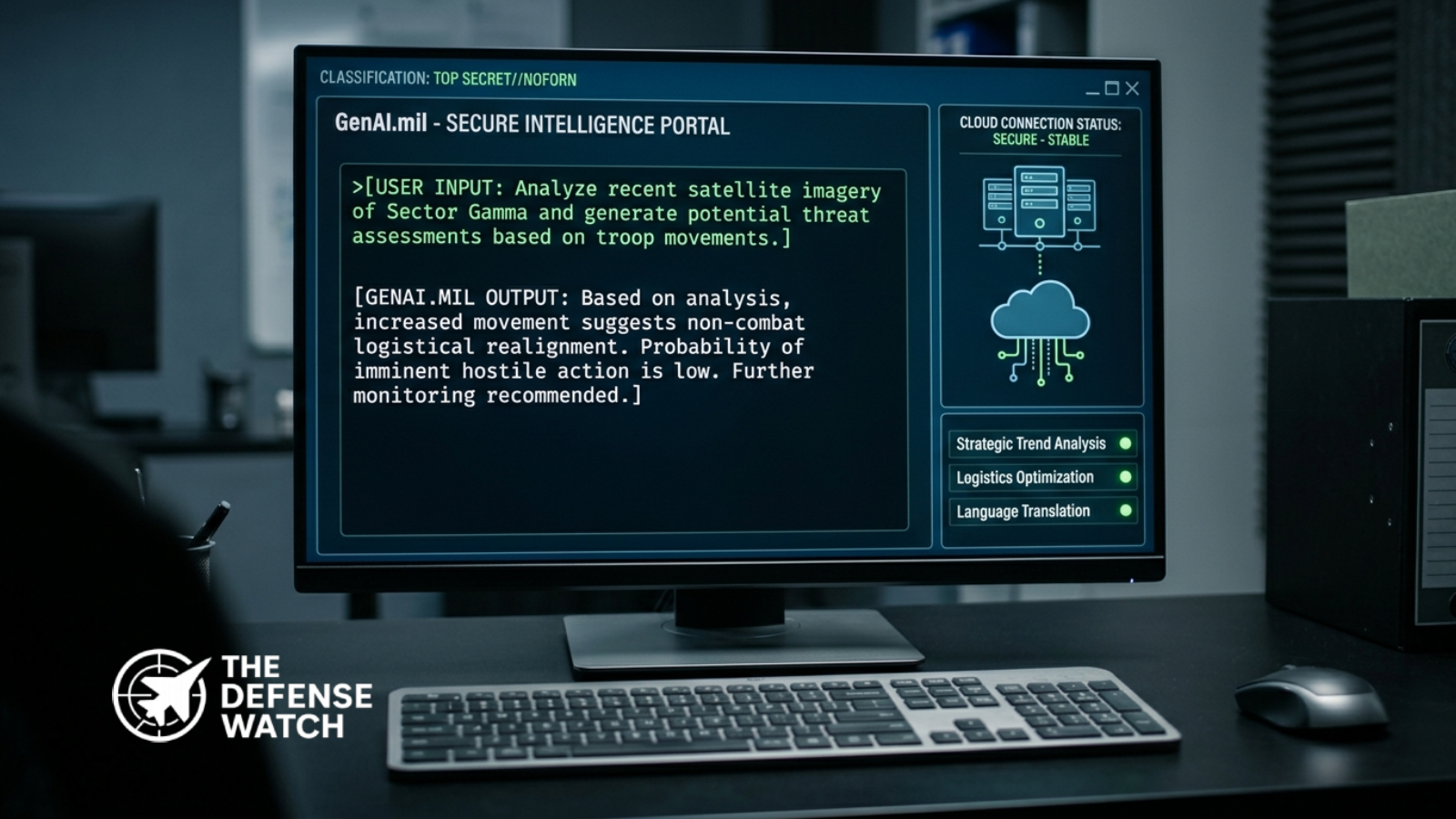
The War Department is expanding its use of commercial artificial intelligence models through GenAI.mil, with officials saying the platform has reached about 1.7 million users and is increasingly being incorporated into software development, research, acquisition, finance and other military workflows.
The figures were discussed Sept. 30 at GenAI.mil Excite Day at the Pentagon, where officials and industry representatives described the department’s effort to close the historical gap between government deployment cycles and the pace of commercial AI development.
Deya Banisakher, acting director for Frontier AI at the Chief Digital and Artificial Intelligence Office and program manager for GenAI.mil, said the department is increasingly able to deploy new models close to their public commercial release dates.
That represents a significant change in the way the Pentagon is approaching enterprise software. Rather than developing a single government-owned AI capability and waiting through lengthy acquisition and accreditation cycles, GenAI.mil is being structured as an enterprise environment capable of hosting multiple commercial frontier models.
GenAI.mil Moves From Pilot to Enterprise Scale
GenAI.mil began with Google’s Gemini for Government and has since expanded to include Starshield AI’s Grok for Government and OpenAI’s ChatGPT Mil.
The department said all three platforms are available to personnel with a Common Access Card for approved uses. The War Department previously announced Grok for Government as an Impact Level 5 capability for controlled unclassified information, while its Sept. 1 announcement confirmed the addition of both Grok and ChatGPT to the existing Gemini offering.
The 1.7 million-user figure is significant because it indicates that GenAI.mil is no longer functioning primarily as a technology demonstration. The department has already moved into the harder phase of enterprise adoption, where the central questions become how personnel use AI, how workflows change and how the resulting systems are governed.
The department has more than 3 million personnel, according to official GenAI.mil material. The 1.7 million-user figure therefore represents a substantial portion of the workforce, although user counts do not by themselves demonstrate how frequently personnel use the tools or how much mission output has actually changed.
That distinction matters. Enterprise adoption is easier to measure than operational effectiveness.
From General-Purpose AI to Mission Workflows
The immediate applications described at the Pentagon are largely centered on information-intensive work.
Officials cited research, summarization, information extraction, software development, graphic design, operations research, acquisition and finance. These functions share an important characteristic: they involve large amounts of structured or unstructured information and frequently require personnel to move between documents, databases and software tools.
Generative AI can reduce the amount of time required for some of those tasks, particularly when the underlying information is accessible to the model and the user can verify its output.
The productivity case is therefore less about replacing military personnel and more about reducing the administrative workload surrounding military operations.
That distinction is particularly relevant to the department’s broader effort to improve decision speed. A model that can rapidly organize thousands of pages of documents, generate a draft briefing or help a programmer translate requirements into code can shorten parts of the workflow without becoming the decision maker itself.
Navy Software Example Highlights Potential Productivity Gains
Banisakher cited a Navy software project as an example of the potential effect.
According to her account, a project that previously was expected to require two to three years of manual development and more than $10 million was modernized by three Navy developers using GenAI.mil in approximately 30 days.
Those figures were presented by the official during the Pentagon event and should be treated as a reported case study rather than a department-wide productivity benchmark.
The example nevertheless illustrates why software development has become one of the most immediate military applications for generative AI.
AI-assisted coding can help developers generate, explain, refactor and document software. It can also reduce the time needed to work through large legacy codebases. The limiting factors remain software assurance, testing, cybersecurity, architecture and human review.
For military systems, those requirements are particularly important because software errors can affect operational networks, logistics systems and weapons-related applications.
The practical value of AI-assisted development will therefore depend not only on how quickly code can be generated, but on whether organizations can validate that code quickly enough to preserve the time savings.
Three Commercial AI Platforms Create a Multi-Model Architecture
The addition of multiple frontier AI providers is also strategically significant.
| Platform | Provider | GenAI.mil role | Reported access |
|---|---|---|---|
| Gemini for Government | Google Public Sector | Initial GenAI.mil frontier AI offering | Department-wide approved users |
| Grok for Government | Starshield AI | Additional frontier model and enterprise workflow capabilities | Department-wide approved users |
| ChatGPT Mil | OpenAI | Generative AI for research, analysis and administrative workflows | Department-wide approved users |
The multi-model approach reduces reliance on a single commercial provider and allows the department to compare capabilities as models evolve.
That is important because frontier AI development is moving faster than traditional government software refresh cycles. A model that leads in coding, reasoning or document analysis today can be overtaken by another system relatively quickly.
The department’s stated objective is therefore not simply to select one winning model. It is building an environment in which multiple American AI providers can compete for adoption inside a government-controlled framework.
The approach also creates new technical requirements. Model interoperability, identity management, data controls, logging, security monitoring and consistent evaluation become more important when multiple models operate inside the same enterprise environment.
Grok Adds Collaboration and Automation Features
Starshield AI’s Grok for Government is being positioned around more than basic question-and-answer functions.
Gerard Connolly, a Grok for Government technician, described capabilities including shared workspaces, projects, automated tasks and reusable skills designed to generate recurring administrative products.
Those functions move GenAI.mil toward an agent-oriented model of enterprise AI.
The distinction is important. A conventional chatbot primarily responds to an individual prompt. An AI system integrated into a workflow can instead organize files, perform recurring steps and produce standardized outputs.
For defense organizations, this could eventually have greater value than isolated chatbot use because many military processes involve repeatable administrative and analytical sequences.
At the same time, greater automation increases the need for controls. The more steps an AI system can perform without direct user intervention, the more important it becomes to define permissions, audit actions and establish points where human approval is required.
ChatGPT Mil Extends the Multi-Provider Model
OpenAI’s ChatGPT Mil was introduced alongside Grok for Government in September.
OpenAI said its GenAI.mil deployment was designed for approved unclassified government work and runs within authorized government cloud infrastructure. The company said data processed within the government environment remains isolated from its public and commercial model-training systems.
The company’s February announcement also described applications including summarizing policy documents, drafting procurement material, producing internal reports and supporting research and planning.
This positions ChatGPT Mil within the same broad enterprise productivity category as the other GenAI.mil offerings rather than as a weapon-specific AI system.
That distinction is important when assessing the military significance of the program. The immediate capability is primarily an information and software productivity layer. Its potential effects on operational decision-making will depend on future integration with military data, networks and command processes.
The Next Barrier Is Classified Connectivity
The most consequential development discussed at the event may be the planned expansion of AI into classified environments.
Officials said the next step is to put AI capabilities onto the Secret Internet Protocol Router Network, or SIPRNet, and the Joint Worldwide Intelligence Communications System, or JWICS.
SIPRNet supports classified defense communications, while JWICS provides communications and collaboration services for the intelligence community at the Top Secret/Sensitive Compartmented Information level.
Moving AI into those environments would represent a substantially different security problem from deploying generative AI for controlled unclassified information.
The models would have to operate within infrastructure designed to protect classified information, while the department would need to address access controls, data segregation, model behavior, logging, cybersecurity and accreditation.
It also raises a technical question about where inference occurs.
Cloud-based enterprise AI can centralize computing and security controls, but military organizations may eventually require AI capabilities closer to tactical users and operational data sources. That creates a spectrum ranging from centralized enterprise AI to edge systems operating with intermittent connectivity.
GenAI.mil’s current enterprise architecture is an early step in that larger transition.
Security and Scale Will Determine the Next Phase
Jonathan Buchanan, the authorizing official for GenAI.mil platforms, said the three systems were soft-launched in part to ensure that they could be scaled while being monitored for security and performance.
That approach reflects one of the central problems facing military AI adoption: deployment speed has to increase without removing the controls required for defense networks.
The department is attempting to solve both problems simultaneously.
The first is access. Personnel need usable AI tools that are available without lengthy local development cycles.
The second is trust. Users and commanders need to understand where the systems can be used, what data can be entered and how outputs should be verified.
The third is infrastructure. AI systems require computing capacity, network connectivity, data pipelines and secure cloud environments capable of supporting large numbers of users.
The fourth is workforce adaptation. The department needs personnel who understand both the underlying military mission and the limitations of AI-generated outputs.
AI Adoption Does Not Equal Autonomous Warfare
The current GenAI.mil rollout should not be confused with autonomous weapons deployment.
The examples presented at the Pentagon focus primarily on administrative, analytical and software tasks. These are different from using AI to independently control weapons or make high-stakes operational decisions.
That distinction will become increasingly important as the department expands AI into classified networks.
OpenAI’s published agreement with the department states that its system is not to independently direct autonomous weapons where applicable law, regulation or department policy requires human control. The company also described a cloud-based deployment architecture with additional safeguards.
For GenAI.mil more broadly, the critical issue will be maintaining clear boundaries between AI-assisted work and decisions that remain under human authority.
A Potential Shift in Defense Software Acquisition
The broader implication of GenAI.mil extends beyond chatbots.
Traditional defense software programs often operate through long development cycles, formal requirements, testing processes and scheduled technology refreshes. Frontier AI evolves on a much shorter timeline.
If the department can maintain secure access to current commercial models, it could shift part of its software strategy from periodically acquiring new capabilities toward continuously updating an enterprise AI layer.
That could affect defense contractors as well.
Companies providing cloud infrastructure, cybersecurity, data engineering, AI evaluation, model integration and secure software development could become increasingly important alongside companies that build the underlying AI models.
The department’s multi-provider strategy also creates competitive pressure among U.S. AI companies. Rather than committing the entire enterprise to one vendor, GenAI.mil provides a government environment in which multiple providers can demonstrate performance and user value.
What Comes Next
The immediate GenAI.mil milestone is scale. The more important test will be whether that scale produces measurable improvements in military workflows without introducing unacceptable security or reliability risks.
Three developments will be particularly important to watch:
- Classified-network integration: The planned expansion toward SIPRNet and JWICS will test whether frontier AI can be deployed securely beyond controlled unclassified environments.
- Workflow automation: Tools such as reusable skills, projects and AI agents could move GenAI.mil from individual productivity assistance toward organization-level process automation.
- Mission-level evaluation: User numbers and prompt counts show adoption, but the department will need stronger measures of time saved, error rates, software quality, acquisition-cycle improvements and mission outcomes to establish the operational value of AI.
GenAI.mil is therefore becoming more than a portal for commercial AI models. It is emerging as a test of whether the U.S. defense enterprise can absorb rapidly changing commercial technology at the scale required by a modern military organization.
The 1.7 million-user figure shows that access can be expanded quickly. The next phase will determine whether that access can be translated into secure, repeatable and measurable improvements across the joint force.