

Executive Summary
- Northrop Grumman says a collaborative robot has reduced a bolt-installation task on the F-35 Communications, Navigation and Identification, or CNI, module from hours to a few minutes.
- The company is also expanding AI-based quality-control systems that inspect completed CNI modules and flag potential defects before shipment. Northrop Grumman separately reports that its Palmdale Integrated Assembly Line produces an F-35 center fuselage approximately every 30 hours.
- The manufacturing changes come as the F-35 program faces continuing production, supply-chain and sustainment pressures. GAO reported in 2026 that industry capacity constraints remain a risk to meeting growing F-35 demand.
Northrop Grumman is applying collaborative robotics and artificial intelligence to another part of the F-35 Lightning II manufacturing process, targeting both assembly time and production quality as the U.S. and allied F-35 fleet continues to expand.
The company said September 30 that a collaborative robot, or co-bot, installed on its CNI production line assists technicians with installing bolts on the front housing area of the CNI module. According to Northrop Grumman manufacturing manager Lavell Catlin, a task that previously required hours can now be completed in a few minutes.
The significance extends beyond the time saved on one assembly operation. For a fighter program operating at large production volumes, reducing labor-intensive tasks can increase manufacturing flexibility, while automated inspection can identify problems earlier in the production cycle.
Robotics Moves Into F-35 Avionics Assembly
The CNI system is a major component of the F-35’s integrated avionics architecture. Northrop Grumman identifies the CNI system among the F-35 mission systems it produces, alongside the AN/APG-81 radar and other sensors and avionics.
The new co-bot does not replace technicians. Instead, it works alongside them on a defined assembly operation.
That distinction matters in aerospace manufacturing. Collaborative robotics can take over repetitive, physically demanding or highly repeatable tasks while allowing technicians to concentrate on operations that require judgment, adjustment and inspection.
Northrop Grumman said the change also allowed several employees to move to other production activities. The company has not publicly disclosed a full labor-hour reduction for the entire CNI module, so the reported improvement should not be interpreted as a reduction in total module production time by the same amount.
From Manual Work to Human-Machine Production
The latest CNI automation is part of a broader manufacturing strategy that Northrop Grumman has applied to the F-35 for years.
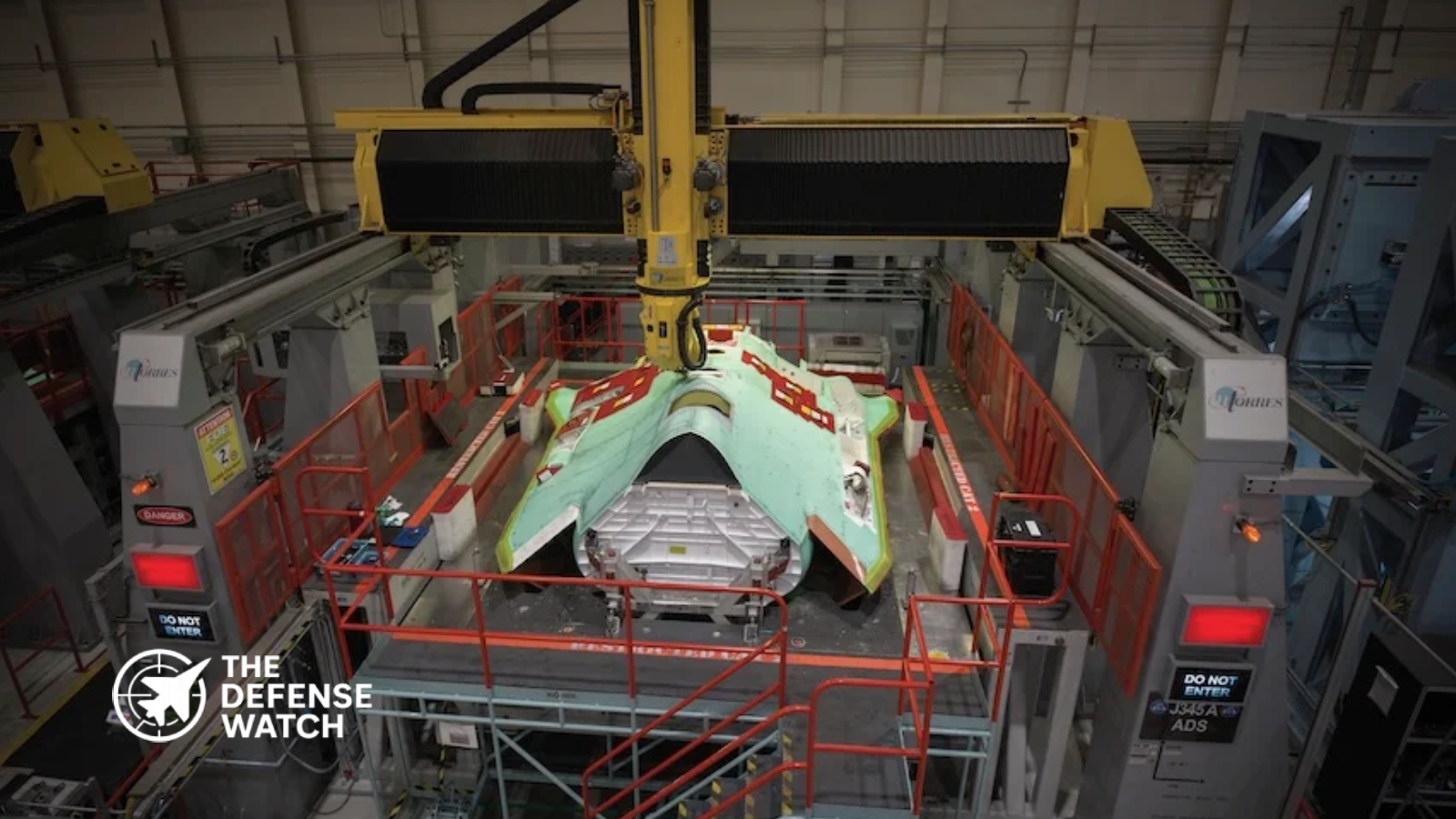
At its Palmdale, California, facility, the company’s Integrated Assembly Line combines automated systems, robotics and human technicians to produce center fuselages for all three F-35 variants.
Northrop Grumman currently reports a production interval of approximately 30 hours for an F-35 center fuselage. Its manufacturing system includes as many as 115 assembly positions and more than 3,000 tools.
That provides important context for the CNI initiative. The company is not starting from a conventional aircraft factory and suddenly introducing automation. Instead, it is extending an established automation model deeper into the aircraft’s electronic and mission-system manufacturing processes.
AI Adds a Second Layer of Production Control
The other major development is the expansion of AI-based quality control.
Northrop Grumman says its production teams are using AI-based inspection systems to examine completed CNI modules and flag potential issues before the hardware leaves the factory. The company is extending these tools to additional portions of the CNI production line.
The immediate manufacturing benefit is earlier detection.
A defect discovered late in assembly can require additional inspection, rework or disassembly. Detecting a potential problem closer to the point where it is introduced can reduce the amount of downstream work required to identify its cause.
However, Northrop Grumman has not publicly provided enough information to independently quantify the AI system’s defect-detection rate, false-positive rate, reduction in rework hours or financial savings. Those metrics should therefore not be assumed.
Why Avionics Quality Matters
The CNI system is not simply an individual electronic box. Northrop Grumman describes it as an integrated avionics system involving more than 27 avionics components. The company also notes that portions of the CNI manufacturing process continue to require skilled technicians, including delicate tuning operations.
That combination illustrates an important limitation of factory AI and robotics.
Automation can improve repeatability and inspection, but it does not remove the need for skilled aerospace workers. Instead, the manufacturing model increasingly combines automated production, machine-assisted inspection and human expertise.
F-35 Production Needs More Than Faster Assembly
The timing of the improvements is significant because the F-35 industrial base continues to face capacity and supply-chain constraints.
A June 2026 GAO assessment found that F-35 sustainment remains affected by constrained industry capacity. GAO reported that a 2025 industry study found sufficient supply capacity for approximately 95 percent of F-35 parts, while 2 percent, representing 48 parts, had identified supplier-capacity gaps.
GAO also reported broader readiness challenges. Across fiscal years 2021 through 2025, the fleet’s mission-capable rate declined from 67 percent to 44 percent, while the full-mission-capable rate declined from 38 percent to 25 percent.
These figures concern sustainment rather than Northrop Grumman’s CNI production line specifically. They nonetheless demonstrate why manufacturing efficiency alone cannot solve every F-35 availability problem.
The production system must simultaneously manage component availability, supplier capacity, quality, aircraft assembly, modernization requirements and sustainment demand.
Automation Can Help Address the Industrial Base Bottleneck
The F-35 program has already demonstrated how production automation can change aircraft manufacturing economics and throughput.
Northrop Grumman’s Palmdale Integrated Assembly Line was designed around automation from the beginning. The company says the line uses 22 automated systems and produces center fuselages for the F-35A, F-35B and F-35C on the same production line.
The CNI initiative applies the same basic principle to avionics manufacturing.
| Manufacturing area | Northrop Grumman approach | Potential production effect |
|---|---|---|
| CNI bolt installation | Collaborative robot assists technicians | Shorter task duration |
| CNI inspection | AI-based quality-control tools | Earlier identification of potential defects |
| Center fuselage | Automated Integrated Assembly Line | Higher production throughput |
| Multi-variant manufacturing | Common production tooling | Supports F-35A, F-35B and F-35C production |
| Skilled labor | Human-machine collaboration | Allows technicians to shift toward other production activities |
The final column describes the potential manufacturing effect, not a company-confirmed program-wide performance improvement.
The Difference Between Faster Production and More Aircraft
One important analytical distinction is that a faster individual manufacturing task does not automatically translate into proportionally higher aircraft production.
Aircraft production is a system of interconnected operations. A faster CNI assembly process only increases overall output if other production steps, component availability, testing capacity and supplier throughput can support the additional pace.
This is particularly relevant to the F-35.
In a 2025 report, GAO found that the F-35 program had planned continued production increases even though Lockheed Martin had not been able to meet the lower production demand at that time. GAO also identified continuing supply-chain problems affecting aircraft and engine production.
That means automation should be viewed as one part of a larger industrial-base strategy.
If a factory eliminates a production bottleneck but another supplier remains constrained, the overall aircraft production rate may not change significantly. Conversely, improvements across multiple bottlenecks can accumulate and create measurable gains in throughput.
AI and Robotics Could Become More Important as F-35 Demand Expands
The F-35 production ecosystem is unusually large, involving U.S. services, international partners and foreign military sales customers.
GAO reported in 2026 that the Department of Defense operates and sustains more than 800 F-35s and plans to acquire roughly 1,700 additional aircraft by the mid-2040s.
That scale creates a continuing requirement for manufacturing capacity.
Northrop Grumman’s approach points toward a production model in which robotics handle repeatable physical operations while AI systems increasingly support inspection and process control. The longer-term value is not simply making one assembly step faster. It is creating a manufacturing system that can collect more production data, detect deviations earlier and move skilled workers toward operations that machines cannot easily perform.
For the defense industrial base, that distinction is important. Expanding output through additional factories and workers can be expensive and slow. Increasing the productivity of existing production infrastructure can provide another route to greater capacity, although it cannot eliminate shortages of raw materials, specialized components or qualified suppliers.
What Northrop Grumman Has Not Disclosed
The latest announcement provides useful evidence of how automation is being applied, but several quantitative questions remain unanswered.
Northrop Grumman has not publicly disclosed:
- The exact number of labor hours eliminated from total CNI module production.
- The annual production increase attributable specifically to the new co-bot.
- The AI inspection system’s measured defect-detection accuracy.
- The false-positive rate of the AI inspection process.
- The total cost savings generated by the technology.
- Whether the technology has changed the overall F-35 aircraft production schedule.
Those limitations are important when evaluating claims about manufacturing acceleration. The reported reduction from hours to minutes applies to a specific bolt-installation task, not the complete F-35 production cycle.
What It Means for the F-35 Industrial Base
The Northrop Grumman development represents a shift from automation focused primarily on large structural assemblies toward greater automation of mission-system manufacturing and inspection.
That could matter as the F-35 fleet grows. The aircraft’s production challenge is not simply building more airframes. It also involves producing sophisticated avionics, sensors and other systems at sufficient quality and volume while maintaining the workforce and supplier network needed to support them.
Northrop Grumman’s reported CNI improvements therefore fit into a broader manufacturing trend: use robotics to compress repeatable production tasks, use AI to identify quality problems earlier, and use human technicians where judgment and specialized skills remain essential.
The approach does not resolve the F-35 program’s wider production and sustainment constraints. But it provides another mechanism for improving manufacturing productivity within one of the world’s largest military aircraft programs.
