








@2026 – All Right Reserved. TheDefenseWatch.com
- Home
- Defense Systems
- Fighter Jets
- Mirage 2000 Fighter Jet
Mirage 2000 Fighter Jet
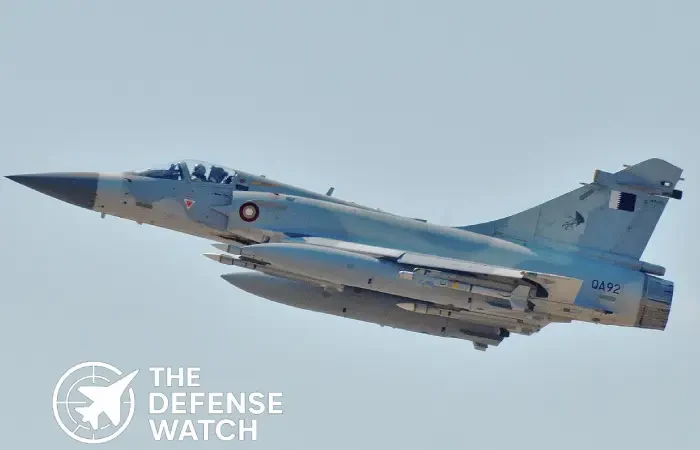
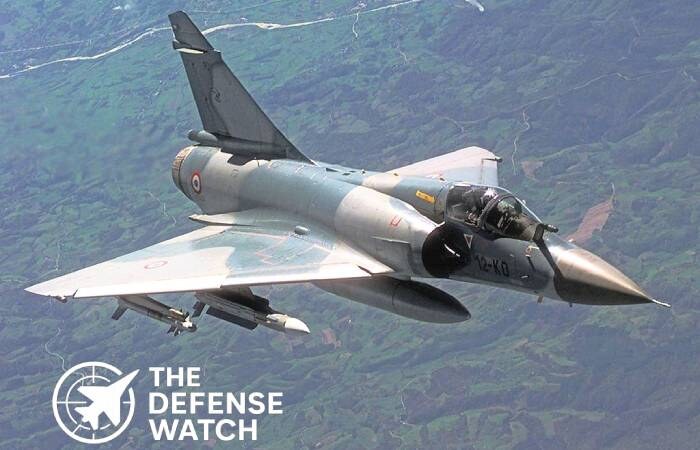
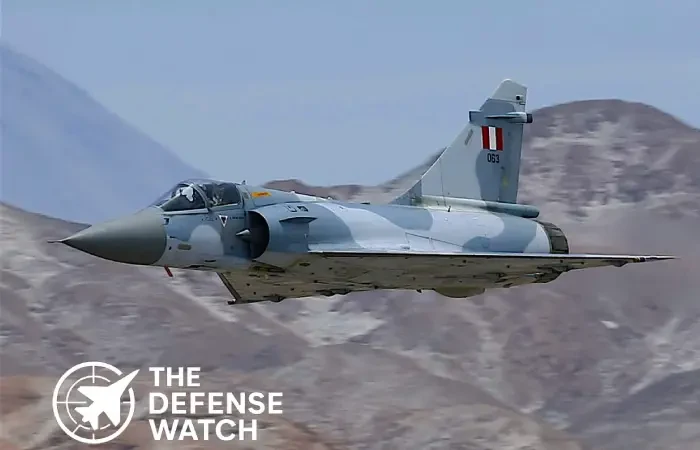
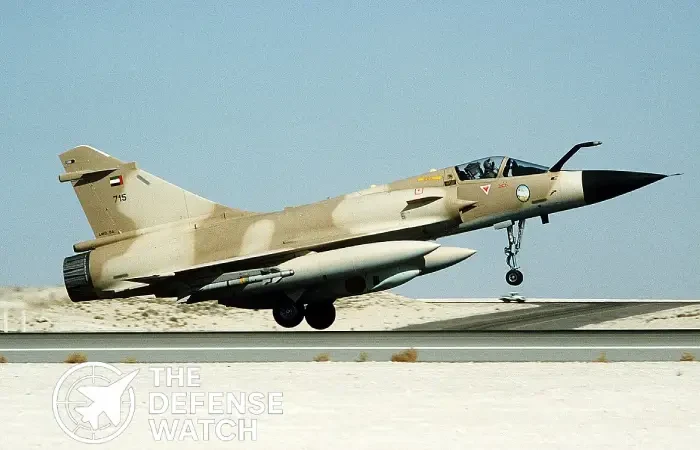
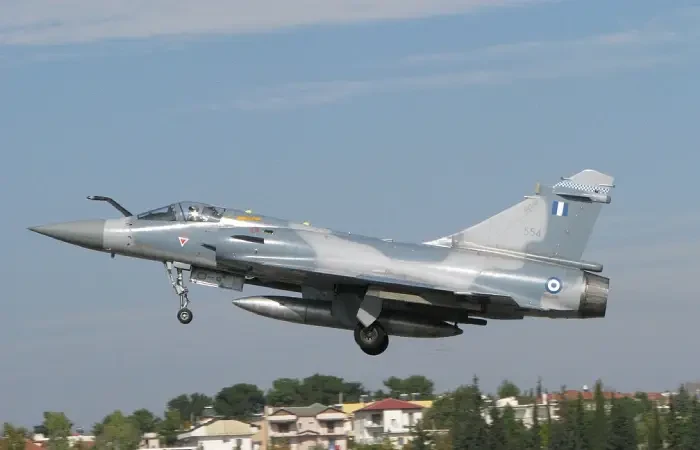
Defense Systems Full Specifications
General Information
| Name | Mirage 2000 |
| Manufacturer | Dassault Aviation |
| Country of Origin | France |
| Type / Role | Multirole fighter / interceptor |
| Generation | Fourth-generation |
| Status | In service (many upgraded) |
| First Flight | 10 March 1978 |
| Introduction / In Service Since | 1984 |
| Number Built | ~601 |
| Operators | France, India, UAE, Egypt, Greece, Taiwan, Qatar, Peru, etc. |
Dimensions & Structure
| Length | 14.36 m (47.1 ft) |
| Wingspan | 9.13 m (29.9 ft) |
| Height | 5.20 m |
| Wing Area | 41 m² |
| Empty Weight | ~7,500 kg |
| Maximum Takeoff Weight (MTOW) | ~17,000 kg |
| Internal Weapons Bay | None (no internal bay) |
| External Hardpoints | 9 total (5 fuselage + 4 under wings) |
Performance
| Maximum Speed | Mach 2.2 (~2,338 km/h) |
| Range | ~1,550 km (standard) to ≈3,335 km ferry with external tanks |
| Combat Radius | ~780–900 km (depending on load) |
| Service Ceiling | ~16,460 m (~54,000 ft) |
| Rate of Climb | ~17,000 m/min (≈ 60,000 ft/min) |
| Thrust-to-Weight Ratio | Approx ~0.9+ (varies by weight) |
| G Limits | –3 to +9 g |
Powerplant
| Engine Type | SNECMA M53-P2 afterburning turbofan |
| No. of Engines | 1 |
| Thrust (each) | ~95.1 kN (with afterburner) |
| Thrust Vectoring | None |
| Fuel Capacity | ~3,950 L internal (plus external tanks) |
Armament
| Gun | 2 × 30 mm DEFA / GIAT 30-550 (≈125 rnd each) |
| Missiles (Air-to-Air) | MICA (IR/EM), Magic II, Super 530, exported Sidewinder in some cases |
| Missiles (Air-to-Ground) | AS-30L, SCALP / Storm Shadow (in modern upgrades), AASM in some roles |
| Bombs | Laser-guided bombs (GBU series), dumb bombs, cluster munitions on export versions |
| Hardpoints | 9 pylons (5 fuselage, 4 wing) |
| Payload Capacity | ~6.3 tonnes |
Avionics & Systems
| Radar | RDM / RDI in older, RDY multimode in 2000-5 evolution |
| Radar Range | ~100–150 km multitrack capability (≈150 km) |
| Electronic Warfare (EW) System | ICMS / Serval / Spirale jammers / RWR |
| Targeting System | ATLIS II, Damocles pod in upgraded versions |
| Helmet Display | Standard HUD, integration in upgrades (VEH-3020 etc.) |
| Navigation | INS / GPS hybrid + terrain following in some variants |
| Autopilot / AI Assistance | Basic autopilot; flight augmentation via fly-by-wire system |
| Communication | VHF/UHF radios, datalink in upgraded variants |
Stealth & Technology
| Radar Cross Section (RCS) | Moderate (not stealth-optimized) |
| Stealth Features | None purpose-built |
| Infrared Signature Reduction | Limited implementation |
| Sensor Fusion | Partial in upgraded versions |
| Networking Capabilities | Link / datalink in modern upgrades |
Variants
| Special Export Versions | e.g. Mirage 2000-9, 2000-5I/TI (India), others |
Operational History
| Major Conflicts / Deployments | Gulf War, Kosovo, Libya, Mali, Afghanistan, cross-border strikes |
| Notable Operators | France, India, UAE, Egypt, Greece, Taiwan, Peru, Qatar |
| Combat Proven? | Yes, used in multiple theaters |
| Mission Types | Interceptor, air policing, ground strike, nuclear deterrence |
Cost & Program
| Unit Cost | Varies by variant and upgrade (older estimates ~$30–50M range adjusted) |
| Development Cost | Internal to Dassault and French programs |
| Program Name | Mirage 2000 program |
| Funding Countries | Primarily French government, export customers |
Additional Information
| Upgrades Planned | Continued avionics modernization (2000D RMV for French service) |
| Future Replacement | Dassault Rafale (within French service) |
| Export Restrictions | French export controls on advanced systems |
| Notable Achievements | Long service life, many international users |
| Competitors | F-16, MiG-29, J-10, Saab Gripen etc. |
PROS
- Strong top-end speed and climb — Mach 2.2 class interceptor capability
- Multi-role flexibility (air defense, strike, nuclear deterrence in variants)
- Upgradable avionics and radar (2000-5 modernization path)
- Well-proven platform with export support and logistics
- Good payload for its class (≈ 6.3 t external load)
CONS
- Older airframe design lacking stealth features
- Limited internal fuel capacity compared to newer fighters
- Smaller sensors suite compared to 5th-generation adversaries
- Aging logistics and lifecycle costs in some operators
- Vulnerable to advanced electronic warfare or networked anti-air systems
Mirage 2000 Multirole Delta-Wing Fighter
From the skies of Europe to the frontiers of Asia, the Dassault Mirage 2000 remains a hallmark of fourth-generation fighter design. Introduced in the 1980s, it blends agility, versatile armament, and upgrade potential—attributes still relevant in modern defense planning.
Manufacturer, Origin & Purpose
Developed by Dassault Aviation in France, the Mirage 2000 was conceived as a lightweight replacement for the Mirage III, combining a delta-wing platform with fly-by-wire control for high maneuverability. Built in the late 1970s, it entered service in 1984 with the French Air Force. Its mission scope evolved from pure interceptor to multirole (air superiority, strike and nuclear deterrent) across variants like the 2000C, 2000N, 2000D, and 2000-5.
Major Capabilities & Performance
The Mirage 2000, in its standard configuration, can reach Mach 2.2 at altitude (≈ 2,338 km/h) and operates with a service ceiling above 16,000 m (≈ 54,000 ft). It can carry about 6.3 t of external stores over nine hardpoints (two wing pylons each side, five fuselage) including air-to-air and air-to-ground weapons. Its twin 30 mm cannons (DEFA 554 or GIAT 30-550 variants) deliver selectable rates (1,200 or 1,800 rpm) with ~125 rounds per gun. The aircraft’s radar — evolving from RDM / RDI to RDY in the 2000-5 upgrade — supports multitrack engagements, and avionics upgrades often include improved navigation, electronic warfare (ECM/ECM suites like ICMS/Serval), and datalink integration.
In operational use, Mirage 2000s have flown in conflicts over Libya, Mali, Afghanistan, Kosovo, and by export operators such as India, UAE, Egypt, Greece, Taiwan. Many remain under modernization programs (e.g. Indian fleet to 2000-5, French Mirage 2000D RMV mid-life upgrades through the 2020s) to extend service lives into the 2030s.
Variants
| Field | Example |
|---|---|
| Mirage 2000C / B | Single-seat / two-seat air defense versions |
| Mirage 2000N | Nuclear-strike optimized model |
| Mirage 2000D | Conventional strike, precision attack |
| Mirage 2000-5 | Upgraded multirole radar and avionics |
| Special Export Versions | e.g. Mirage 2000-9, 2000-5I/TI (India), others |
Disclaimer Note
The information provided on TheDefenseWatch.com is for general informational purposes only. While we strive to ensure the accuracy, completeness, and timeliness of our content regarding defense and aerospace products, technologies, and specifications, we cannot guarantee that all information is 100% accurate or up-to-date due to the evolving nature of military technology and classified data.TheDefenseWatch.com does not warrant the reliability, suitability, or availability of the information for any specific purpose. Users are advised to consult official sources, such as manufacturers, government publications, or defense agencies, for precise and verified data before making decisions based on our content.We are not affiliated with any defense manufacturers, governments, or military organizations mentioned. Opinions, reviews, and ratings reflect expert analysis but are subjective and should not be considered endorsements. TheDefenseWatch.com is not responsible for any errors, omissions, or consequences arising from the use of this website’s content.External links are provided for convenience and do not imply endorsement. TheDefenseWatch.com reserves the right to update or modify content without prior notice. By using this website, you agree to our Privacy & Cookies Policy.
New Arrivals
Popular Comparisons
-
 Tejas Fighter Jet vs F-16 Fighting Falcon: Capability Compared
View Comparison →
Tejas Fighter Jet vs F-16 Fighting Falcon: Capability Compared
View Comparison → -
Rafale Fighter Jet vs F-16 Fighting Falcon : Which Fighter Has the Edge?
View Comparison →
-
Su-57 Fighter Jet vs J-20 Fighter Jet: Stealth and Air Combat Compared
View Comparison →
-
Mirage 2000 vs Tejas Mk1A: Legacy Combat Power vs Indigenous Modernization
View Comparison →
-
Rafale Fighter Jet vs F-22 Raptor: Which Air Dominance Fighter Has the Edge?
View Comparison →
-
Tejas Fighter Jet vs. Rafale Fighter Jet: India’s Indigenous Fighter Meets France’s Proven Multirole Combat Aircraft
View Comparison →
-
F-22 Raptor vs. F-35 Joint Strike Fighter: Which Fifth Generation Fighter Has the Edge?
View Comparison →
-
F-35A vs. F-22 Raptor: Which U.S. Stealth Fighter Dominates Modern Air Combat?
View Comparison →
-
AGM-114 Hellfire vs. AGM-179 JAGM: Which U.S. Precision Missile Is Better?
View Comparison →
-
Patriot (PAC-3) vs. THAAD: Complete Missile Defense System Comparison, Capabilities, Range, and Strategic Roles
View Comparison →
- F-16 Crashes at Spangdahlem Air Base in Germany, Pilot Ejects Safely

- FQ-42 Vengeance Flies With F-35 and F-15E as Air Force Advances CCA Teaming
- Albania Secures $302 Million U.S. Defense Loan for Military Modernization
- Rockwell Collins Wins $10.7M Navy E-2D Training Contract
- Boeing Receives $11.8 Million Contract Modification for Kuwait F/A-18E/F Support
- General Dynamics Wins $22.4M MK 41 VLS Engineering Contract
- Bell Boeing Wins $29.7M Contract for V-22 Loads and Dynamics Data
- Raytheon Wins $34.4M V-22 Tactical Software Sustainment Contract
- Dayton T. Brown Wins $55.8M P-8A Mobile Mission Systems Contract
- Finland deepens European F-35 cooperation with first pilot flight in Europe