













@2026 – All Right Reserved. TheDefenseWatch.com
- Home
- Defense Systems
- Missiles & Precision Weapons
- China PL-17 Missile
China PL-17 Missile
Defense Systems Full Specifications
1. General Information
| Name / Designation | PL‑17 (CH‑AA‑12 Auger) |
| Type / Role | Very Long-Range Air-to-Air Missile |
| Country of Origin | China |
| Manufacturer | Shanghai Academy of Spaceflight Technology |
| Service Entry / Year Introduced | Circa 2022–2023 |
| Operational Status | Active |
2. Performance & Range
| Range | 300–500 km (approx.) |
| Speed | Mach 4+ (estimated) |
| Ceiling / Altitude Limit | High-altitude engagements |
| Accuracy (CEP) | Not publicly verified |
| Warhead Type | High-explosive fragmentation |
3. Guidance & Targeting
| Guidance System | INS, satellite navigation, midcourse datalink, AESA radar |
| Targeting Mode | Midcourse updates with active terminal homing |
| Launch Platform Compatibility | PLAAF fighter hardpoints |
| Seeker Type | AESA radar with possible passive modes |
4. Physical Characteristics
| Length | ~6 meters |
| Diameter | Not officially disclosed |
| Wingspan | Control fins present |
| Launch Weight | Estimated heavy class |
| Propulsion | Dual-pulse solid rocket motor |
5. Warhead & Payload
| Warhead Weight | Not officially disclosed |
| Explosive Type | HE fragmentation |
| Detonation Mechanism | Proximity/impact |
| Payload Options | Conventional |
6. Operational Use & Capabilities
| Operational Range Type | Very long |
| Deployment Platform | Air (fighter aircraft) |
| Target Types | Tankers, AEW&C, EW aircra |
| Combat Proven | Active service |
| Users / Operators | China PLAAF |
PROS
- Exceptional engagement range exceeds most Western counterparts, enabling strikes against distant high-value targets.
- High terminal speed (Mach 4+) reduces target reaction time and enhances kinetic performance.
- Advanced AESA seeker with potential dual-mode (radar/IR) capability improves jamming resistance.
- Dual-pulse motor and lofted trajectory optimize energy management for maximum reach.
- Supports networked warfare by leveraging offboard targeting from AEW&C or stealth platforms.
CONS
- Large size (6m length) limits internal carriage on stealth fighters, requiring external mounting that increases radar signature.
- Heavy weight and dimensions reduce the number that can be carried per aircraft.
- Dependence on external sensors for full-range effectiveness in contested environments.
- Limited public data on combat testing or proven kills against realistic targets.
- High complexity may increase vulnerability to advanced electronic countermeasures if seeker performance is overestimated.
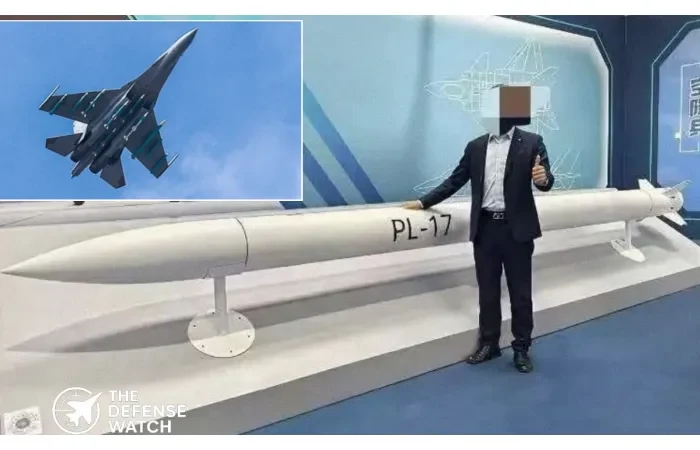
China’s PL-17 Very Long-Range Air-to-Air Missile
The PL-17 represents a significant advancement in China’s air-to-air missile technology, designed as a very long-range beyond-visual-range (BVR) weapon primarily for the People’s Liberation Army Air Force (PLAAF). First observed in testing around 2016 and entering operational service by around 2023, this missile addresses the need to engage high-value airborne assets (HVAA) such as aerial refueling tankers, airborne early warning and control (AEW&C) aircraft, and other strategic platforms at distances far exceeding those of conventional BVR missiles. Its development underscores China’s focus on extending engagement envelopes in contested airspace, particularly in scenarios involving anti-access/area-denial (A2/AD) strategies in the Indo-Pacific region.
Manufacturer and Origin
The PL-17 is developed in China, likely by entities associated with the PLAAF’s missile research programs, though specific prime contractor details remain limited in open sources. It is a domestic product of China’s advanced aerospace industry, distinct from ramjet-powered designs like the PL-21, and relies on solid rocket propulsion.
Speed and Range
The missile achieves a maximum speed in excess of Mach 4, enabled by its dual-pulse solid rocket motor and lofted trajectory profile that optimizes energy retention for extended reach. Range estimates vary based on launch conditions, but credible assessments place effective engagement distances between 300–500 km, with a commonly cited figure around 400 km under favorable parameters. This positions the PL-17 among the longest-range air-to-air missiles in service globally.
Cost/Price
Exact unit costs for the PL-17 are not publicly disclosed, consistent with Chinese military procurement practices. As a specialized, large-scale weapon system, it is expected to carry a substantial price tag relative to medium-range missiles, though specific figures remain classified.
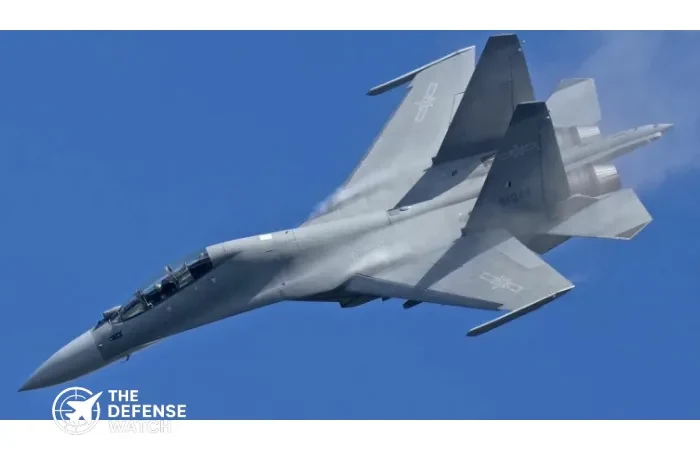
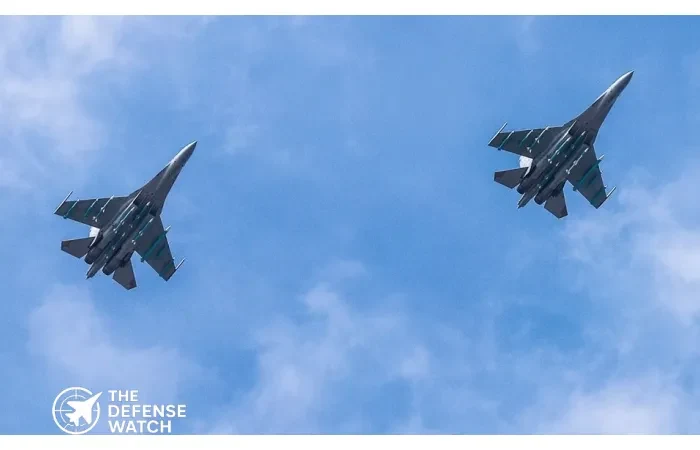
The PL-17’s large dimensions—approximately 6 meters in length and 300–305 mm in diameter—accommodate greater propellant capacity, supporting its extended performance. Guidance combines inertial navigation with mid-course updates via two-way datalink, transitioning to terminal active radar homing using an advanced AESA seeker, potentially supplemented by infrared elements for enhanced resistance to countermeasures. It employs thrust vectoring for control and flies a semi-ballistic path to maximize range. Primary launch platforms include the J-16 multirole fighter, with potential compatibility on other heavy fighters like the Su-35 and future integration pathways on stealth platforms. The missile’s primary role targets non-maneuvering or large-signature assets, relying on offboard sensors such as AEW&C aircraft (e.g., KJ-500) or networked fighters for initial targeting data in long-range scenarios.
Disclaimer Note
The information provided on TheDefenseWatch.com is for general informational purposes only. While we strive to ensure the accuracy, completeness, and timeliness of our content regarding defense and aerospace products, technologies, and specifications, we cannot guarantee that all information is 100% accurate or up-to-date due to the evolving nature of military technology and classified data.TheDefenseWatch.com does not warrant the reliability, suitability, or availability of the information for any specific purpose. Users are advised to consult official sources, such as manufacturers, government publications, or defense agencies, for precise and verified data before making decisions based on our content.We are not affiliated with any defense manufacturers, governments, or military organizations mentioned. Opinions, reviews, and ratings reflect expert analysis but are subjective and should not be considered endorsements. TheDefenseWatch.com is not responsible for any errors, omissions, or consequences arising from the use of this website’s content.External links are provided for convenience and do not imply endorsement. TheDefenseWatch.com reserves the right to update or modify content without prior notice. By using this website, you agree to our Privacy & Cookies Policy.
More Defense Systems from Shanghai Academy of Spaceflight Technology
New Arrivals
Popular Comparisons
-
 Tejas Fighter Jet vs F-16 Fighting Falcon: Capability Compared
View Comparison →
Tejas Fighter Jet vs F-16 Fighting Falcon: Capability Compared
View Comparison → -
Rafale Fighter Jet vs F-16 Fighting Falcon : Which Fighter Has the Edge?
View Comparison →
-
Su-57 Fighter Jet vs J-20 Fighter Jet: Stealth and Air Combat Compared
View Comparison →
-
Mirage 2000 vs Tejas Mk1A: Legacy Combat Power vs Indigenous Modernization
View Comparison →
-
Rafale Fighter Jet vs F-22 Raptor: Which Air Dominance Fighter Has the Edge?
View Comparison →
-
Tejas Fighter Jet vs. Rafale Fighter Jet: India’s Indigenous Fighter Meets France’s Proven Multirole Combat Aircraft
View Comparison →
-
F-22 Raptor vs. F-35 Joint Strike Fighter: Which Fifth Generation Fighter Has the Edge?
View Comparison →
-
F-35A vs. F-22 Raptor: Which U.S. Stealth Fighter Dominates Modern Air Combat?
View Comparison →
-
AGM-114 Hellfire vs. AGM-179 JAGM: Which U.S. Precision Missile Is Better?
View Comparison →
-
Patriot (PAC-3) vs. THAAD: Complete Missile Defense System Comparison, Capabilities, Range, and Strategic Roles
View Comparison →
- Lockheed Martin Wins $76.6M Trident II D5LE2 Development Contract

- Lockheed Martin Gets $871.2M F-35 Site Support Contract Increase
- Pete Hegseth Texas Enlistment Ceremony: Hegseth Tells Military Families, We Have Their Back
- U.S., Denmark and Greenland Reach Security Agreement to Expand American Military Presence
- SpaceX Wins Three More NASA Crew Missions in $946 Million ISS Contract
- U.S. Clears Potential $24.3 Billion F-35 Sale to Saudi Arabia
- Type 99B Tank Training Shows China’s Shift Toward Networked Armored Warfare
- JRC Integrated Systems Gets $47.4M SLCM-N Support Contract
- GE Aerospace Says CPP Deal Is Not a Blueprint for Broader Integration
- Lockheed Martin Receives First PAC-3 MSE Components From GM Defense