












@2026 – All Right Reserved. TheDefenseWatch.com
- Home
- Defense Systems
- Missiles & Precision Weapons
- AGM-129A Advanced Cruise Missile
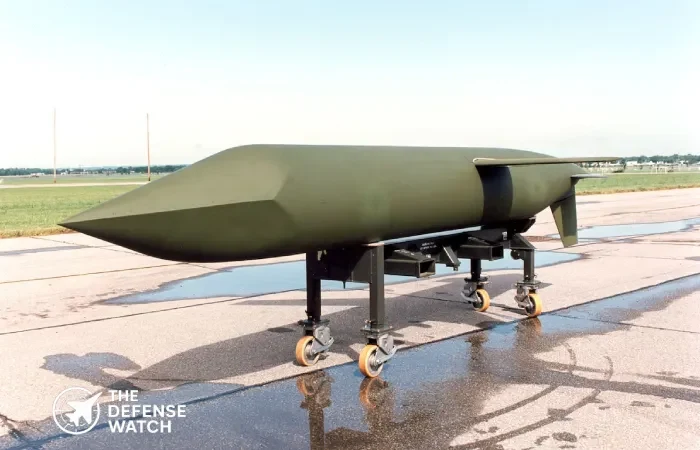
AGM-129A Advanced Cruise Missile
Defense Systems Full Specifications
1. General Information
| Name / Designation | AGM-129A Advanced Cruise Missile (ACM) |
| Type / Role | Air-launched strategic cruise missile, nuclear standoff |
| Country of Origin | United State |
| Manufacturer | General Dynamics (Convair) → Raytheon Missile Systems |
| Service Entry / Year Introduced | 1990 |
| Operational Status | Retired (withdrawn from service in 2012) |
2. Performance & Range
| Range | >2,000 miles (>3,200 km; some sources cite ~2,300–2,500 statute miles) |
| Speed | High subsonic |
| Ceiling / Altitude Limit | Low-level terrain-following flight profile (typically 100–500 ft AGL) |
| Accuracy (CEP) | High precision (estimated <90 meters) |
| Warhead Type | Nuclear (thermonuclear) |
3. Guidance & Targeting
| Guidance System | Inertial + TERCOM + laser Doppler velocimeter |
| Targeting Mode | Autonomous / pre-programmed flight path |
| Launch Platform Compatibility | B-52H Stratofortress (external pylons or internal rotary launcher) |
| Seeker Type | None (no active terminal seeker; relies on inertial/terrain matching) |
4. Physical Characteristics
| Length | 20 ft 10 in (6.35 m) |
| Diameter | 2 ft 3.5 in (0.705 m) |
| Wingspan | 10 ft 2 in (3.1 m) |
| Launch Weight | >3,700 lb (1,680 kg) |
| Propulsion | Williams F112-WR-100 turbofan engine |
5. Warhead & Payload
| Warhead Weight | ~123 kg (W80-1 warhead assembly) |
| Explosive Type | Thermonuclear |
| Detonation Mechanism | Contact / proximity / airburst options |
| Payload Options | Nuclear only (W80-1 variable-yield) |
6. Operational Use & Capabilities
| Operational Range Type | Long |
| Deployment Platform | Air (strategic bomber only) |
| Target Types | Hardened strategic targets, command centers, airfields, high-value assets |
| Combat Proven | No |
| Users / Operators | United States (U.S. Air Force – decommissioned) |
PROS
- Exceptional stealth design significantly reduces detectability by enemy radars.
- Extended range allows deep standoff strikes without penetrating defended airspace.
- High navigation accuracy via multi-mode guidance system.
- Variable-yield nuclear warhead provides flexible targeting options.
- Enhanced bomber survivability by keeping launch platforms farther from threats.
CONS
- High unit and sustainment costs led to limited production and early retirement.
- Complex stealth features increased maintenance and reliability challenges.
- Exclusively nuclear-armed, limiting role in conventional conflicts.
- Retired in 2012, no longer part of active U.S. arsenal.
- Restricted to B-52H platform, reducing deployment flexibility.
The AGM-129A Advanced Cruise Missile represents a pinnacle of late Cold War-era U.S. strategic deterrence technology. Developed as a low-observable, air-launched standoff weapon, it was designed to penetrate sophisticated air defenses and deliver precise strikes against high-value, heavily defended targets. With its stealth features and extended range, the missile enhanced the survivability of U.S. strategic bombers by allowing attacks from well outside enemy radar coverage.
Manufacturer:
Originally developed by General Dynamics (Convair division), with production and later support handled by Raytheon Missile Systems (now part of RTX).
Speed and Range:
The AGM-129A is subsonic, cruising at high subsonic speeds (approximately 500 mph or Mach ~0.8). Its operational range exceeds 2,000 miles (over 3,200 km, with some sources indicating up to ~2,300 statute miles or more depending on profile), significantly surpassing earlier cruise missiles like the AGM-86B.
Cost/Price: Unit costs were high due to advanced stealth features, limited production, and sustainment challenges—estimated at around $4–7 million per missile in 1990s dollars (equivalent to roughly $10–15 million adjusted for inflation today), though exact figures varied with procurement cuts.
AGM-129A Advanced Cruise Missile
The AGM-129A Advanced Cruise Missile (ACM) emerged during the 1980s as a response to evolving Soviet air defense networks. Intended primarily for nuclear deterrence, it provided the U.S. Air Force with a highly survivable, long-range option for strategic bombers.
The missile’s primary purpose was to serve as a stealthy, standoff nuclear delivery system, complementing and eventually superseding aspects of the AGM-86 ALCM family. Key capabilities include low radar cross-section achieved through careful shaping (including forward-swept wings), radar-absorbent materials, and buried engine inlet/exhaust design. Navigation relies on an inertial system augmented by terrain contour matching (TERCOM) and laser Doppler velocimeter updates for exceptional accuracy.
Powered by a Williams International F112-WR-100 turbofan engine (thrust >700 lbs), it achieves efficient long-endurance flight. The warhead is the W80-1 variable-yield thermonuclear device (selectable 5–150 kt), enabling flexible response options against hardened or dispersed targets.
The AGM-129A entered service in 1990 and was deployed exclusively on the B-52H Stratofortress (up to 12–20 missiles per aircraft externally or in the bay). Production totaled around 460 units after initial plans for 1,500 were scaled back post-Cold War. It saw no combat use but contributed to U.S. nuclear posture until retirement in 2012 due to high maintenance costs, arms control considerations (e.g., START treaty impacts), and prioritization of the remaining AGM-86B inventory.
Its stealth and precision made it one of the most advanced cruise missiles of its time, though sustainment proved challenging compared to simpler predecessors.
Disclaimer Note
The information provided on TheDefenseWatch.com is for general informational purposes only. While we strive to ensure the accuracy, completeness, and timeliness of our content regarding defense and aerospace products, technologies, and specifications, we cannot guarantee that all information is 100% accurate or up-to-date due to the evolving nature of military technology and classified data.TheDefenseWatch.com does not warrant the reliability, suitability, or availability of the information for any specific purpose. Users are advised to consult official sources, such as manufacturers, government publications, or defense agencies, for precise and verified data before making decisions based on our content.We are not affiliated with any defense manufacturers, governments, or military organizations mentioned. Opinions, reviews, and ratings reflect expert analysis but are subjective and should not be considered endorsements. TheDefenseWatch.com is not responsible for any errors, omissions, or consequences arising from the use of this website’s content.External links are provided for convenience and do not imply endorsement. TheDefenseWatch.com reserves the right to update or modify content without prior notice. By using this website, you agree to our Privacy & Cookies Policy.
New Arrivals
Popular Comparisons
-
 Tejas Fighter Jet vs F-16 Fighting Falcon: Capability Compared
View Comparison →
Tejas Fighter Jet vs F-16 Fighting Falcon: Capability Compared
View Comparison → -
Rafale Fighter Jet vs F-16 Fighting Falcon : Which Fighter Has the Edge?
View Comparison →
-
Su-57 Fighter Jet vs J-20 Fighter Jet: Stealth and Air Combat Compared
View Comparison →
-
Mirage 2000 vs Tejas Mk1A: Legacy Combat Power vs Indigenous Modernization
View Comparison →
-
Rafale Fighter Jet vs F-22 Raptor: Which Air Dominance Fighter Has the Edge?
View Comparison →
-
Tejas Fighter Jet vs. Rafale Fighter Jet: India’s Indigenous Fighter Meets France’s Proven Multirole Combat Aircraft
View Comparison →
-
F-22 Raptor vs. F-35 Joint Strike Fighter: Which Fifth Generation Fighter Has the Edge?
View Comparison →
-
F-35A vs. F-22 Raptor: Which U.S. Stealth Fighter Dominates Modern Air Combat?
View Comparison →
-
AGM-114 Hellfire vs. AGM-179 JAGM: Which U.S. Precision Missile Is Better?
View Comparison →
-
Patriot (PAC-3) vs. THAAD: Complete Missile Defense System Comparison, Capabilities, Range, and Strategic Roles
View Comparison →
- Bell Boeing Wins $19.8M V-22 Tactical Software Support Contract

- Honeywell Wins $53.9M Navy Contract for WSN-7 Gyro Components
- Lockheed Martin Wins $76.6M Trident II D5LE2 Development Contract
- Lockheed Martin Gets $871.2M F-35 Site Support Contract Increase
- Pete Hegseth Texas Enlistment Ceremony: Hegseth Tells Military Families, We Have Their Back
- U.S., Denmark and Greenland Reach Security Agreement to Expand American Military Presence
- SpaceX Wins Three More NASA Crew Missions in $946 Million ISS Contract
- U.S. Clears Potential $24.3 Billion F-35 Sale to Saudi Arabia
- Type 99B Tank Training Shows China’s Shift Toward Networked Armored Warfare
- JRC Integrated Systems Gets $47.4M SLCM-N Support Contract