
- Home
- Defense Systems
- Defense Systems
- Tempest Air Defense System
Tempest Air Defense System
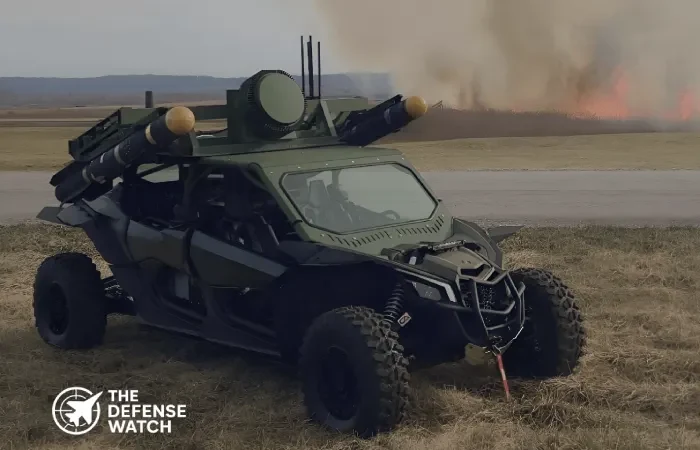
Defense Systems Full Specifications
1. General Information
| System Name | Tempest Air Defense System |
| Manufacturer | V2X |
| Country of Origin | United States |
| Type / Role | Short-Range Air Defense (SHORAD) / Counter-UAS System |
| In Service | Yes |
| Year Introduced | 2025 |
| Unit Cost | USD 5-10 Million (Estimated per Platform) |
2. Performance & Capabilities
| Maximum Engagement Range | 8-11 km |
| Maximum Engagement Altitude | Up to 5 km |
| Target Types | Class 2-3 UAS, Loitering Munitions, Helicopters, Low-Flying Aircraft |
| Interception Probability | High (Based on Hellfire Performance) |
| Reaction Time | Under 15 seconds |
| Radar Detection Range | 8-10 km |
3. Missile Specifications
| Missile Type | AGM-114L Hellfire Longbow |
| Missile Length | 1.63 m |
| Missile Weight | 49 kg | |
| Warhead Type | High-Explosive Anti-Tank (HEAT) / Fragmentation |
| Warhead Weight | 9 kg |
| Speed | Mach 1.3 |
4. Radar & Fire Control
| Radar Type | Millimeter-Wave Radar |
| Radar Name | Integrated Tactical Radar |
| Detection Range | 8-10 km |
| Tracking Capacity | Multiple Targets |
| Guidance System | Active Radar Homing / Fire-and-Forget |
| Fire Control System | Automated Onboard System |
5. Launcher & Mobility
| Launcher Type | Mobile / Vehicle-Mounted |
| No. of Missiles per Launcher | 2 |
| Reload Time | 10-30 minutes |
| Mobility Platform | 4x4 All-Terrain Vehicle (e.g., Can-Am Maverick X3) |
| Crew Required | 2-3 personnel |
6. Command & Control
| C2 System | Integrated Mission Router |
| Connectivity | Secure Data Links / Potential Link-1 |
| Network Capability | Yes (Layered Defense Integration) |
| Operation Mode | Autonomous / Networked |
7. Operational Use
| Primary Operator | Ukraine, United States (Testing) |
| Combat Proven | Yes |
| Conflict History | Russo-Ukrainian War |
| Notable Feature | Rapid Deployment for Mobile Air Defense |
PROS
- High mobility on 4x4 chassis allows rapid repositioning and shoot-and-scoot tactics.
- All-weather capability with millimeter-wave radar ensures reliable performance in adverse conditions.
- Cost-effective design using COTS components reduces production time and expenses.
- Proven effectiveness against drones and low-flying threats, as demonstrated in Ukraine.
- Fire-and-forget missiles minimize operator exposure during engagements.
CONS
- Limited ammunition capacity of only two missiles per launcher restricts sustained fire.
- Short engagement range limits utility against high-altitude or long-distance threats.
- High per-missile cost could strain budgets in prolonged conflicts.
- Vulnerability to ground-based counterattacks if not relocated quickly.
- Reliance on specific Hellfire variants may complicate logistics in diverse operational environments.
The Tempest air defense system emerges as a vital tool in the evolving landscape of asymmetric warfare, where unmanned aerial systems (UAS) and low-altitude threats pose increasing risks to ground forces and critical infrastructure. Developed in response to lessons from ongoing conflicts, this lightweight, modular platform integrates proven missile technology with high-mobility vehicles to deliver quick, effective intercepts. Primarily aimed at short-range air defense (SHORAD), the Tempest excels in protecting forward-operating bases, convoys, and urban areas from drone swarms and rotary-wing aircraft. Its design emphasizes “shoot-and-scoot” tactics, allowing operators to engage targets and relocate swiftly to evade counterfire. As U.S. forces and allies face proliferating drone threats, the Tempest represents a cost-effective bridge between traditional air defense batteries and emerging counter-UAS solutions.
Manufacturer
The Tempest is produced by V2X, a U.S.-based defense contractor headquartered in Virginia, specializing in integrated mission solutions for military operations. Formerly known as Vectrus, V2X leverages commercial off-the-shelf (COTS) components to accelerate production and reduce costs, drawing on expertise in logistics, engineering, and counter-UAS technologies. The system was unveiled at the 2025 Association of the United States Army (AUSA) exhibition, highlighting American innovation in adapting existing armaments for new threats.
Speed and Range
Powered by the AGM-114L Hellfire Longbow missile, the Tempest achieves engagement speeds of up to Mach 1.3, enabling rapid intercepts of agile targets. Its maximum range extends to approximately 8-11 kilometers, depending on environmental conditions, making it ideal for close-in defense. The system’s millimeter-wave radar provides detection and tracking within a similar radius, supporting all-weather operations and fire-and-forget guidance for enhanced operator safety.
Cost/Price
Deployment costs for the Tempest remain competitive due to its use of modular, COTS-based architecture, with estimates placing a single platform at around USD 5-10 million, excluding missiles. Each AGM-114L Hellfire missile carries a unit price of about USD 150,000, factoring into operational expenses for sustained use. Tempest Short-Range Air Defense System Price considerations make it an attractive option for U.S. allies seeking scalable SHORAD without the billion-dollar investments required for larger systems like the Patriot.
With its combat debut in Ukraine, where it has downed over 20 Shahed drones, the Tempest underscores the shift toward mobile, layered air defenses. Integrating with networks like Link-16, it enhances situational awareness and multi-domain operations, positioning it as a key asset for U.S. military planners focused on near-peer conflicts.
Disclaimer Note
The information provided on TheDefenseWatch.com is for general informational purposes only. While we strive to ensure the accuracy, completeness, and timeliness of our content regarding defense and aerospace products, technologies, and specifications, we cannot guarantee that all information is 100% accurate or up-to-date due to the evolving nature of military technology and classified data.TheDefenseWatch.com does not warrant the reliability, suitability, or availability of the information for any specific purpose. Users are advised to consult official sources, such as manufacturers, government publications, or defense agencies, for precise and verified data before making decisions based on our content.We are not affiliated with any defense manufacturers, governments, or military organizations mentioned. Opinions, reviews, and ratings reflect expert analysis but are subjective and should not be considered endorsements. TheDefenseWatch.com is not responsible for any errors, omissions, or consequences arising from the use of this website’s content.External links are provided for convenience and do not imply endorsement. TheDefenseWatch.com reserves the right to update or modify content without prior notice. By using this website, you agree to our Privacy & Cookies Policy.
New Arrivals

Popular Comparisons
-
 J-10C vs JF-17 Thunder: Which Fighter Is More Capable?
View Comparison →
J-10C vs JF-17 Thunder: Which Fighter Is More Capable?
View Comparison → -
Tejas vs Gripen: Key Differences and Capabilities
View Comparison →
-
Tejas vs MiG-21 Bison: How India Replaced Its Iconic Supersonic Fighter
View Comparison →
-
F-35 vs F-16: Stealth, Sensors and Combat Roles
View Comparison →
-
Tejas Fighter Jet vs F-16 Fighting Falcon: Capability Compared
View Comparison →
-
Rafale Fighter Jet vs F-16 Fighting Falcon : Which Fighter Has the Edge?
View Comparison →
-
Su-57 Fighter Jet vs J-20 Fighter Jet: Stealth and Air Combat Compared
View Comparison →
-
Mirage 2000 vs Tejas Mk1A: Legacy Combat Power vs Indigenous Modernization
View Comparison →
-
Rafale Fighter Jet vs F-22 Raptor: Which Air Dominance Fighter Has the Edge?
View Comparison →
-
Tejas Fighter Jet vs. Rafale Fighter Jet: India’s Indigenous Fighter Meets France’s Proven Multirole Combat Aircraft
View Comparison →


- Pratt & Whitney Begins $100 Million Polish Expansion for F-35 Engine Parts

- Northrop Grumman Wins $43.9 Million Contract for Trident II Rocket Motor Facilities
- Ukraine Drone Strikes Disrupt Russian Data Centers, Raising Questions About AI Infrastructure Security
- Lockheed Martin Wins $114.6 Million Contract to Redesign F-35 Navigation Systems
- Project Agincourt Pushes Pentagon to Speed Up Autonomous Weapons Fielding
- Northrop Grumman Factory Expansion Aims to Increase B-21 Raider Production
- France Orders Four More SAMP/T NG Air Defense Systems
- France and UAE Revive Rafale F5 Fighter Development Partnership
- P-800 Oniks Missile: Range, Speed and BrahMos Comparison
- Ukrainian Drone Unit Caused 70% of Simulated U.S. Brigade Casualties in Germany Exercise

Fighter Jets
-
 F-100 Super Sabre
-
North American F-86 Sabre
-
Northrop YF-23 Fighter
-
Rafale F5 Fighter
-
SU-57 Felon Stealth Fighter
-
Boeing F/A-XX Fighter
-
JF-17 Thunder Fighter Jet
-
F-47 Fighter Jet
-
MIG-31 Fighter Jet
-
J-10CE Fighter Jet
-
Chengdu J-10 Fighter Jet
-
Chengdu J-10C Fighter Jet
-
Gripen E Fighter Jet
-
Tejas Mk1A Fighter Jet
-
Tejas Mk‑2 Fighter Jet
-
F-16V Viper Block 70 Fighter Jet
-
F-15EX Eagle II Fighter
-
F-15E Strike Eagle Fighter
-
F/A-18E/F Super Hornet Fighter Jet
-
Saab Gripen F Fighter Jet
-
JAS 39E/F Gripen Fighter Jet
-
JAS 39 Gripen Fighter Jet
-
F-35A Lightning II Fighter Jet
-
F/A-18F Super Hornet







Recent Compares
-
J-10C vs JF-17 Thunder: Which Fighter Is More Capable?
View Comparison →
-
Tejas vs Gripen: Key Differences and Capabilities
View Comparison →
-
Tejas vs MiG-21 Bison: How India Replaced Its Iconic Supersonic Fighter
View Comparison →
-
F-35 vs F-16: Stealth, Sensors and Combat Roles
View Comparison →
-
Tejas Fighter Jet vs F-16 Fighting Falcon: Capability Compared
View Comparison →
Latest Defense Systems
10 Compares Defense Systems
-
J-10C vs JF-17 Thunder: Which Fighter Is More Capable?
View Comparison →
-
Tejas vs Gripen: Key Differences and Capabilities
View Comparison →
-
Tejas vs MiG-21 Bison: How India Replaced Its Iconic Supersonic Fighter
View Comparison →
-
F-35 vs F-16: Stealth, Sensors and Combat Roles
View Comparison →
-
Tejas Fighter Jet vs F-16 Fighting Falcon: Capability Compared
View Comparison →
-
Rafale Fighter Jet vs F-16 Fighting Falcon : Which Fighter Has the Edge?
View Comparison →
-
Su-57 Fighter Jet vs J-20 Fighter Jet: Stealth and Air Combat Compared
View Comparison →
-
Mirage 2000 vs Tejas Mk1A: Legacy Combat Power vs Indigenous Modernization
View Comparison →
-
Rafale Fighter Jet vs F-22 Raptor: Which Air Dominance Fighter Has the Edge?
View Comparison →
-
Tejas Fighter Jet vs. Rafale Fighter Jet: India’s Indigenous Fighter Meets France’s Proven Multirole Combat Aircraft
View Comparison →
- Pratt & Whitney Begins $100 Million Polish Expansion for F-35 Engine Parts
- Northrop Grumman Wins $43.9 Million Contract for Trident II Rocket Motor Facilities
- Ukraine Drone Strikes Disrupt Russian Data Centers, Raising Questions About AI Infrastructure Security
- Lockheed Martin Wins $114.6 Million Contract to Redesign F-35 Navigation Systems
- Project Agincourt Pushes Pentagon to Speed Up Autonomous Weapons Fielding