- Home
- Catalog
- Attack & Multirole Drones (UAVs)
- VTOL Drone
VTOL Drone
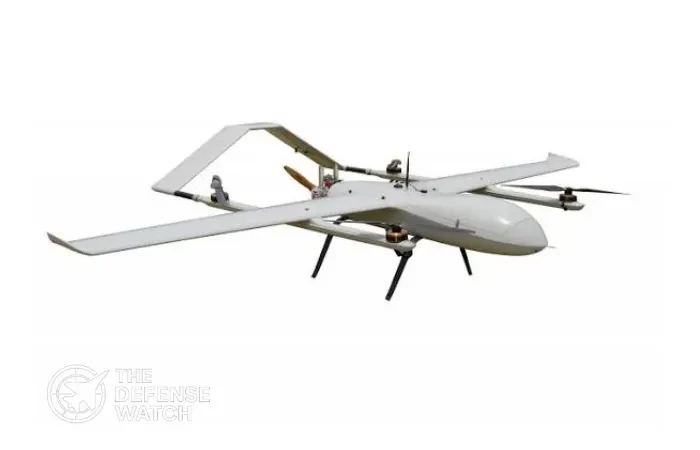
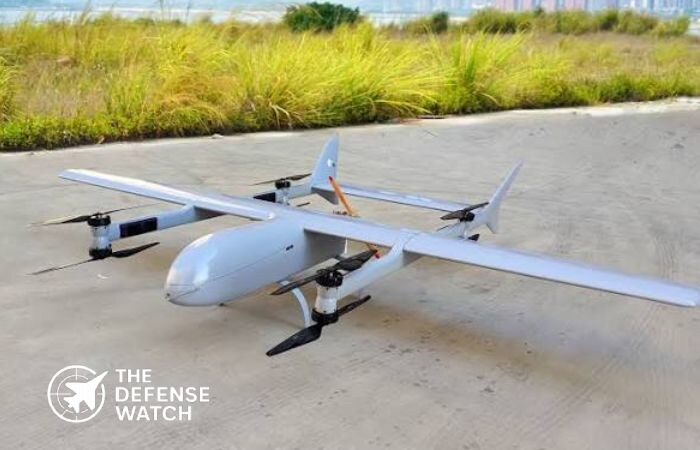
Full Specifications
1. General Information
| Manufacturer | AeroVironment / European OEMs |
| Country of Origin | United States / NATO Allies |
| Type / Role | VTOL ISR / Tactical UAV |
| First Flight / Introduced | 2018–2022 (various models) |
| Status | In Service / Under Development |
| Unit Cost | USD 2–6 Million (Approx.) |
2. Performance
| Maximum Speed | 150 km/h |
| Cruise Speed | 110 km/h |
| Operational Range | 180 km |
| Endurance | 12 hours |
| Service Ceiling | 15,000 ft |
| Rate of Climb | 6 m/s |
3. Dimensions
| Length | 2.5 m |
| Wingspan | 4.2 m |
| Height | 0.9 m |
| Maximum Takeoff Weight (MTOW) | 180 kg |
4. Payload & Armament
| Payload Capacity | 50–120 kg |
| Hardpoints | 2 (configurable) |
| Weapons | Micro-guided bombs, loitering strike munitions |
| Sensors | EO/IR, SAR, Communications Relay, Laser Designator |
| Avionics | GPS/INS, Encrypted Link, Autonomous Flight System |
5. Propulsion
| Engine Type | Electric / Hybrid Propulsion |
| Engine Power | 5–15 kW |
| Propeller Type | Multi-rotor / Tilt-rotor |
6. Communication & Control
| Control Type | Remote / Autonomous |
| Data Link Range | 50 km LOS / SATCOM optional |
| Navigation | GPS / INS / GPS-denied capable |
| Ground Control Station | Portable / Vehicle-Mounted |
7. Operational Use
| Primary Users | U.S. Army, USMC, NATO special forces |
| Combat Proven | Yes (various ISR missions) |
| Notable Operations | Middle East, Africa, Indo-Pacific ISR tasks |
PROS
- No runway required for takeoff or landing
- Highly maneuverable in urban and maritime environments
- Supports modular ISR and strike payloads
- Lower acoustic signature than fixed-wing UAVs
- Ideal for rapid-deployment and special operations
CONS
- Lower endurance than large MALE fixed-wing drones
- Payload capacity limited by lift requirements
- More complex mechanical components (rotors/tilt mechanisms)
- Slower cruise speeds compared to fixed-wing UAVs
- Higher maintenance footprint in harsh environments
Advanced Military VTOL Drone Platform
Vertical Takeoff and Landing (VTOL) drones have rapidly emerged as one of the most versatile unmanned systems in modern military operations. Designed to operate without runways, VTOL UAVs combine helicopter-like lift with fixed-wing endurance, giving U.S. and allied forces a flexible option for intelligence, surveillance, reconnaissance (ISR), and precision support missions.
Most current-generation VTOL military drones are developed by leading Western defense manufacturers such as AeroVironment, Northrop Grumman, and European unmanned aviation firms, with the core design principle focused on maneuverability, modular payloads, and rapid deployment. Their ability to hover, transition to forward flight, and land in confined spaces makes them ideal for operations in dense urban terrain, maritime environments, and remote forward bases—scenarios where traditional fixed-wing UAVs are limited.
Modern VTOL drones typically support a range of mission payloads including EO/IR sensors, synthetic aperture radar, communications relay modules, and small strike munitions. Depending on configuration, these platforms offer endurance between 6 to 20+ hours, operational ranges exceeding 150–300 km, and payload capacities supporting small guided bombs or anti-armor micro-munitions.
Advanced variants feature autonomous flight management, AI-assisted targeting, encrypted data links, and GPS-denied navigation capabilities. Their quiet electric or hybrid propulsion systems reduce acoustic signature—a critical advantage for special operations, border patrol, and close-range reconnaissance.
For U.S. defense planners, VTOL drones fill a strategic niche between compact quadcopters and large HALE/MALE UAVs. They provide persistent ISR, maritime overwatch, and tactical strike options for the Army, Marine Corps, and SOCOM, while requiring minimal logistical support. As demand grows for expeditionary and distributed operations, VTOL UAVs are becoming a key element in modern battlefield networks, supporting rapid-response missions, grey-zone operations, and autonomous swarm concepts.
Get real time update about this post category directly on your device, subscribe now.
Reviews
Disclaimer Note
The information provided on TheDefenseWatch.com is for general informational purposes only. While we strive to ensure the accuracy, completeness, and timeliness of our content regarding defense and aerospace products, technologies, and specifications, we cannot guarantee that all information is 100% accurate or up-to-date due to the evolving nature of military technology and classified data.TheDefenseWatch.com does not warrant the reliability, suitability, or availability of the information for any specific purpose. Users are advised to consult official sources, such as manufacturers, government publications, or defense agencies, for precise and verified data before making decisions based on our content.We are not affiliated with any defense manufacturers, governments, or military organizations mentioned. Opinions, reviews, and ratings reflect expert analysis but are subjective and should not be considered endorsements. TheDefenseWatch.com is not responsible for any errors, omissions, or consequences arising from the use of this website’s content.External links are provided for convenience and do not imply endorsement. TheDefenseWatch.com reserves the right to update or modify content without prior notice. By using this website, you agree to our Privacy & Cookies Policy.
More Products from AeroVironment
New Arrivals



Popular Comparisons
-
 SIG XM7 Rifle vs M4: Key Differences and Performance Comparison
View Comparison →
SIG XM7 Rifle vs M4: Key Differences and Performance Comparison
View Comparison → -
Eurofighter Typhoon vs Rafale vs F-35: Fighter Jet Comparison
View Comparison →
-
J-20 vs F-22: Stealth Fighter Showdown Explained
View Comparison →
-
F-14 Tomcat vs Su-57: Can a Legend Challenge Russia’s Stealth Fighter?
View Comparison →
-
Su-35 vs Su-57: Russia’s Top Fighter Jets Compared
View Comparison →
-
Eurofighter Typhoon vs Su-57: Ultimate Fighter Jet Comparison
View Comparison →
-
Rafale vs Su-57: 4.5 Gen vs 5th Gen Fighter Jet Comparison
View Comparison →
-
Su-57 vs F-16 Fighting Falcon: Stealth vs Speed
View Comparison →
-
China vs Russia: J-20 Mighty Dragon vs Su-57 Felon Comparison
View Comparison →
-
Su-57 Felon vs F-22 Raptor: Stealth Air Superiority Face-Off
View Comparison →


- Lockheed Martin Awarded $700 Million F-35 Contract Modification To Support Denmark And Global Partners

- U.S. Army Brigadier General Nominations Announced In March 9 General Officer Announcement
- US War Against Iran Cost $6 Billion In First Week, Pentagon Reveals
- Turkey Deploys F-16 Fighter Jets To Northern Cyprus Amid Rising Eastern Mediterranean Tensions
- Israel Strikes Iranian Missile Sites And Security Force Headquarters In New Wave Of IDF Operations
- PLA Navy Commissions Two New Type 055 Destroyers, Fleet Reaches 10 Ships
- UK RAF Typhoons Deploy To Qatar To Reinforce UK Air Power In The Gulf
- U.S. Air Force Moves to Dual-Source Its Stand-in Attack Weapon as Iran Conflict Exposes Munitions Demand
- US B-2 Spirit Stealth Bombers Strike 200 Targets In Iran During 72 Hour Operation
- US Navy Launches Operation Ice Camp Boarfish With Submarines USS Delaware And USS Santa Fe In The Arctic