- Home
- Catalog
- Missiles & Precision Weapons
- QW-19 Missile
QW-19 Missile
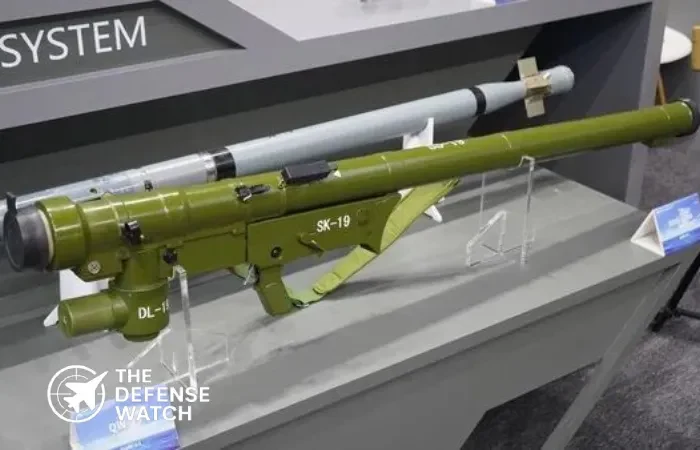
Full Specifications
1. General Information
| Name / Designation | QW‑19 (Vanguard‑19) |
| Type / Role | MANPADS / Short-Range Surface-to-Air Missile |
| Country of Origin | China |
| Manufacturer | Qianwei (CASIC-affiliated) |
| Service Entry / Year Introduced | Mid‑2010s |
| Operational Status | Active |
2. Performance & Range
| Range | 0.5 – 5 km |
| Speed | ~600 m/s (approx. Mach 2) |
| Ceiling / Altitude Limit | Up to ~4,000 meters |
| Accuracy (CEP) | Not publicly disclosed; proximity/impact fuze improves probability |
| Warhead Type | High-explosive fragmentation |
3. Guidance & Targeting
| Guidance System | Dual-band passive infrared seeker |
| Targeting Mode | Fire-and-forget |
| Launch Platform Compatibility | Shoulder-fired by infantry or light-vehicle ground launch |
| Seeker Type | Dual-band infrared (tail-plume and skin heating detection) |
4. Physical Characteristics
| Length | Missile ~1.526 m; launch tube ~1.576 m |
| Diameter | ~71 mm |
| Wingspan | Folding control fins (not publicly disclosed) |
| Launch Weight | ~16.5 kg (missile + launcher) |
| Propulsion | Solid-fuel rocket |
5. Warhead & Payload
| Warhead Weight | ~1.42 kg warhead; ~0.57 kg explosive filling |
| Explosive Type | High-explosive fragmentation |
| Detonation Mechanism | Impact fuse + laser-proximity fuse |
| Payload Options | Conventional HE fragmentation |
6. Operational Use & Capabilities
| Operational Range Type | Short to Medium range (point / tactical air defense) |
| Deployment Platform | Ground — infantry shoulder-launched or light-vehicle mounted |
| Target Types | UAVs, attack helicopters, cruise missiles, low-flying aircraft |
| Combat Proven | Active / In service |
| Users / Operators | China (domestic); exported to select countries |
PROS
- Dual‑band infrared seeker offers robust tracking and resistance to IR jamming and decoys.
- Composite impact + laser proximity fuze improves hit probability against small or maneuvering targets.
- Portable and lightweight (~16.5 kg), suitable for rapid deployment by infantry or light vehicle.
- Effective at low altitudes (down to ~15 m) — useful against drones, cruise missiles, and helicopters.
- Quick reaction time and relatively short launch prep — useful in dynamic, unpredictable combat environments.
CONS
- Limited range (0.5–5 km) restricts engagement to short/medium-range threats only.
- Altitude ceiling (~4,000 m) limits effectiveness against high-altitude aircraft or ballistic threats.
- Infrared seeker may still struggle against advanced stealth or low-heat signature targets.
- Not a replacement for layered air defense — serves only as a point-defense / last line against low-level threats.
- Export availability and interoperability with Western systems may be limited for U.S. partners.
The QW-19 (Vanguard‑19) enters the modern battlefield as a lightweight yet potent short-to-medium range air‑defense missile — a highly mobile solution aimed at countering low-altitude threats such as UAVs, attack helicopters, cruise missiles, and fixed‑wing aircraft operating at tree‑top heights.
Origins, Purpose & Manufacturer
Developed in China as the next evolution in the “Qianwei” (Vanguard) family of man-portable air-defense systems (MANPADS), QW‑19 builds on predecessors like the QW‑1 and QW‑18. The system retains the same basic shoulder‑launch concept but incorporates more advanced guidance, fuze, and seeker technologies — reflecting a shift toward addressing modern aerial threats.
The QW‑19 is designed for tactical air defense forces, ideally deployed by infantry, light vehicles, or static ground-launch teams, to defend against low- to medium-altitude aerial incursions and asymmetric threats.
Key Capabilities & Technical Performance
The QW‑19 employs a dual-band passive infrared seeker (detecting both exhaust plume and airframe skin heating) that enhances its anti-jamming performance — a marked improvement over earlier single-band seekers. A composite “trigger + laser proximity” fuze enables the missile to detonate on impact or when it comes within lethal proximity of the target, increasing its effectiveness against small, low-visibility, or agile threats such as drones and cruise missiles.
QW‑19’s launcher tube and missile together weigh about 16.5 kg, making it comparable in portability to other MANPADS such as the U.S. systems. The missile length is roughly 1.526 m, and the launch tube is about 1.576 m long, with a diameter around 71 mm.
Performance specs place its engagement range at approximately 500 to 5,000 meters, with optimal interception altitudes up to around 4,000 meters, and minimum effective altitude lowered to about 15 meters — enhancing capability against ultra-low altitude threats. The missile reaches a flight speed near 600 m/s (some sources suggest up to Mach‑2 class), sufficient to engage fast-moving targets.
Because of these attributes — portability, quick reaction (cold‑start and launch readiness in under ~10 seconds), infrared dual-band guidance, and composite proximity/impact fuze — QW‑19 offers a credible, low-cost air defense layer that is especially suited for modern asymmetric and hybrid threats in tactical theaters.
QW-19 Missile Price
As a Chinese export-design MANPADS, QW‑19 is not offered for direct sale on Western defense catalogs. Its procurement and price for U.S. or allied forces would be subject to bilateral agreements, export controls, and geopolitical considerations. Based on publicly available information, no official U.S. sale price is disclosed.
Get real time update about this post category directly on your device, subscribe now.
Reviews
Disclaimer Note
The information provided on TheDefenseWatch.com is for general informational purposes only. While we strive to ensure the accuracy, completeness, and timeliness of our content regarding defense and aerospace products, technologies, and specifications, we cannot guarantee that all information is 100% accurate or up-to-date due to the evolving nature of military technology and classified data.TheDefenseWatch.com does not warrant the reliability, suitability, or availability of the information for any specific purpose. Users are advised to consult official sources, such as manufacturers, government publications, or defense agencies, for precise and verified data before making decisions based on our content.We are not affiliated with any defense manufacturers, governments, or military organizations mentioned. Opinions, reviews, and ratings reflect expert analysis but are subjective and should not be considered endorsements. TheDefenseWatch.com is not responsible for any errors, omissions, or consequences arising from the use of this website’s content.External links are provided for convenience and do not imply endorsement. TheDefenseWatch.com reserves the right to update or modify content without prior notice. By using this website, you agree to our Privacy & Cookies Policy.
New Arrivals


Popular Comparisons
-
 SIG XM7 Rifle vs M4: Key Differences and Performance Comparison
View Comparison →
SIG XM7 Rifle vs M4: Key Differences and Performance Comparison
View Comparison → -
Eurofighter Typhoon vs Rafale vs F-35: Fighter Jet Comparison
View Comparison →
-
J-20 vs F-22: Stealth Fighter Showdown Explained
View Comparison →
-
F-14 Tomcat vs Su-57: Can a Legend Challenge Russia’s Stealth Fighter?
View Comparison →
-
Su-35 vs Su-57: Russia’s Top Fighter Jets Compared
View Comparison →
-
Eurofighter Typhoon vs Su-57: Ultimate Fighter Jet Comparison
View Comparison →
-
Rafale vs Su-57: 4.5 Gen vs 5th Gen Fighter Jet Comparison
View Comparison →
-
Su-57 vs F-16 Fighting Falcon: Stealth vs Speed
View Comparison →
-
China vs Russia: J-20 Mighty Dragon vs Su-57 Felon Comparison
View Comparison →
-
Su-57 Felon vs F-22 Raptor: Stealth Air Superiority Face-Off
View Comparison →


- Iran-US Ceasefire Negotiations Stall as Strait of Hormuz Standoff Deepens

- US Deploys Uncrewed Drone Boats In Conflict With Iran As Maritime Tensions Escalate
- Raytheon Expands Alabama Missile Integration Facility To Boost U.S. Defense Production Capacity
- Australian-Built Boxer Combat Reconnaissance Vehicles Roll Off Production Line, Boosting Land 400 Program
- U.S. Army To Begin M1E3 Abrams Prototype Operational Testing In Summer 2026
- Raytheon Secures $773.5M Contract Boost For AN/TPY-2 Radar Development Through 2030
- Javelin Missile Production Ramp Accelerates as Lockheed Martin Overhauls Supply Chain for High-Volume Output
- Indian Army To Buy 800 Km Plus Range BrahMos Supersonic Cruise Missiles
- US Navy Iwo Jima Amphibious Ready Group Expands Caribbean Anti-Trafficking Push
- Chinas Laser Air Defense Systems Light Arrow 21A And Light Arrow 11E Form Layered Counter Drone Shield