- Home
- Catalog
- Aircraft Carriers
- Giuseppe Garibaldi Aircraft Carrier
Giuseppe Garibaldi Aircraft Carrier
Full Specifications
1. Physical Characteristics
| Ship Type | Light Aircraft Carrier |
| Class | Giuseppe Garibaldi class |
| Length | 180 m |
| Beam (Width) | 33 m |
| Flight Deck Width | Approx. 30 m |
| Draft | 8.2 m |
| Displacement (Full Load) | Approx. 14,000 tons |
2. Propulsion & Performance
| Propulsion Type | Conventional Gas Turbine |
| Powerplant | 4 Gas Turbines |
| Shafts | 2 |
| Maximum Speed | 30 knots |
| Range | 7,000 nautical miles |
| Endurance | 45 days |
3. Flight Operations
| Aircraft Launch System | STOVL |
| Catapult Type | None |
| Recovery System | Vertical landing |
| Total Aircraft Capacity | Up to 16 aircraft |
| Hangar Capacity | Enclosed hangar deck |
| Aircraft Types Supported | Fighters and ASW helicopters |
4. Sensors & Electronics
| Primary Radar | 3D Air Search Radar |
| Navigation Radar | Standard naval navigation radar |
| Fire Control Radar | Supports CIWS and SAM |
| Electronic Warfare Suite | ESM and ECM systems |
| Communication Systems | SATCOM and NATO data links |
5. Weapons & Defense Systems
| CIWS | Close in gun systems |
| Short-Range SAMs | Albatros Aspide system |
| Missile Launchers | Surface defense only |
| Decoy Systems | Chaff and flare launchers |
6. Command & Control
| Combat Management System | Integrated CMS |
| Combat Information Center (CIC) | Dedicated CIC |
| Air Operations Center | Full flight control center |
| Data Links | NATO compatible links |
7. Crew & Capacity
| Ship Crew | Approx. 550 |
| Air Wing Personnel | Approx. 230 |
| Total Complement | Approx. 780 |
8. Construction & Cost
| Shipbuilder/Manufacturer | Fincantieri |
| Construction Started | 1981 |
| Commissioned | 1985 |
| Estimated Cost | $1.3 to $1.5 billion adjusted |
PROS
- Proven NATO operational history
- VSTOL capability with ski jump deck
- High top speed for a light carrier
- Flexible helicopter and strike roles
- Strong command and control suite
CONS
- Limited aircraft capacity
- Conventional propulsion limits endurance
- Lacks catapult launch system
- Older radar compared to modern carriers
- Reduced survivability versus larger carriers
Giuseppe Garibaldi Light Aircraft Carrier
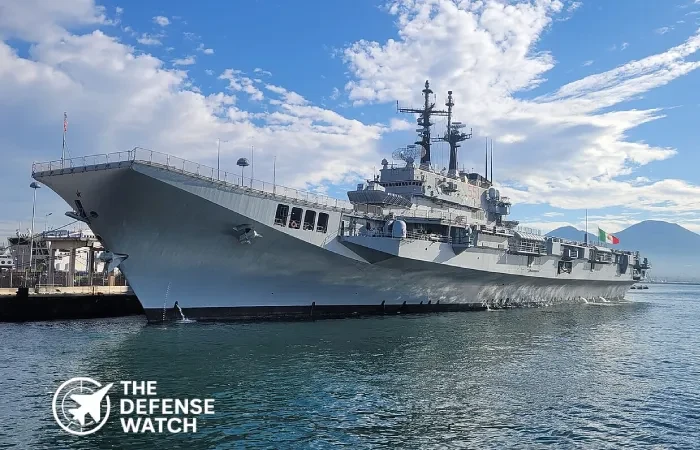
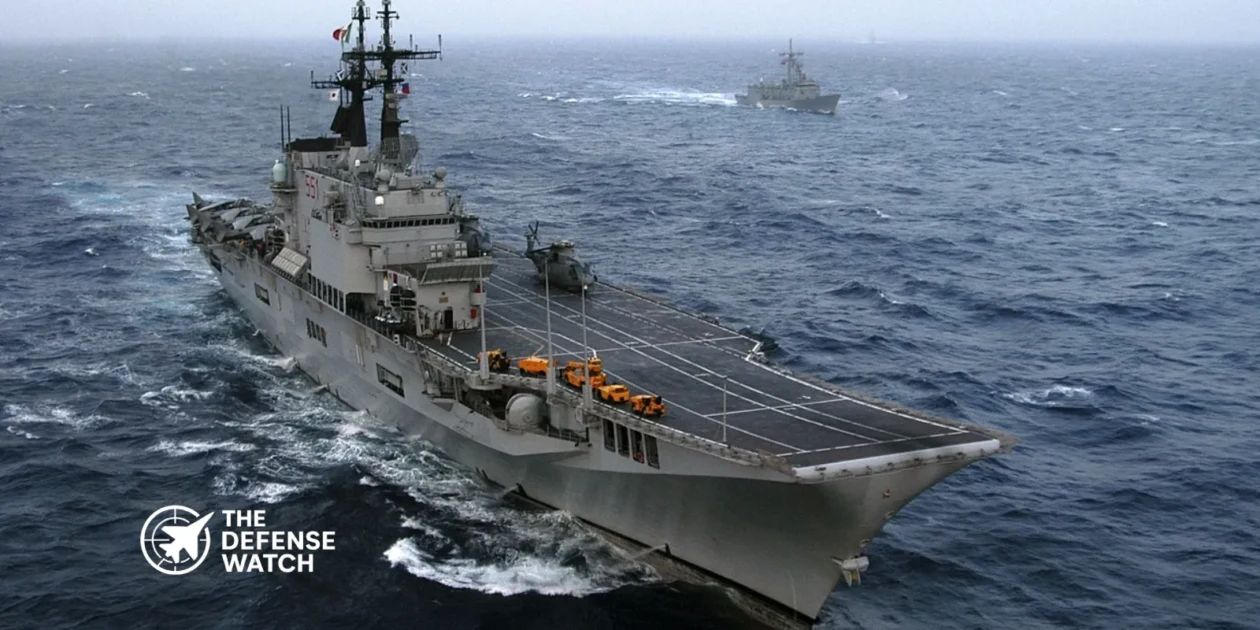
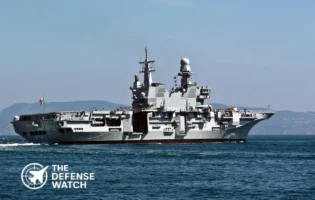
The Giuseppe Garibaldi aircraft carrier served for decades as the flagship of the Italian Navy and marked a major step in Italy’s post Cold War naval aviation strategy. Commissioned in 1985, it was Italy’s first true aircraft carrier and one of the earliest European ships designed to operate VSTOL fighter jets.
Built by Fincantieri at the Monfalcone shipyard, the vessel was designed as a light aircraft carrier with a focus on fleet air defense, maritime security, and expeditionary operations. It primarily operated the AV-8B Harrier II before transitioning toward helicopter and amphibious support roles later in its service life.
Speed and Range
Powered by a combined gas turbine propulsion system, Giuseppe Garibaldi could reach speeds of approximately 30 knots. The ship had a range of about 7,000 nautical miles at cruising speed, enabling sustained Mediterranean and NATO deployments without frequent refueling.
Operational Role and Capabilities
With a ski jump flight deck, the carrier supported short takeoff and vertical landing aircraft. Its air wing typically included Harrier strike fighters, anti submarine warfare helicopters, and transport helicopters. The ship featured 3D air search radar, electronic warfare systems, and short range air defense systems including surface to air missiles and close in weapon systems.
Giuseppe Garibaldi participated in NATO operations in the Balkans, Afghanistan, and Libya. It served as a mobile air base, command platform, and humanitarian response hub before being replaced by the larger Cavour.
Cost
Estimated construction cost in the 1980s was roughly $1.3 to $1.5 billion in contemporary U.S. dollar terms, adjusted for inflation.
Get real time update about this post category directly on your device, subscribe now.
Reviews
Disclaimer Note
The information provided on TheDefenseWatch.com is for general informational purposes only. While we strive to ensure the accuracy, completeness, and timeliness of our content regarding defense and aerospace products, technologies, and specifications, we cannot guarantee that all information is 100% accurate or up-to-date due to the evolving nature of military technology and classified data.TheDefenseWatch.com does not warrant the reliability, suitability, or availability of the information for any specific purpose. Users are advised to consult official sources, such as manufacturers, government publications, or defense agencies, for precise and verified data before making decisions based on our content.We are not affiliated with any defense manufacturers, governments, or military organizations mentioned. Opinions, reviews, and ratings reflect expert analysis but are subjective and should not be considered endorsements. TheDefenseWatch.com is not responsible for any errors, omissions, or consequences arising from the use of this website’s content.External links are provided for convenience and do not imply endorsement. TheDefenseWatch.com reserves the right to update or modify content without prior notice. By using this website, you agree to our Privacy & Cookies Policy.
More Products from Fincantieri
New Arrivals


Popular Comparisons
-
 SIG XM7 Rifle vs M4: Key Differences and Performance Comparison
View Comparison →
SIG XM7 Rifle vs M4: Key Differences and Performance Comparison
View Comparison → -
Eurofighter Typhoon vs Rafale vs F-35: Fighter Jet Comparison
View Comparison →
-
J-20 vs F-22: Stealth Fighter Showdown Explained
View Comparison →
-
F-14 Tomcat vs Su-57: Can a Legend Challenge Russia’s Stealth Fighter?
View Comparison →
-
Su-35 vs Su-57: Russia’s Top Fighter Jets Compared
View Comparison →
-
Eurofighter Typhoon vs Su-57: Ultimate Fighter Jet Comparison
View Comparison →
-
Rafale vs Su-57: 4.5 Gen vs 5th Gen Fighter Jet Comparison
View Comparison →
-
Su-57 vs F-16 Fighting Falcon: Stealth vs Speed
View Comparison →
-
China vs Russia: J-20 Mighty Dragon vs Su-57 Felon Comparison
View Comparison →
-
Su-57 Felon vs F-22 Raptor: Stealth Air Superiority Face-Off
View Comparison →


- Saab And Ukrainian Defense Industry Sign MoU On Aviation And Airborne Surveillance Cooperation

- NATO Deploys World’s Largest Drone Fleet To Strengthen Baltic Deterrence
- Airbus H175M Military Helicopter Demonstrates Superior Range In Saudi Arabian Desert Trials
- L3Harris Successfully Completes First Phase of P25 Transition for Florida SLERS
- L3Harris VAMPIRE System Successfully Integrates Thales 70mm Rockets In Poland Live-Fire Test
- IDF Eliminates Hezbollah Operative In Southern Lebanon Airstrike
- Turkish KAAN Fighter Jet Expects US Approval For F110 Engines In 2026
- Mexican Navy Unveils New Multipurpose Vessel Class As Construction Reaches 37 Percent
- Switzerland’s 5 Patriot Air Defense Systems Deal Faces Delay, Cost Uncertainty Amid U.S. Ukraine Priority
- Extended-Range GMLRS Completes M270A2 Launch Qualification, Doubles Strike Range To 150 Kilometers