- Home
- Catalog
- Missiles & Precision Weapons
- Glide Vehicle
- Missiles & Precision Weapons
- DF‑ZF Hypersonic Glide Vehicle (HGV)
DF‑ZF Hypersonic Glide Vehicle (HGV)
Full Specifications
1. General Information
| Name / Designation | DF-ZF (formerly WU-14) |
| Type | Hypersonic Glide Vehicle (HGV) |
| Manufacturer | China Aerospace Science Industry Corporation (CASIC), 10th Research Institute |
| Country of Origin | China |
| Role / Purpose | High-speed, maneuverable strike with conventional or nuclear payload |
| Operational Status | Operational (since ≈2020) |
2. Physical Characteristics
| Length | Not publicly disclosed |
| Body Design | Lifting-body glider with control fins for aerodynamic maneuvering |
| Material | High-temperature composites with thermal protection |
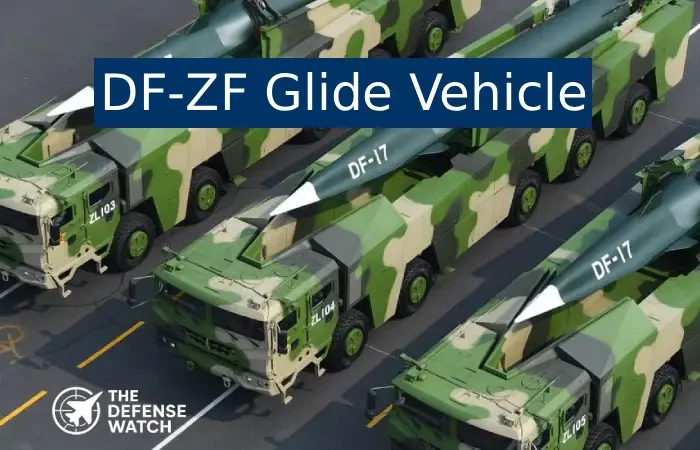
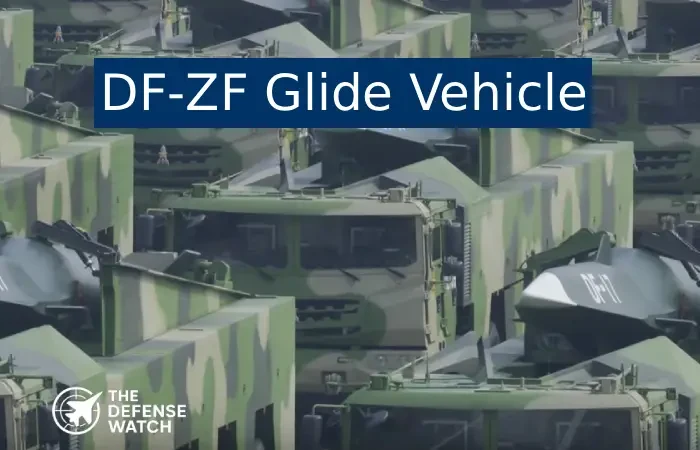
| Launch Platform | DF-17 solid-fueled mobile ballistic missile booster |
| Payload Capacity | Compatible with conventional or nuclear warhead (weight not disclosed) |
3. Propulsion & Performance
| Propulsion Type | None during glide; powered by DF-17 booster until release |
| Speed | Mach 5–10 (~1.7–3.4 km/s) |
| Range | ~1,800–2,500 km (booster-dependent) |
| Maneuverability | High; evasive glide maneuvers during flight |
| Flight Profile | Boost-glide: ascent to near-space, separation, unpowered hypersonic glide |
4. Navigation & Guidance
| Guidance System | Inertial navigation system, possibly augmented by terminal sensors |
| Terminal Guidance | Likely inertial + sensors (details classified) |
| Accuracy (CEP) | Not publicly confirmed; reported “within meters” in tests |
| Counter-Jamming | Hardened against basic electronic countermeasures |
5. Warhead & Payload
| Warhead Type | Conventional or nuclear |
| Explosive Yield | Not publicly disclosed; depends on payload |
| Penetration Ability | Designed to defeat advanced missile-defense systems via high speed & maneuverable glide |
6. Survivability & Defensive Features
| Thermal Protection | Advanced high-temperature composites for re-entry heat resistance |
| Stealth Features | Low-altitude, non-ballistic glide reduces radar/infrared detection |
| Anti-Interception Ability | Unpredictable glide path + hypersonic speed limits effectiveness of current ABM systems |
PROS
- Extremely high speed (Mach 5–10) reduces defense reaction time and increases penetration probability.
- Maneuverable glide path makes interception by conventional missile-defense systems highly difficult.
- Medium-to-long range (≈ 1,800–2,500 km) enables regional strike flexibility.
- Compatible with conventional or nuclear warheads, giving strategic options for deterrence or precision strike.
- Road‑mobile launcher (DF‑17) enhances survivability and rapid deployment readiness.
CONS
- Precise technical performance (accuracy, warhead yield, exact guidance) remains unconfirmed in open sources.
- As a glide-only vehicle, lacks continuous powered propulsion — limiting range/altitude tradeoffs compared to cruise missiles.
- Glide-phase deceleration reduces terminal velocity compared to a ballistic reentry — possibly making it vulnerable to high-altitude or lower‑tier interceptors under some conditions.
- Limited public data on payload capacity or warhead weight reduces clarity on destructive power.
- Operational and logistical footprint (transport, launch infrastructure, maintenance) likely remains complex and resource-intensive.
DF‑ZF Hypersonic Glide Vehicle (HGV)
The DF‑ZF represents a significant leap in modern strike capabilities — a hypersonic glide vehicle (HGV) engineered to outpace and outmaneuver existing missile defenses. Built by China’s China Aerospace Science Industry Corporation (CASIC) in cooperation with its 10th Research Institute, DF‑ZF (formerly designated “WU‑14”) entered operational status around 2019–2020, integrated primarily with the road‑mobile DF‑17 medium-range ballistic missile.
Upon launch, the DF‑17’s solid‑fuel booster carries DF‑ZF to near‑space altitudes — roughly 100 km — before release. At that point, the DF‑ZF shifts to a boost‑glide profile: using aerodynamic lift rather than powered thrust, it glides toward its target at sustained hypersonic velocities, reportedly between Mach 5 and Mach 10.
This combination of extreme speed and maneuverable glide drastically complicates tracking and interception. Traditional ballistic missiles follow predictable arcs; the DF‑ZF instead performs evasive flight, weaving laterally or changing altitude, limiting reaction windows for missile defense systems.
Intended for both conventional and nuclear payloads, DF‑ZF enhances strategic flexibility. Its estimated range — when paired with DF‑17 — lies between 1,800 and 2,500 km, enabling strikes across a broad regional footprint.
As such, DF‑ZF stands as one of the world’s first operational hypersonic glide vehicles, designed not simply for speed but for survivable penetration of modern layered air‑ and missile‑defenses. Its existence shifts the calculus for any adversary relying on legacy interceptor systems.
DF‑ZF Glide Vehicle Price
Due to the classified nature of DF‑ZF, no public data is available regarding acquisition cost. Officially only limited production and deployment numbers are acknowledged by the manufacturer and relevant Chinese authorities; thus a validated “price in the United States” cannot be provided.
Get real time update about this post category directly on your device, subscribe now.
Reviews
Disclaimer Note
The information provided on TheDefenseWatch.com is for general informational purposes only. While we strive to ensure the accuracy, completeness, and timeliness of our content regarding defense and aerospace products, technologies, and specifications, we cannot guarantee that all information is 100% accurate or up-to-date due to the evolving nature of military technology and classified data.TheDefenseWatch.com does not warrant the reliability, suitability, or availability of the information for any specific purpose. Users are advised to consult official sources, such as manufacturers, government publications, or defense agencies, for precise and verified data before making decisions based on our content.We are not affiliated with any defense manufacturers, governments, or military organizations mentioned. Opinions, reviews, and ratings reflect expert analysis but are subjective and should not be considered endorsements. TheDefenseWatch.com is not responsible for any errors, omissions, or consequences arising from the use of this website’s content.External links are provided for convenience and do not imply endorsement. TheDefenseWatch.com reserves the right to update or modify content without prior notice. By using this website, you agree to our Privacy & Cookies Policy.



New Arrivals





Popular Comparisons
-
 SIG XM7 Rifle vs M4: Key Differences and Performance Comparison
View Comparison →
SIG XM7 Rifle vs M4: Key Differences and Performance Comparison
View Comparison → -
Eurofighter Typhoon vs Rafale vs F-35: Fighter Jet Comparison
View Comparison →
-
J-20 vs F-22: Stealth Fighter Showdown Explained
View Comparison →
-
F-14 Tomcat vs Su-57: Can a Legend Challenge Russia’s Stealth Fighter?
View Comparison →
-
Su-35 vs Su-57: Russia’s Top Fighter Jets Compared
View Comparison →
-
Eurofighter Typhoon vs Su-57: Ultimate Fighter Jet Comparison
View Comparison →
-
Rafale vs Su-57: 4.5 Gen vs 5th Gen Fighter Jet Comparison
View Comparison →
-
Su-57 vs F-16 Fighting Falcon: Stealth vs Speed
View Comparison →
-
China vs Russia: J-20 Mighty Dragon vs Su-57 Felon Comparison
View Comparison →
-
Su-57 Felon vs F-22 Raptor: Stealth Air Superiority Face-Off
View Comparison →


- Iran-US Ceasefire Negotiations Stall as Strait of Hormuz Standoff Deepens

- US Deploys Uncrewed Drone Boats In Conflict With Iran As Maritime Tensions Escalate
- Raytheon Expands Alabama Missile Integration Facility To Boost U.S. Defense Production Capacity
- Australian-Built Boxer Combat Reconnaissance Vehicles Roll Off Production Line, Boosting Land 400 Program
- U.S. Army To Begin M1E3 Abrams Prototype Operational Testing In Summer 2026
- Raytheon Secures $773.5M Contract Boost For AN/TPY-2 Radar Development Through 2030
- Javelin Missile Production Ramp Accelerates as Lockheed Martin Overhauls Supply Chain for High-Volume Output
- Indian Army To Buy 800 Km Plus Range BrahMos Supersonic Cruise Missiles
- US Navy Iwo Jima Amphibious Ready Group Expands Caribbean Anti-Trafficking Push
- Chinas Laser Air Defense Systems Light Arrow 21A And Light Arrow 11E Form Layered Counter Drone Shield