- Home
- Catalog
- Attack & Multirole Drones (UAVs)
- Bayraktar TB3 Drone
Bayraktar TB3 Drone
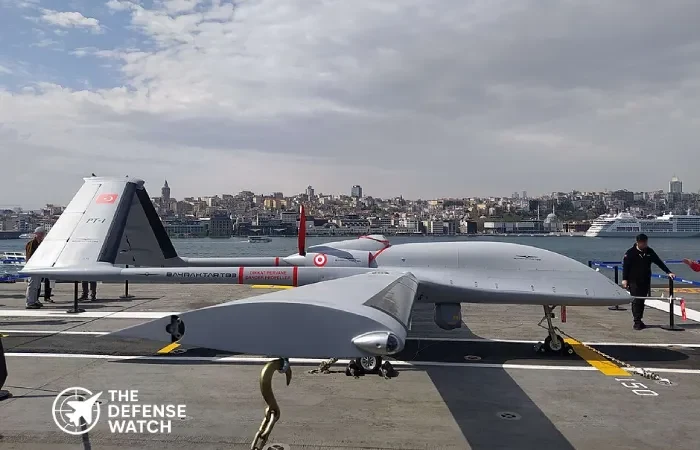
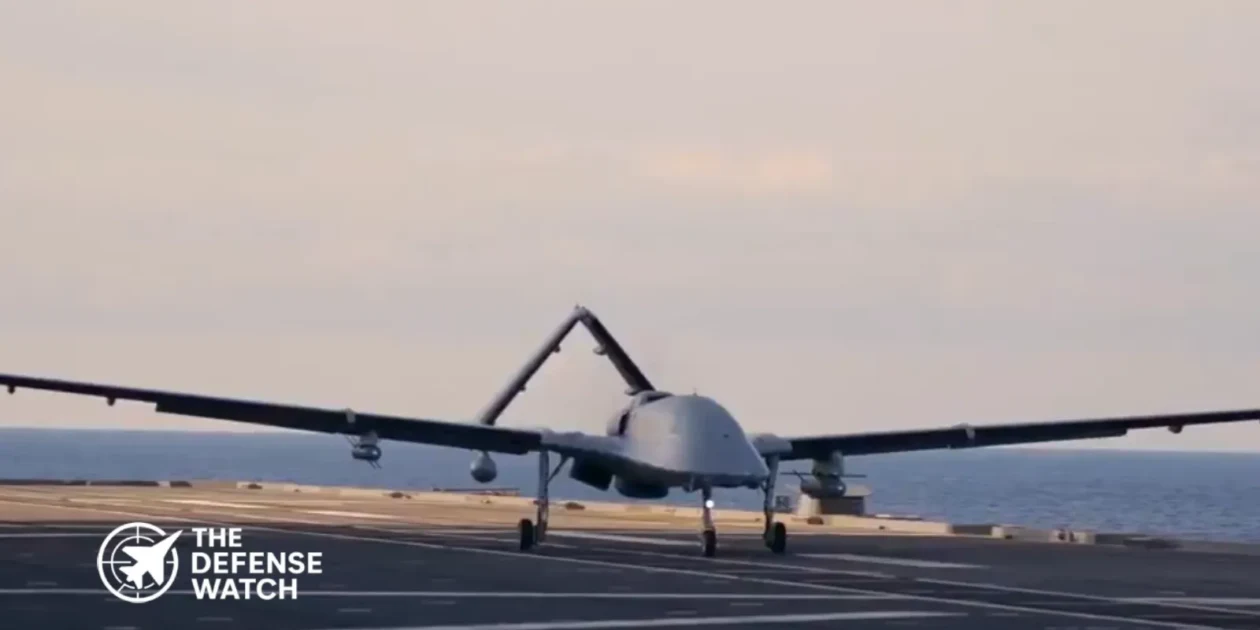
Full Specifications
1. General Information
| Name | Bayraktar TB3 |
| Manufacturer | Baykar Technologies |
| Country of Origin | Turkey |
| Type / Role | Naval Strike and Reconnaissance UAV |
| First Flight / Introduced | 2023 |
| Status | Under Development |
| Unit Cost | Estimated USD 3 to 5 Million |
2. Performance
| Maximum Speed | 300 km per hour |
| Cruise Speed | 220 km per hour |
| Operational Range | Satellite controlled |
| Endurance | 24 plus hours |
| Service Ceiling | 30,000 ft |
3. Dimensions
| Length | Approx. 8.5 m |
| Wingspan | Approx. 14 m folding |
| Maximum Takeoff Weight (MTOW) | Approx. 1,450 kg |
4. Payload & Armament
| Payload Capacity | Approx. 280 kg |
| Hardpoints | 4 |
| Weapons | MAM L, MAM T precision munitions |
| Sensors | EO IR, laser designator |
5. Propulsion
| Engine Type | Turbocharged piston engine |
| Propeller Type | Rear mounted |
6. Communication & Control
| Control Type | Remote and semi autonomous |
| Data Link Range | Line of sight and SATCOM |
| Navigation | GPS INS |
7. Operational Use
| Primary Users | Turkish Armed Forces |
| Combat Proven | Pending |
| Notable Operations | Naval trials ongoing |
PROS
- Designed for ship based operations
- Long endurance for persistent surveillance
- Combat proven weapon ecosystem
- Satellite controlled beyond line of sight
- Lower cost than manned naval aircraft
CONS
- Limited payload compared to larger UAVs
- Subsonic speed reduces survivability
- Dependent on satellite connectivity
- No stealth shaping
- Limited air to air capability
Bayraktar TB3 Naval Strike UAV
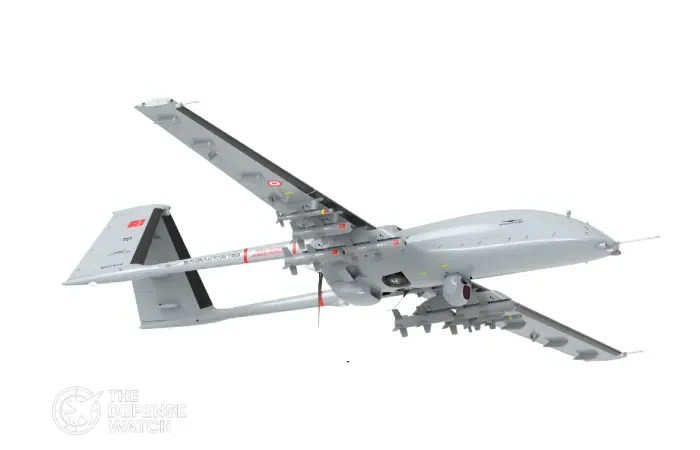
The Bayraktar TB3 is Turkiye’s next step in combat proven unmanned aviation. Designed to operate from short runways and aircraft carrying ships, the TB3 expands the Bayraktar family into true naval strike and expeditionary roles. It is optimized for maritime surveillance, armed reconnaissance, and precision strike missions where manned aircraft access is limited or risky.
Manufacturer and Origin
The TB3 is developed by Baykar Technologies, a private Turkish defense firm known for the Bayraktar TB2 and Akinci UAVs. Built as a navalized evolution of the TB2, the TB3 is intended to operate from Turkiye’s TCG Anadolu amphibious assault ship, as well as land bases with minimal infrastructure.
Speed, Range, and Performance
Bayraktar TB3 features folding wings for shipboard storage and operations. It has a maximum speed of about 300 km per hour and can remain airborne for more than 24 hours. The drone supports beyond line of sight control through satellite communications, enabling regional and expeditionary missions far from the launch platform.
Payload, Sensors, and Armament
The TB3 carries electro optical and infrared sensors with laser designation. It is compatible with Turkish made smart munitions such as MAM L and MAM T precision guided weapons. Payload capacity is higher than TB2, allowing improved strike flexibility and maritime targeting.
The Bayraktar TB3 is Turkiye’s next step in combat proven unmanned aviation. Designed to operate from short runways and aircraft carrying ships, the TB3 expands the Bayraktar family into true naval strike and expeditionary roles. It is optimized for maritime surveillance, armed reconnaissance, and precision strike missions where manned aircraft access is limited or risky.Manufacturer and OriginThe TB3 is developed by Baykar Technologies, a private Turkish defense firm known for the Bayraktar TB2 and Akinci UAVs. Built as a navalized evolution of the TB2, the TB3 is intended to operate from Turkiye’s TCG Anadolu amphibious assault ship, as well as land bases with minimal infrastructure.Speed, Range, and PerformanceBayraktar TB3 features folding wings for shipboard storage and operations. It has a maximum speed of about 300 km per hour and can remain airborne for more than 24 hours. The drone supports beyond line of sight control through satellite communications, enabling regional and expeditionary missions far from the launch platform.Payload, Sensors, and ArmamentThe TB3 carries electro optical and infrared sensors with laser designation. It is compatible with Turkish made smart munitions such as MAM L and MAM T precision guided weapons. Payload capacity is higher than TB2, allowing improved strike flexibility and maritime targeting.Cost and Operational UseExact unit cost has not been disclosed, but analysts estimate the TB3 to be priced in the low single digit millions per unit, depending on configuration. It is expected to serve with the Turkish Navy and attract export interest from navies seeking carrier capable UAVs.Cost and Operational Use
Exact unit cost has not been disclosed, but analysts estimate the TB3 to be priced in the low single digit millions per unit, depending on configuration. It is expected to serve with the Turkish Navy and attract export interest from navies seeking carrier capable UAVs.
Get real time update about this post category directly on your device, subscribe now.
Reviews
Disclaimer Note
The information provided on TheDefenseWatch.com is for general informational purposes only. While we strive to ensure the accuracy, completeness, and timeliness of our content regarding defense and aerospace products, technologies, and specifications, we cannot guarantee that all information is 100% accurate or up-to-date due to the evolving nature of military technology and classified data.TheDefenseWatch.com does not warrant the reliability, suitability, or availability of the information for any specific purpose. Users are advised to consult official sources, such as manufacturers, government publications, or defense agencies, for precise and verified data before making decisions based on our content.We are not affiliated with any defense manufacturers, governments, or military organizations mentioned. Opinions, reviews, and ratings reflect expert analysis but are subjective and should not be considered endorsements. TheDefenseWatch.com is not responsible for any errors, omissions, or consequences arising from the use of this website’s content.External links are provided for convenience and do not imply endorsement. TheDefenseWatch.com reserves the right to update or modify content without prior notice. By using this website, you agree to our Privacy & Cookies Policy.
More Products from Baykar (Türkiye)
New Arrivals



Popular Comparisons
-
 SIG XM7 Rifle vs M4: Key Differences and Performance Comparison
View Comparison →
SIG XM7 Rifle vs M4: Key Differences and Performance Comparison
View Comparison → -
Eurofighter Typhoon vs Rafale vs F-35: Fighter Jet Comparison
View Comparison →
-
J-20 vs F-22: Stealth Fighter Showdown Explained
View Comparison →
-
F-14 Tomcat vs Su-57: Can a Legend Challenge Russia’s Stealth Fighter?
View Comparison →
-
Su-35 vs Su-57: Russia’s Top Fighter Jets Compared
View Comparison →
-
Eurofighter Typhoon vs Su-57: Ultimate Fighter Jet Comparison
View Comparison →
-
Rafale vs Su-57: 4.5 Gen vs 5th Gen Fighter Jet Comparison
View Comparison →
-
Su-57 vs F-16 Fighting Falcon: Stealth vs Speed
View Comparison →
-
China vs Russia: J-20 Mighty Dragon vs Su-57 Felon Comparison
View Comparison →
-
Su-57 Felon vs F-22 Raptor: Stealth Air Superiority Face-Off
View Comparison →


- Iran-US Ceasefire Negotiations Stall as Strait of Hormuz Standoff Deepens

- US Deploys Uncrewed Drone Boats In Conflict With Iran As Maritime Tensions Escalate
- Raytheon Expands Alabama Missile Integration Facility To Boost U.S. Defense Production Capacity
- Australian-Built Boxer Combat Reconnaissance Vehicles Roll Off Production Line, Boosting Land 400 Program
- U.S. Army To Begin M1E3 Abrams Prototype Operational Testing In Summer 2026
- Raytheon Secures $773.5M Contract Boost For AN/TPY-2 Radar Development Through 2030
- Javelin Missile Production Ramp Accelerates as Lockheed Martin Overhauls Supply Chain for High-Volume Output
- Indian Army To Buy 800 Km Plus Range BrahMos Supersonic Cruise Missiles
- US Navy Iwo Jima Amphibious Ready Group Expands Caribbean Anti-Trafficking Push
- Chinas Laser Air Defense Systems Light Arrow 21A And Light Arrow 11E Form Layered Counter Drone Shield