- Home
- Catalog
- Missiles & Precision Weapons
- Babur-Class Cruise Missile
Babur-Class Cruise Missile
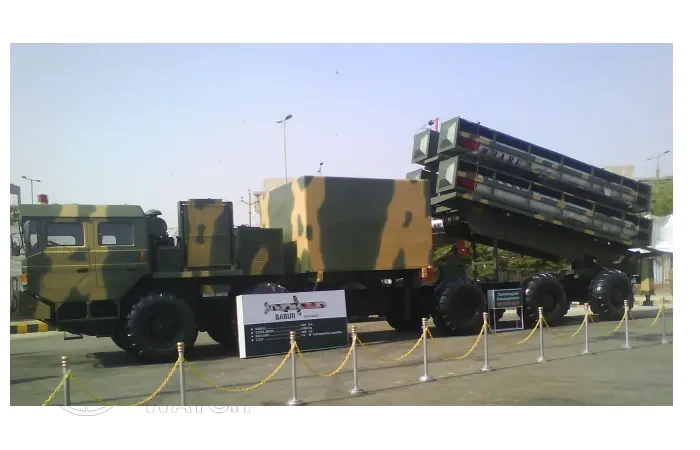
Full Specifications
1. General Information
| Name / Designation | Babur (Hatf-VII) |
| Type / Role | Ground- and Sea‑launched Cruise Missile |
| Country of Origin | Pakistan |
| Manufacturer | NESCOM / National Defence Complex (NDC) |
| Service Entry / Year Introduced | Approx. 2010 |
| Operational Status | Active |
2. Performance & Range
| Range | ~350–700 km (some tests claim up to ~900 km for IB variant) |
| Speed | ~880 km/h (subsonic) |
| Ceiling / Altitude Limit | Terrain-hugging, low-altitude cruise flight |
| Accuracy (CEP) | Not widely disclosed; uses DSMAC/TERCOM for high precision |
| Warhead Type | HE conventional, nuclear (10–35 kt) |
3. Guidance & Targeting
| Guidance System | INS, TERCOM, DSMAC, GPS |
| Targeting Mode | Pre-programmed flight, terrain-following |
| Launch Platform Compatibility | Road-mobile TEL, submarine torpedo tube |
| Seeker Type | No active seeker; relies on navigation systems |
4. Physical Characteristics
| Length | ~6.2 m |
| Diameter | ~0.52 m |
| Wingspan | ~2.5 m |
| Launch Weight | ~1,500 kg |
| Propulsion | Solid booster + Turbofan / Turbojet |
5. Warhead & Payload
| Warhead Weight | ~450–500 kg (conventional) or 10–35 kt (nuclear) |
| Explosive Type | High Explosive, Submunitions, Nuclear |
| Detonation Mechanism | Impact or proximity (not publicly detailed) |
| Payload Options | Conventional warhead or nuclear warhead |
6. Operational Use & Capabilities
| Operational Range Type | Medium-range cruise missile |
| Deployment Platform | Surface TEL, Submarine |
| Target Types | Infrastructure, Command Centers, Sea / Land |
| Combat Proven | Tested multiple times; declared operational |
| Users / Operators | Pakistan |
Babur-Class Cruise Missile
The Babur-Class Cruise Missile, also designated as Hatf‑VII, is Pakistan’s indigenously developed ground- and sea-launched subsonic cruise missile system. Engineered by the National Engineering & Scientific Commission (NESCOM) and the National Defence Complex (NDC), this missile provides Pakistan with a stealthy, low‑altitude, precision-strike capability optimized for strategic deterrence.
Origins, Purpose & Development
First flight‑tested in 2005, the Babur missile entered service around 2010. Its development was motivated by Pakistan’s need for a flexible, survivable strike system that could evade advanced air defenses. Designed to deliver both conventional and nuclear payloads, Babur enhances Pakistan’s second-strike and land-attack options.
Major Capabilities
The Babur is propelled by a turbofan (or turbojet) engine, with a solid-fuel booster for launch. After booster separation, the wings unfold, and the missile cruises at subsonic speeds (~880 km/h, roughly Mach 0.8). Its airframe features a tubular fuselage with folded wings, enabling compact transport.
Guidance is provided by a sophisticated triple‑layer system: inertial navigation (INS), terrain contour matching (TERCOM), and digital scene matching (DSMAC), often complemented by GPS and satellite navigation. This allows the Babur to fly extremely low, hugging terrain to avoid radar detection.
Variants & Operational Use
Multiple variants of Babur exist:
- Babur‑1 / 1A, the original land-launched version with ranges assessed at up to ~700 km by Pakistan, though U.S. assessments have estimated lower ranges.
- Babur‑1B / Weapon System‑1(B), an enhanced-range variant tested by ISPR with claimed range of 700 km and improved avionics.
- Babur‑III, the sea‑launched variant, tested from submarines and offering sub-surface launch capability.
The missile can be armed with either a high‑explosive conventional warhead (~450–500 kg) or a nuclear warhead estimated between 10–35 kilotons. Tasked with land-attack roles, Babur has also been reported in sea-strike configurations.
With its mobile transporter-erector launcher (TEL) system and possible submarine launch, the Babur class contributes significantly to Pakistan’s strategic posture.
Babur-Class Cruise Missile Price
While there is no publicly available unit price for the Babur-class cruise missile on the open U.S. defense market, its highly strategic nature and dual-capable (nuclear / conventional) role suggest it would be classified under restricted technology. Any hypothetical acquisition would likely involve complex export controls, geopolitical scrutiny, and potentially end-use restrictions. As such, no verified U.S. commercial price is publicly documented.
FAQs
The Babur cruise missile, also known as Hatf‑VII, is Pakistan’s indigenously developed subsonic cruise missile. It is designed for precision strikes against land and sea targets, capable of carrying both conventional and nuclear warheads. It uses a terrain-hugging flight path and advanced guidance systems including INS, TERCOM, DSMAC, and GPS to evade radar detection. Babur can be launched from ground-based TELs or submarines.
While “most powerful” depends on the criteria—range, payload, or destructive capability—the U.S. Tomahawk Block IV and Russia’s Kalibr are among the most capable conventional cruise missiles. For nuclear capability, Pakistan’s Babur-III and North Korea’s cruise missiles have strategic roles, but the Tomahawk and Kalibr are generally considered superior in technology, guidance, and global reach.
The exact cost of a Babur missile is not publicly disclosed. As a dual-capable (conventional and nuclear) strategic weapon, pricing is classified. Estimates from analysts suggest it could be in the range of $1–3 million per unit, depending on configuration and warhead type, but this is speculative.
Yes, Pakistan has developed a family of cruise missiles under the Babur program, including land-launched (Babur-1, Babur-1B) and submarine-launched (Babur-III) variants. These missiles are part of Pakistan’s strategic deterrence arsenal and are operational with the Pakistan Armed Forces.
There is no publicly available official price for the Babur missile, as it is a classified military asset. Any unit cost is restricted and subject to export control and defense confidentiality. Publicly, only rough analyst estimates exist, generally ranging between $1–3 million per missile, depending on the variant and payload.
Get real time update about this post category directly on your device, subscribe now.
Reviews
Disclaimer Note
The information provided on TheDefenseWatch.com is for general informational purposes only. While we strive to ensure the accuracy, completeness, and timeliness of our content regarding defense and aerospace products, technologies, and specifications, we cannot guarantee that all information is 100% accurate or up-to-date due to the evolving nature of military technology and classified data.TheDefenseWatch.com does not warrant the reliability, suitability, or availability of the information for any specific purpose. Users are advised to consult official sources, such as manufacturers, government publications, or defense agencies, for precise and verified data before making decisions based on our content.We are not affiliated with any defense manufacturers, governments, or military organizations mentioned. Opinions, reviews, and ratings reflect expert analysis but are subjective and should not be considered endorsements. TheDefenseWatch.com is not responsible for any errors, omissions, or consequences arising from the use of this website’s content.External links are provided for convenience and do not imply endorsement. TheDefenseWatch.com reserves the right to update or modify content without prior notice. By using this website, you agree to our Privacy & Cookies Policy.
New Arrivals



Popular Comparisons
-
 SIG XM7 Rifle vs M4: Key Differences and Performance Comparison
View Comparison →
SIG XM7 Rifle vs M4: Key Differences and Performance Comparison
View Comparison → -
Eurofighter Typhoon vs Rafale vs F-35: Fighter Jet Comparison
View Comparison →
-
J-20 vs F-22: Stealth Fighter Showdown Explained
View Comparison →
-
F-14 Tomcat vs Su-57: Can a Legend Challenge Russia’s Stealth Fighter?
View Comparison →
-
Su-35 vs Su-57: Russia’s Top Fighter Jets Compared
View Comparison →
-
Eurofighter Typhoon vs Su-57: Ultimate Fighter Jet Comparison
View Comparison →
-
Rafale vs Su-57: 4.5 Gen vs 5th Gen Fighter Jet Comparison
View Comparison →
-
Su-57 vs F-16 Fighting Falcon: Stealth vs Speed
View Comparison →
-
China vs Russia: J-20 Mighty Dragon vs Su-57 Felon Comparison
View Comparison →
-
Su-57 Felon vs F-22 Raptor: Stealth Air Superiority Face-Off
View Comparison →


- Iran-US Ceasefire Negotiations Stall as Strait of Hormuz Standoff Deepens

- US Deploys Uncrewed Drone Boats In Conflict With Iran As Maritime Tensions Escalate
- Raytheon Expands Alabama Missile Integration Facility To Boost U.S. Defense Production Capacity
- Australian-Built Boxer Combat Reconnaissance Vehicles Roll Off Production Line, Boosting Land 400 Program
- U.S. Army To Begin M1E3 Abrams Prototype Operational Testing In Summer 2026
- Raytheon Secures $773.5M Contract Boost For AN/TPY-2 Radar Development Through 2030
- Javelin Missile Production Ramp Accelerates as Lockheed Martin Overhauls Supply Chain for High-Volume Output
- Indian Army To Buy 800 Km Plus Range BrahMos Supersonic Cruise Missiles
- US Navy Iwo Jima Amphibious Ready Group Expands Caribbean Anti-Trafficking Push
- Chinas Laser Air Defense Systems Light Arrow 21A And Light Arrow 11E Form Layered Counter Drone Shield