- Home
- Catalog
- Bombers & Strategic Aircraft
- B-52H Stratofortress
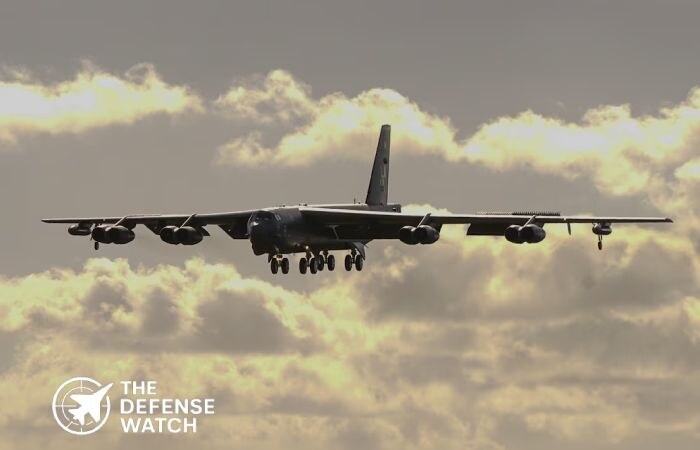
B-52H Stratofortress
Full Specifications
1. General Information
| Name | B-52H Stratofortress |
| Manufacturer | Boeing |
| Country of Origin | United States |
| Introduction / In Service Since | 1961 / Present |
| Status | Active, Modernizing |
| Category | Long-Range Heavy Bomber |
| Crew | 5 |
| Unit Cost | ~$84 million (modernized value) |
2. Dimensions & Structure
| Length | 159 ft 4 in |
| Wingspan | 185 ft |
| Height | 40 ft 8 in |
| Wing Area | 4,000 sq ft |
| Empty Weight | ~185,000 lbs |
| Maximum Takeoff Weight (MTOW) | 488,000 lbs |
3. Performance
| Maximum Speed | ~650 mph |
| Range | 8,800 miles |
| Combat Radius | ~4,400 miles |
| Service Ceiling | 50,000 ft |
| Rate of Climb | ~6,000 ft/min |
4. Powerplant
| Engine Type | 8× TF33-P-3/103 turbofan engines (future: F130 engines) |
| Thrust (per engine) | 17,000 lbf |
| Total Thrust | 136,000 lbf |
5. Payload & Armament
| Internal Payload Capacity | 70,000 lbs |
| Weapons Bay | Conventional & nuclear capable |
| Compatible Weapons | JDAM, JASSM, HARPOON, ALCM, mines, nuclear gravity bombs |
| Hardpoints | 12 external stations |
6. Avionics & Systems
| Radar System | AN/APQ-166 (upgraded AESA planned) |
| Navigation | GPS/INS, digital cockpit |
| Electronic Warfare (EW) | Defensive avionics & jamming suite |
| Stealth Features | None (non-stealth) |
7. Operational History
| Primary Operator | United States Air Force |
| Conflict Usage | Vietnam, Gulf War, OEF, OIF, Middle East operations |
| Notable Missions | Linebacker II, Desert Storm strikes, anti-ISIS operations |
8. Additional Information
| Variants | B-52A–H series |
| Successor / Future Replacement | B-21 Raider (partial replacement) |
| Notable Features | Extreme range, high payload, nuclear capability |
| Estimated Operational Life | Into 2050s–2060s |
PROS
- Extremely long operational range
- Massive 70,000-lb payload capacity
- Proven in decades of combat operations
- Compatible with advanced standoff weapons
- Undergoing modernization for service into 2050s
CONS
- Non-stealth airframe limits survivability in contested airspace
- High maintenance requirements due to age
- Slow compared to modern bombers
- Relies heavily on tanker support for global missions
- Older avionics still being replaced through ongoing upgrades
B-52H Stratofortress Long-Range Heavy Bomber
Few military aircraft symbolize U.S. airpower as powerfully as the B-52H Stratofortress, a long-range heavy bomber designed and built by Boeing for the U.S. Air Force. Introduced in the early 1960s and continually modernized, the B-52H remains one of the world’s most enduring and versatile strategic strike platforms. Its mission is straightforward yet critical: provide the United States with the ability to project conventional or nuclear firepower anywhere on the planet.
Powered by eight turbofan engines, the B-52H delivers exceptional range—over 8,800 miles (14,080 km) without refueling—and can remain airborne for extended missions with tanker support. Its maximum speed of around 650 mph (Mach 0.86) allows it to swiftly deploy across global theaters, while its heavy-lift design supports a payload capacity of up to 70,000 lbs, including precision-guided munitions, cruise missiles, naval mines, and nuclear weapons under U.S. strategic command.
Advanced Systems & Capabilities
Modernization upgrades continue to extend the bomber’s life into the 2050s, including advanced radar systems, digital communications, electronic warfare suites, and new Rolls-Royce F130 engines. The aircraft features a multi-mission capability set covering long-range strike, maritime operations, close air support, and strategic deterrence.
Operational Legacy
The B-52H has seen combat in Vietnam, the Gulf War, Operation Enduring Freedom, and numerous precision strike campaigns across the Middle East. Its ability to loiter for long durations while delivering large volumes of firepower ensures it remains a cornerstone of America’s strategic bomber fleet.
B-52H Stratofortress Price
While the U.S. no longer manufactures new B-52H airframes, the estimated value of a fully modernized aircraft—considering upgrades, avionics, and engines—can exceed $84 million per unit, depending on configuration and lifecycle enhancements.
Get real time update about this post category directly on your device, subscribe now.
Reviews
Disclaimer Note
The information provided on TheDefenseWatch.com is for general informational purposes only. While we strive to ensure the accuracy, completeness, and timeliness of our content regarding defense and aerospace products, technologies, and specifications, we cannot guarantee that all information is 100% accurate or up-to-date due to the evolving nature of military technology and classified data.TheDefenseWatch.com does not warrant the reliability, suitability, or availability of the information for any specific purpose. Users are advised to consult official sources, such as manufacturers, government publications, or defense agencies, for precise and verified data before making decisions based on our content.We are not affiliated with any defense manufacturers, governments, or military organizations mentioned. Opinions, reviews, and ratings reflect expert analysis but are subjective and should not be considered endorsements. TheDefenseWatch.com is not responsible for any errors, omissions, or consequences arising from the use of this website’s content.External links are provided for convenience and do not imply endorsement. TheDefenseWatch.com reserves the right to update or modify content without prior notice. By using this website, you agree to our Privacy & Cookies Policy.
New Arrivals



Popular Comparisons
-
 SIG XM7 Rifle vs M4: Key Differences and Performance Comparison
View Comparison →
SIG XM7 Rifle vs M4: Key Differences and Performance Comparison
View Comparison → -
Eurofighter Typhoon vs Rafale vs F-35: Fighter Jet Comparison
View Comparison →
-
J-20 vs F-22: Stealth Fighter Showdown Explained
View Comparison →
-
F-14 Tomcat vs Su-57: Can a Legend Challenge Russia’s Stealth Fighter?
View Comparison →
-
Su-35 vs Su-57: Russia’s Top Fighter Jets Compared
View Comparison →
-
Eurofighter Typhoon vs Su-57: Ultimate Fighter Jet Comparison
View Comparison →
-
Rafale vs Su-57: 4.5 Gen vs 5th Gen Fighter Jet Comparison
View Comparison →
-
Su-57 vs F-16 Fighting Falcon: Stealth vs Speed
View Comparison →
-
China vs Russia: J-20 Mighty Dragon vs Su-57 Felon Comparison
View Comparison →
-
Su-57 Felon vs F-22 Raptor: Stealth Air Superiority Face-Off
View Comparison →


- Iran-US Ceasefire Negotiations Stall as Strait of Hormuz Standoff Deepens

- US Deploys Uncrewed Drone Boats In Conflict With Iran As Maritime Tensions Escalate
- Raytheon Expands Alabama Missile Integration Facility To Boost U.S. Defense Production Capacity
- Australian-Built Boxer Combat Reconnaissance Vehicles Roll Off Production Line, Boosting Land 400 Program
- U.S. Army To Begin M1E3 Abrams Prototype Operational Testing In Summer 2026
- Raytheon Secures $773.5M Contract Boost For AN/TPY-2 Radar Development Through 2030
- Javelin Missile Production Ramp Accelerates as Lockheed Martin Overhauls Supply Chain for High-Volume Output
- Indian Army To Buy 800 Km Plus Range BrahMos Supersonic Cruise Missiles
- US Navy Iwo Jima Amphibious Ready Group Expands Caribbean Anti-Trafficking Push
- Chinas Laser Air Defense Systems Light Arrow 21A And Light Arrow 11E Form Layered Counter Drone Shield