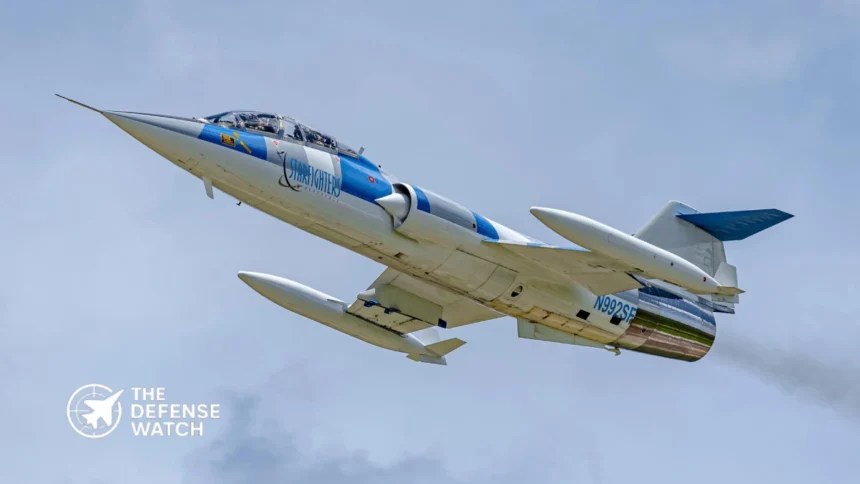
Starfighters Space plans to fly its Starlaunch 1 suborbital development vehicle beneath a Lockheed F-104 Starfighter in December 2026, beginning airborne integration testing for a program intended to develop an aircraft-launched rocket system. The planned flight will keep the test vehicle attached to the aircraft throughout the mission, rather than attempt a release or rocket-powered ascent.
The company announced the milestone on October 13, saying it had finalized the Starlaunch 1 airframe design and ordered flight hardware from Italian engineering company Robby Moto Engineering. The planned flight would move the program from ground-based development into flight testing, although it would not establish that the vehicle is ready to launch payloads.
What the December flight is designed to prove
The planned captive-carry mission will assess how the Starlaunch 1 test article behaves while attached to the F-104 and allow engineers to evaluate the aircraft’s integration with the vehicle.
Starfighters expects to assemble the inert flight hardware at its Kennedy Space Center hangar after its anticipated arrival in November. The company plans to test the interface between the aircraft and the underwing article before conducting the flight between Kennedy Space Center in Florida and the FAA-licensed Cecil Spaceport in Jacksonville.
The test is an early step in a longer development sequence. According to Starfighters, the planned follow-on activities include a drop test over the Atlantic Ocean and a demonstration of an integrated propulsion system.
Those later milestones are important because carrying a vehicle and releasing it safely are different engineering challenges. A captive-carry flight can provide information about aerodynamic behavior, structural loads and aircraft integration, but it cannot by itself validate separation dynamics, ignition, propulsion performance or payload delivery.
The company has not announced a completed powered flight of Starlaunch 1 in the material reviewed for this report.
Why use an F-104 Starfighter?
The F-104 was originally developed as a high-performance supersonic interceptor. Starfighters Space now operates the aircraft for commercial aerospace testing, pilot training and research involving high-speed flight environments.
The aircraft provides an existing airborne platform that can carry test hardware to altitude and expose it to flight conditions before release. This could reduce the need to develop a dedicated carrier aircraft, although the overall cost and practicality of the approach will depend on the vehicle, mission requirements and operational support.
Starfighters says its F-104 fleet can support research involving hypersonic technologies, advanced materials, missile defense systems, electronic equipment and microgravity science. These are company-described service areas, not evidence that every proposed application has been qualified or demonstrated.
An aircraft-launched rocket also starts its flight with some altitude and forward velocity. That can provide a different set of launch conditions from a rocket departing vertically from the ground. However, the practical benefit depends on the rocket’s mass, propulsion system, trajectory and payload requirements. Air launch does not automatically mean lower costs or better performance than ground launch.
For Starfighters, the immediate objective is to establish whether the F-104 can safely carry and integrate the vehicle before the company proceeds to more demanding tests.
Starlaunch 1 and the planned path to space
Starlaunch 1 is the initial suborbital development vehicle in Starfighters Space’s broader air-launch program. The company has described it as a pathfinder for later launch capabilities, including Starlaunch 2, which is intended to support orbital missions.
In its December 2025 securities filing, Starfighters described Starlaunch 1 as a rocket under development for carrying smaller payloads toward suborbital altitudes. The filing also outlined plans for Starlaunch 2 as the next stage of the company’s space-launch ambitions.
The distinction between suborbital and orbital flight matters. A suborbital vehicle can travel above the commonly used 100-kilometer boundary of space without entering a sustained orbit around Earth. An orbital launch vehicle must provide enough velocity and manage its trajectory to place a payload into orbit.
Consequently, demonstrating that Starlaunch 1 can be carried, released and powered in flight would represent progress, but would not by itself validate an operational satellite-launch service. The larger orbital system would require its own development and qualification work.
Starfighters has also identified a hybrid rocket motor under development by propulsion partner Vaya Defense & Space as part of the program. The company says data from the December mission will support that work, but the captive-carry test is not intended to demonstrate the integrated motor in powered flight.
The commercial and regulatory hurdles remain
The planned flight is one milestone in a program that must demonstrate more than aircraft performance. A commercially viable air-launch service would need to establish reliable vehicle separation, propulsion performance, payload integration, launch operations and compliance with applicable safety and licensing requirements.
Starfighters’ own securities disclosures identify launch licensing and regulatory approvals as requirements for its launch-services business. Its May 2026 announcement also described future development milestones as dependent on regulatory approvals and program execution.
The company has not disclosed a verified operational launch rate or a demonstrated cost per payload for Starlaunch 1. Without those figures, it is too early to determine whether the system could compete economically with established small-satellite launch providers.
The F-104 platform may offer flexibility for testing and specialized missions, particularly where customers need controlled exposure to high-speed atmospheric conditions. But the business case for orbital delivery will depend on payload capacity, mission frequency, reliability, licensing and the cost of maintaining the aircraft and supporting infrastructure.
Starfighters has also said that the December flight may carry its Wind Tunnel in the Sky test hardware beneath the opposite wing on a customer-funded mission. That arrangement could allow the company to collect data for more than one activity during the same flight, provided the aircraft’s configuration and safety requirements permit it.
What the next milestones will establish
The December captive-carry flight is best understood as an integration and flight-test milestone, not a launch demonstration. If completed as planned, it should provide the company with experience and data needed to prepare for the next stages of testing.
The more consequential evidence will come from a successful separation test and subsequent powered flights. Those results will help establish whether Starlaunch 1 can progress beyond an underwing test article toward a functioning suborbital vehicle.
For now, the program remains in development. Starfighters Space has outlined its intended test sequence, but the available public information does not yet establish when Starlaunch 1 will complete a powered flight or when Starlaunch 2 will be ready to deliver payloads to orbit.