Yi Song Hui’s 48-year career with the U.S. Army in South Korea offers an example of how civilian personnel and local support organizations contribute to the readiness of American forces on the Korean Peninsula.
The U.S. Army’s November 22, 2026, profile of Yi describes her work with the Korean Service Corps (KSC), an organization that provides essential support to U.S. forces and helps prepare for wartime mobilization alongside the Republic of Korea (ROK) military.
Yi, currently chief of the S1 Human Resources Division of the Korean Service Corps Battalion, has worked across personnel administration, finance, company management, training and mobilization since joining the organization in May 1978.
Her career illustrates an important part of the U.S.-ROK military relationship that receives less attention than combined exercises, combat aircraft, missile defense systems and major military deployments: the personnel and logistical infrastructure required to keep forces operational.
Korean Service Corps: A Wartime Organization With a Continuing Mission
The Korean Service Corps traces its origins to the Korean War, when U.S. and South Korean forces faced significant manpower and logistical challenges during the defense of the Korean Peninsula.
On July 26, 1950, South Korean President Syngman Rhee issued Emergency Decree No. 6, providing a legal basis for mobilizing Korean civilian manpower and resources to support the war effort.
The Civilian Transportation Corps was subsequently established on March 15, 1951, to support U.S. and South Korean forces defending positions along the Nakdong River. It was reorganized as the Korean Service Corps on July 14, 1951, under the direction of U.S. Army General James Van Fleet.
During the war, KSC personnel transported ammunition, food, construction materials and other military supplies. They also helped evacuate wounded personnel and supported the construction of defensive positions and transportation routes.
The organization became known as the A-Frame Army because personnel frequently carried supplies using wooden A-frame carriers across difficult terrain.
Its wartime contribution established a continuing support relationship between Korean personnel and U.S. forces that remains part of the military structure on the peninsula.
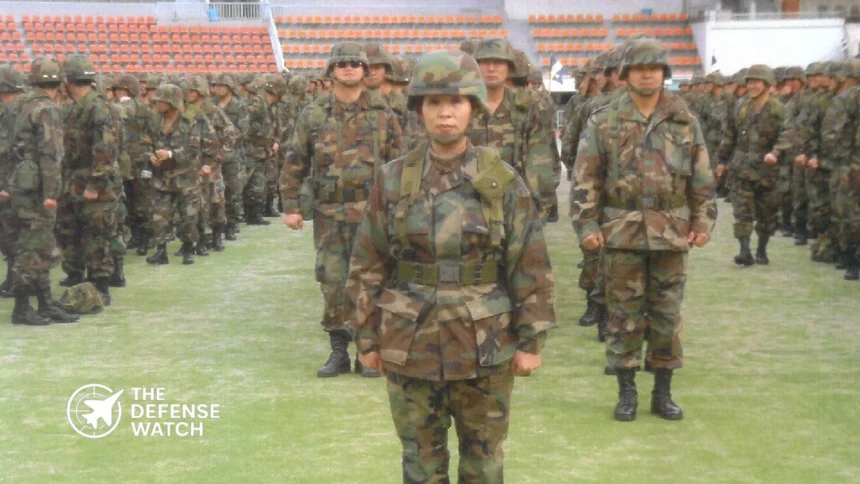
Today, the KSC operates as a U.S. Army-aligned organization staffed by Korean nationals. It is assigned to Materiel Support Command-Korea and the 19th Expeditionary Sustainment Command.
According to the U.S. Army’s organizational information, the battalion manages approximately 2,185 Korean personnel organized into 18 companies. These personnel provide embedded sustainment support to American forces across South Korea.
Yi Song Hui’s Career and Contribution to Mobilization
Yi joined the KSC personnel office in May 1978. Her initial responsibilities included maintaining employee records and supporting personnel administration across an organization employing approximately 2,000 people.
Over nearly five decades, she held nine different positions covering several areas of battalion administration and support.
In 2003, she became the first female assistant company commander in the KSC Battalion, a position she held until 2011. According to her U.S. Army profile, she helped prepare personnel for wartime mobilization and supported coordination between U.S. and South Korean forces during exercises.
Her responsibilities included explaining the wartime mission and mobilization procedures of the 33rd Korean Service Corps Company to American and South Korean personnel.
The company had approximately 100 civilian employees preparing for contingency mobilization. Yi also supported control-center operations during exercises, helping personnel understand their responsibilities if the organization transitioned from peacetime support to wartime operations.
In 2011, she became chief of the battalion’s S1 Human Resources Division, a position involving personnel management and administrative readiness.
Her experience is relevant because mobilization requires more than identifying available personnel. Organizations must maintain accurate records, establish responsibilities, coordinate assignments and ensure that personnel administration can continue under contingency conditions.
The Army profile also identifies Yi as the first woman to serve as assistant company commander in the battalion. She attributed effective leadership to dedication, fairness and professional conduct rather than gender.
Why Personnel Administration Matters During a Military Crisis
The KSC’s contribution extends beyond traditional logistics.
The organization provides personnel and sustainment capabilities that help U.S. forces maintain their operational requirements while preparing for a potential conflict.
Its wartime purpose is particularly important because U.S. forces stationed in South Korea would need to sustain operations while additional American and allied forces move into the theater.
The U.S. Army describes the KSC as a capability intended to bridge the gap between existing American force levels and the personnel requirements of wartime operations until reinforcement forces arrive.
This arrangement gives the U.S. military access to established local support capabilities rather than requiring every additional manpower requirement to be filled by deploying more American personnel.
The KSC’s mission is also connected to the broader sustainment structure managed by the 19th Expeditionary Sustainment Command.
Headquartered in Daegu, the command coordinates sustainment operations for the Eighth U.S. Army and works with South Korean military organizations, U.S. logistics agencies and other defense partners.
Its responsibilities include operational sustainment, mission command, reception and onward movement of incoming forces, and support to joint and coalition operations.
The command’s official profile identifies approximately 5,600 assigned personnel across the Korean theater. It also emphasizes coordination with Republic of Korea Army organizations, including transportation and logistics commands.
The KSC therefore forms part of a wider support network connecting U.S. military units, Korean personnel and combined logistics organizations.
Administrative Readiness and the Scale of the Mission
Yi’s human resources responsibilities demonstrate the administrative workload behind this support structure.
According to the Army’s November 22 profile, she supervised annual production of more than 6,000 awards and 5,000 personnel actions while leading the battalion’s human resources section.
These activities involved maintaining personnel records, processing administrative requirements and ensuring consistent treatment across a large workforce.
However, an important organizational change took place in November 2025.
The Army reported that responsibility for those personnel actions transitioned to the G-1 section of the 19th Expeditionary Sustainment Command. The battalion’s S1 division continues to maintain core human resources functions and prepare to provide essential personnel support during contingency operations.
This distinction matters because the transfer of administrative responsibilities does not mean the battalion has lost its readiness mission. Instead, the organization continues to maintain the personnel support functions required for its own operational requirements.
Yi has also emphasized that consistent personnel policies help maintain trust across the organization. With nearly 2,000 employees, fair treatment and accountability remain important elements of effective personnel management.
The Army’s account presents these administrative responsibilities as part of the battalion’s wider readiness contribution, rather than treating them as routine office functions.
What the KSC Means for the U.S.-ROK Alliance
The U.S.-ROK alliance depends on more than the presence of American combat forces and advanced military equipment.
Its effectiveness also relies on combined command arrangements, transportation, maintenance, personnel management, medical support and the ability to sustain military operations during a crisis.
The Korean Service Corps provides an established local workforce with experience supporting U.S. military requirements. Its wartime mobilization role also connects current peacetime activities with contingency planning.
For the United States, this arrangement helps preserve support capacity on the peninsula while reducing the need to source every required function from incoming reinforcement forces.
For South Korea, the organization represents a longstanding contribution to the combined defense structure and a practical example of cooperation between Korean personnel and American military institutions.
The KSC’s mission has changed considerably since its early days of transporting ammunition and supplies using A-frame carriers. Its continued role, however, remains tied to the same operational requirement: ensuring that military forces have the personnel and support needed to function during peacetime and wartime.
Yi Song Hui’s career provides a human perspective on that long-running mission. Her experience also illustrates how readiness is maintained through administrative continuity, workforce management and institutional knowledge, alongside the weapons and military units more commonly associated with deterrence on the Korean Peninsula.
Enjoying our coverage?
Make The Defense Watch a preferred source on Google to see more of our geopolitical and defense insights when relevant to you.