Northrop Grumman is highlighting more than 500,000 hours of autonomous flight experience as it promotes its intelligence, surveillance, reconnaissance and targeting (ISR&T) capabilities, supported by platforms including the RQ-4 Global Hawk and MQ-4C Triton.
In a November 19, 2026, company announcement titled Owning the High Ground: How Northrop Grumman Leads in ISR&T, the defense contractor outlined its approach to combining autonomous aircraft, multi-domain sensors, real-time data processing and interoperable mission systems.
The announcement focuses on the company’s experience in persistent intelligence collection rather than introducing a new aircraft or announcing a specific procurement agreement. Northrop Grumman says its systems are designed to provide military decision-makers with timely intelligence across air, land and maritime environments.
The company’s central argument is that modern military operations increasingly depend on the ability to collect information continuously, process it quickly and distribute it to forces that need to act on it.
Why Persistent ISR Is Becoming More Important
Intelligence, surveillance and reconnaissance capabilities help military commanders understand the operational environment before and during military operations.
Traditional reconnaissance aircraft, satellites, ground-based sensors and remotely operated unmanned systems each provide different forms of intelligence. However, their effectiveness depends on factors such as coverage, persistence, sensor quality, communications availability and the time required to process collected information.
Persistent ISR addresses one of the central challenges of military surveillance: maintaining awareness of an area over extended periods rather than relying on occasional observations.
This is particularly relevant in maritime environments, where large geographic areas, long distances and limited infrastructure can make continuous monitoring difficult.
For military planners, persistent surveillance can help identify changes in maritime activity, monitor potential threats, track moving objects and support operational planning.
Northrop Grumman’s approach combines long-endurance aircraft with multiple intelligence sensors and systems designed to distribute collected information to military users.
However, the availability of surveillance data does not automatically guarantee accurate targeting or successful military operations. Information must still be assessed, validated and integrated into command-and-control networks.
Global Hawk and Triton Form the Core of Its High-Altitude ISR Portfolio
Two aircraft illustrate Northrop Grumman’s established position in high-altitude unmanned surveillance: the RQ-4 Global Hawk and MQ-4C Triton.
RQ-4 Global Hawk
The RQ-4 Global Hawk is a high-altitude, long-endurance unmanned aircraft developed to collect intelligence over large geographic areas.
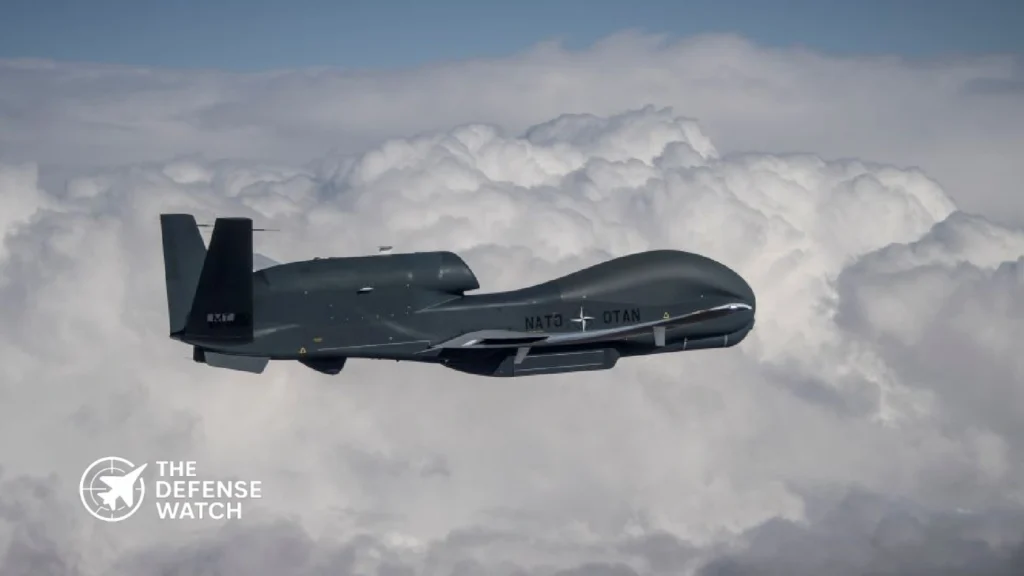
According to the U.S. Air Force, the platform provides persistent, near-real-time intelligence through imagery intelligence (IMINT), signals intelligence (SIGINT) and moving target indicator capabilities.
Its Block 30 configuration combines electro-optical, infrared, synthetic aperture radar and signals intelligence sensors. The Block 40 configuration incorporates an active electronically scanned array radar for moving target indication and synthetic aperture radar missions.
The aircraft can remain airborne for more than 30 hours, allowing it to conduct extended reconnaissance missions.
The Global Hawk’s operational value comes from its ability to gather information over large areas without requiring a crew onboard the aircraft.
However, it remains part of a wider operational system involving ground-based pilots, sensor operators, communications links and intelligence-processing infrastructure.
MQ-4C Triton
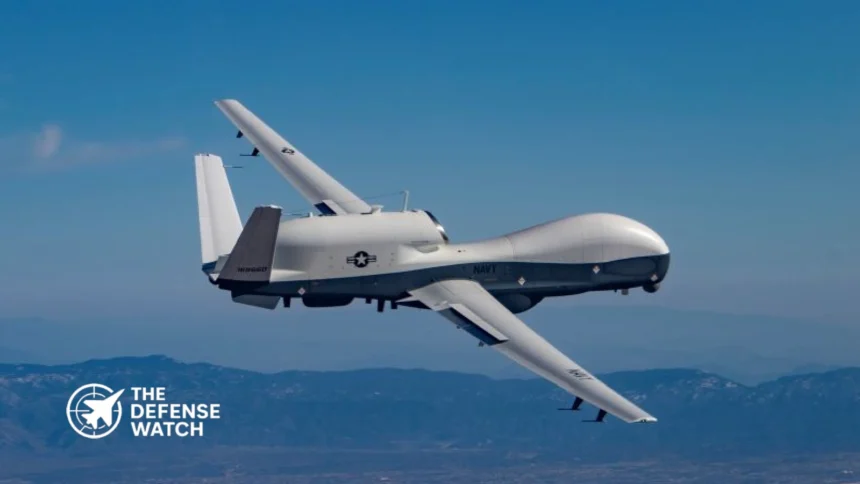
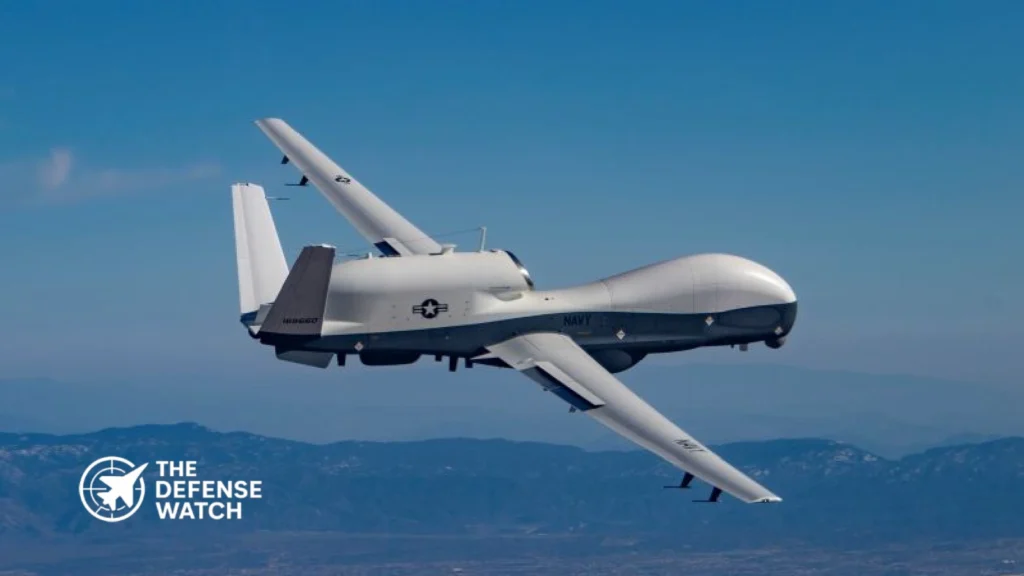
The MQ-4C Triton extends the Global Hawk concept into maritime surveillance.

Northrop Grumman’s MQ-4C Triton provides persistent autonomous maritime surveillance and real-time intelligence. (Photo Credit: Northrop Grumman) Developed for the U.S. Navy, Triton is designed to monitor large ocean and coastal areas using multiple sensors. Its mission includes detecting, classifying and tracking maritime contacts while providing intelligence to naval commanders.
According to Naval Air Systems Command (NAVAIR), the aircraft can operate above 50,000 feet, remain airborne for more than 24 hours and has a published range of 7,400 nautical miles.
Triton operates alongside the crewed P-8A Poseidon maritime patrol aircraft as part of the Navy’s Maritime Patrol and Reconnaissance Force.
The two platforms provide complementary capabilities. Triton supports persistent wide-area surveillance, while the P-8A provides a crewed multi-mission aircraft with its own maritime surveillance and operational capabilities.
NAVAIR identifies three Triton operational orbits, including deployments associated with Guam, Naval Air Station Sigonella in Italy and U.S. Central Command following the establishment of a third orbit in 2024.
Sensor Fusion and Data Processing Are Central to the Mission
Aircraft endurance is only one part of modern ISR capability.
Military forces also need to combine information collected by different sensors and distribute it to decision-makers in a format that can support operational planning.
Northrop Grumman says its ISR&T approach combines multi-domain sensors with real-time data fusion and interoperable mission systems.
This can involve integrating information from radar, electro-optical and infrared sensors, signals intelligence systems and other collection assets.
The objective is to produce a more complete operational picture than individual sensors could provide independently.
For example, maritime radar information can help identify and track surface contacts, while additional intelligence sources may provide information that helps operators understand the nature of those contacts.
The company also emphasizes interoperability between autonomous aircraft and crewed military platforms.
Such integration is particularly important for distributed operations, where surveillance aircraft, maritime patrol aircraft, command centers and operational units may be separated by significant distances.
Nevertheless, the actual performance of these systems depends on communications availability, data quality, processing capacity and the ability to operate in environments where adversaries may attempt to disrupt or deceive sensors.
Northrop Grumman has not disclosed new technical performance figures or a specific sensor upgrade in its November announcement.
The Difference Between Autonomous Flight and Fully Autonomous Targeting
An important distinction in Northrop Grumman’s announcement concerns the meaning of autonomy.
The Global Hawk and Triton are unmanned aircraft that use autonomous flight capabilities, but they are not independent military decision-makers.
Their operations involve ground-based personnel responsible for aircraft control, mission planning, sensor management and intelligence exploitation.
In the Triton’s case, NAVAIR identifies five personnel associated with its ground station, including an air vehicle operator, tactical coordinator, mission payload operators and a signals intelligence coordinator.
Autonomous navigation and mission execution can reduce the need for continuous manual aircraft control. They do not eliminate human responsibility for mission decisions.
Similarly, ISR&T does not mean that an aircraft independently selects and engages targets.
Target detection, classification, intelligence assessment and operational authorization remain distinct activities.
This distinction matters as defense companies increasingly incorporate artificial intelligence, automated sensor management and advanced data processing into military systems.
The operational value of autonomy will depend not simply on how much of a mission can be automated, but also on how reliably information reaches commanders and how effectively human operators can assess it.
Triton’s Operational Record Also Shows the Challenges of Fielding Advanced ISR
Northrop Grumman’s experience with Triton is part of a wider effort to expand the U.S. Navy’s unmanned maritime surveillance capabilities.
However, the aircraft’s development history also demonstrates why flight hours and operational availability should not be treated as interchangeable measures.
A September 2025 report by the Department of Defense Office of Inspector General identified deficiencies in the Navy’s management of the MQ-4C program.
The audit found that the Navy declared Initial Operational Capability in August 2023 before completing initial operational test and evaluation. It also identified unresolved developmental and operational testing deficiencies that could affect the aircraft’s ability to accomplish certain missions.
The report stated that 20 Triton aircraft had been delivered to the Navy by March 2025, according to information provided during the audit. It also identified additional retrofit requirements associated with outstanding deficiencies.
These findings provide important context for evaluating Northrop Grumman’s claims about its ISR capabilities.
The company’s reported 500,000 autonomous flight hours demonstrate accumulated experience, but they do not independently establish the operational effectiveness, availability or mission success rate of every platform.
They also do not resolve the specific testing and sustainment issues identified by government oversight.
For military customers, these factors are as important as the aircraft’s endurance and sensor capabilities.
What Northrop Grumman’s ISR Strategy Means for Future Military Operations
Northrop Grumman’s November announcement reflects an important direction in military aviation: the integration of persistent surveillance, autonomous platforms and connected intelligence systems.
For the United States and its allies, these capabilities are particularly relevant to maritime domain awareness, monitoring strategic regions and maintaining intelligence coverage across large operational areas.
The MQ-4C Triton provides an established maritime surveillance capability, while the RQ-4 Global Hawk demonstrates the wider role of high-altitude unmanned aircraft in strategic intelligence collection.
However, future capability improvements will depend on more than additional aircraft or longer flight times.
Communications resilience, sensor performance, data processing, interoperability, maintenance and operational testing will all influence how effectively these platforms support military operations.
Northrop Grumman’s reported 500,000 autonomous flight hours offer a measure of its accumulated experience in the field. The more important measure for military customers will be how consistently that experience translates into reliable intelligence and operationally useful information.


Enjoying our coverage?
Make The Defense Watch a preferred source on Google to see more of our geopolitical and defense insights when relevant to you.