
- Home
- Defense Systems
- Fighter Jets
- Typhoon FGR4 Fighter Jet
Typhoon FGR4 Fighter Jet
Defense Systems Full Specifications
General Information
| Name | Eurofighter Typhoon FGR4 |
| Manufacturer | Eurofighter GmbH |
| Country of Origin | United Kingdom and Europe |
| Type / Role | Multirole Fighter Aircraft |
| Generation | 4.5 |
| Status | Active Service |
| First Flight | 1994 |
| Introduction / In Service Since | 2007 |
| Number Built | 570 plus |
| Operators | United Kingdom, Germany, Italy, Spain, others |
Dimensions & Structure
| Length | 15.96 m |
| Wingspan | 10.95 m |
| Height | 5.28 m |
| Wing Area | 50 square meters |
| Empty Weight | 11,000 kg |
| Maximum Takeoff Weight (MTOW) | 23,500 kg |
| Internal Weapons Bay | None |
| External Hardpoints | 13 |
Performance
| Maximum Speed | Mach 2 |
| Range | 2,900 km |
| Combat Radius | 1,390 km |
| Service Ceiling | 55,000 ft |
| Rate of Climb | 315 meters per second |
| Thrust-to-Weight Ratio | Greater than 1 |
| G Limits | plus 9 g |
Powerplant
| Engine Type | Eurojet EJ200 turbofan |
| No. of Engines | 2 |
| Thrust (each) | 20,000 lbf with afterburner |
| Thrust Vectoring | No |
| Fuel Capacity | Approx. 5,000 kg internal |
Armament
| Gun | 27 mm Mauser BK 27 cannon |
| Missiles (Air-to-Air) | Meteor, AMRAAM, ASRAAM |
| Missiles (Air-to-Ground) | Brimstone, Storm Shadow |
| Bombs | Paveway II, Paveway IV |
| Hardpoints | 13 |
| Payload Capacity | Up to 7,500 kg |
Avionics & Systems
| Radar | Captor E AESA |
| Radar Range | 160 km plus |
| Electronic Warfare (EW) System | Praetorian Defensive Aids Suite |
| Targeting System | Litening III pod |
| Helmet Display | Striker II helmet |
| Navigation | INS with GPS |
| Autopilot / AI Assistance | Digital flight control system |
| Communication | Secure NATO data links |
Stealth & Technology
| Radar Cross Section (RCS) | Reduced |
| Stealth Features | Airframe shaping, radar absorbing materials |
| Infrared Signature Reduction | Engine and exhaust design |
| Sensor Fusion | Yes |
| Networking Capabilities | Link 16 |
Variants
| Special Export Versions | RAF multirole fighter variant |
Operational History
| Major Conflicts / Deployments | Middle East operations, Baltic Air Policing |
| Notable Operators | Royal Air Force |
| Combat Proven? | Yes |
| Mission Types | Air superiority, ground attack, interception |
Cost & Program
| Unit Cost | 120 to 140 million USD |
| Development Cost | Over 20 billion USD |
| Program Name | Eurofighter Typhoon |
| Funding Countries | UK, Germany, Italy, Spain |
Additional Information
| Upgrades Planned | Radar and weapons integration |
| Future Replacement | Tempest program |
| Export Restrictions | Government approval required |
| Notable Achievements | Meteor missile operational integration |
| Competitors | Rafale, F 15EX |
PROS
- Excellent air to air performance
- Advanced AESA radar and sensors
- Wide weapons compatibility
- Proven NATO operational record
- Strong electronic warfare suite
CONS
- High procurement cost
- Expensive maintenance
- Limited stealth design
- No internal weapons bay
- Smaller global user base than F 16
Eurofighter Typhoon FGR4 Multirole Fighter Jet
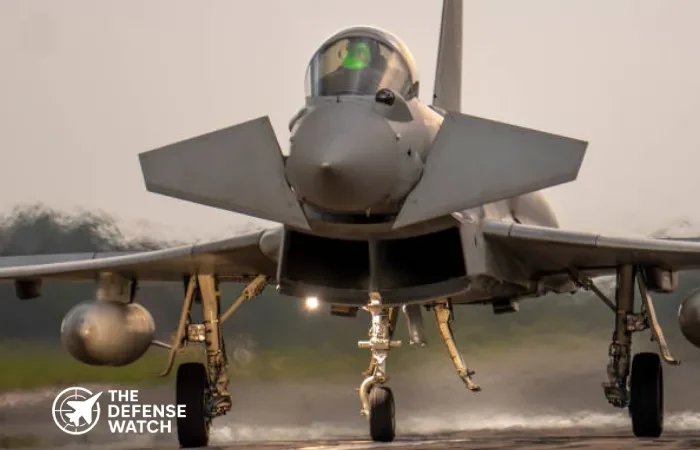
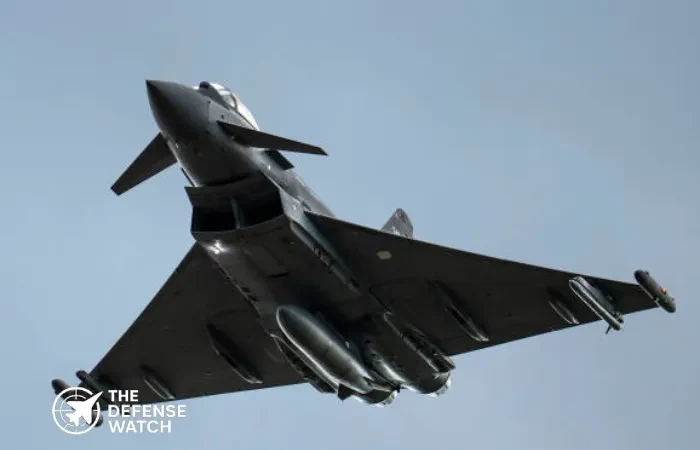
The Eurofighter Typhoon FGR4 is the Royal Air Force frontline multirole combat aircraft, built for air superiority and precision strike missions. It represents the most advanced operational standard of the Typhoon family, combining high speed, agility, and modern sensors for complex combat environments.
Developed by a European consortium led by BAE Systems, Airbus, and Leonardo, the Typhoon originated as an air dominance fighter. The FGR4 variant expands that role with full ground attack capability, electronic warfare upgrades, and improved networked operations. It serves as a core element of UK and NATO airpower.
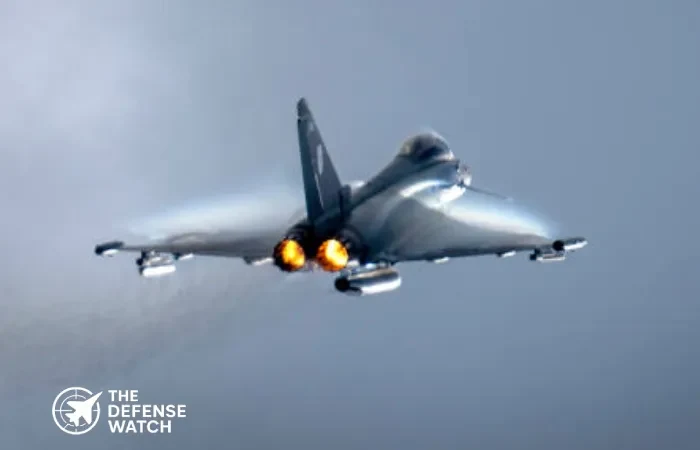
Powered by twin Eurojet EJ200 engines, the FGR4 reaches speeds above Mach 2 and can supercruise without afterburners. Its delta wing and canard design deliver high maneuverability, making it effective in both beyond visual range and close combat engagements.
The aircraft is equipped with the Captor E AESA radar, PIRATE infrared search and track system, and a modern defensive aids suite. These systems allow pilots to detect, track, and engage multiple targets while operating in contested airspace. The FGR4 supports a wide range of weapons, including Meteor long range air to air missiles, Paveway guided bombs, and Storm Shadow cruise missiles.
Operationally, the Typhoon FGR4 has been deployed in Baltic Air Policing, Middle East strike missions, and NATO quick reaction alert duties. It remains a key bridge between fourth and fifth generation fighters, working alongside the F 35 in UK service.
Eurofighter Typhoon FGR4 Price in US
The Eurofighter Typhoon FGR4 Fighter Jet unit cost in US terms is estimated at 120 to 140 million dollars depending on configuration, support packages, and upgrade level. Costs vary by contract and sustainment terms.
Disclaimer Note
The information provided on TheDefenseWatch.com is for general informational purposes only. While we strive to ensure the accuracy, completeness, and timeliness of our content regarding defense and aerospace products, technologies, and specifications, we cannot guarantee that all information is 100% accurate or up-to-date due to the evolving nature of military technology and classified data.TheDefenseWatch.com does not warrant the reliability, suitability, or availability of the information for any specific purpose. Users are advised to consult official sources, such as manufacturers, government publications, or defense agencies, for precise and verified data before making decisions based on our content.We are not affiliated with any defense manufacturers, governments, or military organizations mentioned. Opinions, reviews, and ratings reflect expert analysis but are subjective and should not be considered endorsements. TheDefenseWatch.com is not responsible for any errors, omissions, or consequences arising from the use of this website’s content.External links are provided for convenience and do not imply endorsement. TheDefenseWatch.com reserves the right to update or modify content without prior notice. By using this website, you agree to our Privacy & Cookies Policy.
New Arrivals


Popular Comparisons
-
 J-10C vs JF-17 Thunder: Which Fighter Is More Capable?
View Comparison →
J-10C vs JF-17 Thunder: Which Fighter Is More Capable?
View Comparison → -
Tejas vs Gripen: Key Differences and Capabilities
View Comparison →
-
Tejas vs MiG-21 Bison: How India Replaced Its Iconic Supersonic Fighter
View Comparison →
-
F-35 vs F-16: Stealth, Sensors and Combat Roles
View Comparison →
-
Tejas Fighter Jet vs F-16 Fighting Falcon: Capability Compared
View Comparison →
-
Rafale Fighter Jet vs F-16 Fighting Falcon : Which Fighter Has the Edge?
View Comparison →
-
Su-57 Fighter Jet vs J-20 Fighter Jet: Stealth and Air Combat Compared
View Comparison →
-
Mirage 2000 vs Tejas Mk1A: Legacy Combat Power vs Indigenous Modernization
View Comparison →
-
Rafale Fighter Jet vs F-22 Raptor: Which Air Dominance Fighter Has the Edge?
View Comparison →
-
Tejas Fighter Jet vs. Rafale Fighter Jet: India’s Indigenous Fighter Meets France’s Proven Multirole Combat Aircraft
View Comparison →


- Saab Presents First GlobalEye AEW&C Aircraft for Sweden

- Israel Signs Deal for 12 AH-64E Apache Attack Helicopters
- Nepal Orders Robinson Unmanned SPIRIT Drones for Army Operations
- Draken Deploys Sting and Phantom Sky Training System Together for First Time
- Ukraine Says Neptune Strike Damaged Six Russian Su-34 Aircraft
- Why Pakistan Still Relies on F-16 Fighters Despite Chinese Advances
- US Military Weighs MOAB for Potential Future Strikes on Iran, CNN Reports
- Saab Wins $120 Million Order for New Gripen Flight Control Computer
- L3Harris Delivers First VAMPIRE Counter-Drone Systems to U.S. Army
- Lockheed Martin Invests $300 Million in Texas Munitions Expansion, Plans 6,000 U.S. Jobs


Fighter Jets
-
 MIG-31 Fighter Jet
-
J-10CE Fighter Jet
-
Chengdu J-10 Fighter Jet
-
Chengdu J-10C Fighter Jet
-
Gripen E Fighter Jet
-
Tejas Mk1A Fighter Jet
-
Tejas Mk‑2 Fighter Jet
-
F-16V Viper Block 70 Fighter Jet
-
F-15EX Eagle II Fighter
-
Boeing F/A-XX Fighter
-
F-15E Strike Eagle Fighter
-
F/A-18E/F Super Hornet Fighter Jet
-
Saab Gripen F Fighter Jet
-
JAS 39E/F Gripen Fighter Jet
-
JAS 39 Gripen Fighter Jet
-
F-35A Lightning II Fighter Jet
-
F/A-18F Super Hornet
-
J-50 Fighter Jet
-
Spanish EF-18 Hornet Fighter
-
F-47 Fighter Jet
-
F-35i Adir Fighter Jet
-
F-16 Fighting Falcon
-
AIDC T-5 Brave Eagle
-
F-CK-1 Ching-Kuo Fighter








Recent Compares
-
J-10C vs JF-17 Thunder: Which Fighter Is More Capable?
View Comparison →
-
Tejas vs Gripen: Key Differences and Capabilities
View Comparison →
-
Tejas vs MiG-21 Bison: How India Replaced Its Iconic Supersonic Fighter
View Comparison →
-
F-35 vs F-16: Stealth, Sensors and Combat Roles
View Comparison →
-
Tejas Fighter Jet vs F-16 Fighting Falcon: Capability Compared
View Comparison →
Latest Defense Systems
10 Compares Defense Systems
-
J-10C vs JF-17 Thunder: Which Fighter Is More Capable?
View Comparison →
-
Tejas vs Gripen: Key Differences and Capabilities
View Comparison →
-
Tejas vs MiG-21 Bison: How India Replaced Its Iconic Supersonic Fighter
View Comparison →
-
F-35 vs F-16: Stealth, Sensors and Combat Roles
View Comparison →
-
Tejas Fighter Jet vs F-16 Fighting Falcon: Capability Compared
View Comparison →
-
Rafale Fighter Jet vs F-16 Fighting Falcon : Which Fighter Has the Edge?
View Comparison →
-
Su-57 Fighter Jet vs J-20 Fighter Jet: Stealth and Air Combat Compared
View Comparison →
-
Mirage 2000 vs Tejas Mk1A: Legacy Combat Power vs Indigenous Modernization
View Comparison →
-
Rafale Fighter Jet vs F-22 Raptor: Which Air Dominance Fighter Has the Edge?
View Comparison →
-
Tejas Fighter Jet vs. Rafale Fighter Jet: India’s Indigenous Fighter Meets France’s Proven Multirole Combat Aircraft
View Comparison →
- Saab Presents First GlobalEye AEW&C Aircraft for Sweden
- Israel Signs Deal for 12 AH-64E Apache Attack Helicopters
- Nepal Orders Robinson Unmanned SPIRIT Drones for Army Operations
- Draken Deploys Sting and Phantom Sky Training System Together for First Time
- Ukraine Says Neptune Strike Damaged Six Russian Su-34 Aircraft