












@2026 – All Right Reserved. TheDefenseWatch.com
- Home
- Defense Systems
- Attack & Multirole Drones (UAVs)
- S-100 Camcopter Drone
S-100 Camcopter Drone

Defense Systems Full Specifications
1. General Information
| Name | Schiebel Camcopter S-100 |
| Manufacturer | Schiebel Group |
| Country of Origin | Austria |
| Type / Role | VTOL UAV / ISR & Maritime Recon |
| First Flight / Introduced | 2005 |
| Status | In Service |
| Unit Cost | Estimated USD 3–5 Million (varies by config) |
2. Performance
| Maximum Speed | ~222 km/h |
| Cruise Speed | 100–105 km/h |
| Operational Range | 200 km (line-of-sight) |
| Endurance | 6 hr (standard) / 10+ hr (extended) |
| Service Ceiling | ~5,486 m (≈18,000 ft) |
| Rate of Climb | N/A (rotorcraft hover capability) |
3. Dimensions
| Length | 3.11 m |
| Wingspan | 3.4 m |
| Height | 1.12 m |
| Maximum Takeoff Weight (MTOW) | ~200 kg |
4. Payload & Armament
| Payload Capacity | Up to 50 kg |
| Hardpoints | Side mounts + internal bays |
| Weapons | Not standard; light guided munitions only in test demos |
| Sensors | EO/IR, Thermal, SAR/GMTI Radar, Maritime Radar, COMINT/SIGINT, AIS, Laser Designator |
| Avionics | Real-time video link, stabilized sensor suite, mission computer |
5. Propulsion
| Engine Type | Wankel Rotary Engine (≈50 hp) |
| Engine Power | Fuel Type : AVGas, Jet-A1, or JP-5 (heavy fuel) |
6. Communication & Control
| Control Type | Remote / Autonomous (GPS waypoint) |
| Data Link Range | Up to 200 km |
| Navigation | Redundant GPS / INS |
| Ground Control Station | Portable or Fixed GCS |
7. Operational Use
| Primary Users | Austria, France, UAE, Australia, India, Italy, others |
| Combat Proven | Yes – maritime ISR and border security missions |
| Notable Operations | Naval patrols, SAR, anti-smuggling, border monitoring, ISR |
PROS
- Highly flexible VTOL capability — no runway or complex launch gear needed
- Strong payload versatility: EO/IR sensors, SAR/GMTI radar, maritime radar, comms relay, etc.
- Good endurance (6–10 hours) and real-time data link out to ~200 km – suitable for extended maritime patrol or ISR missions
- Ship-deck and austere-site capable — deployable from small vessels or remote locations
- Proven in both military (naval, border security) and civilian roles (SAR, environmental monitoring)
CONS
- Relatively limited payload capacity (≈ 50 kg), constraining heavier sensor or weapon packages
- Endurance and performance degrade when carrying maximum payload or in adverse conditions
- Rotorcraft UAV — slower and with lower range compared to fixed-wing drones for long-range overland ISR
- Payload and fuel limitations restrict heavy armament or large sensor arrays
- As an older UAV, newer systems may offer better sensor integration, networked operations or autonomy
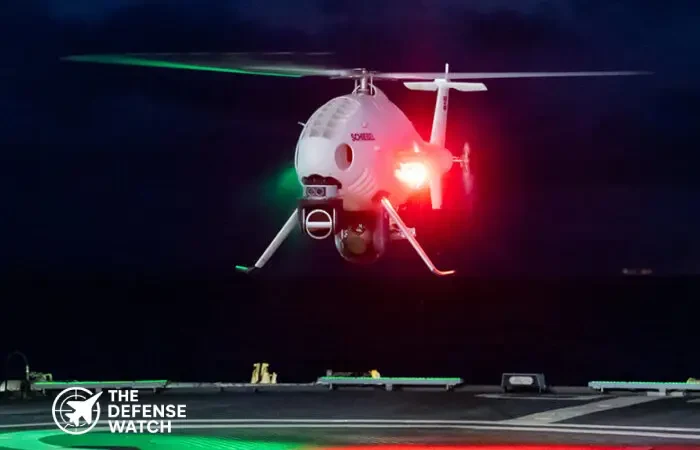
Schiebel Camcopter S-100 – Compact VTOL Naval/ISR Drone
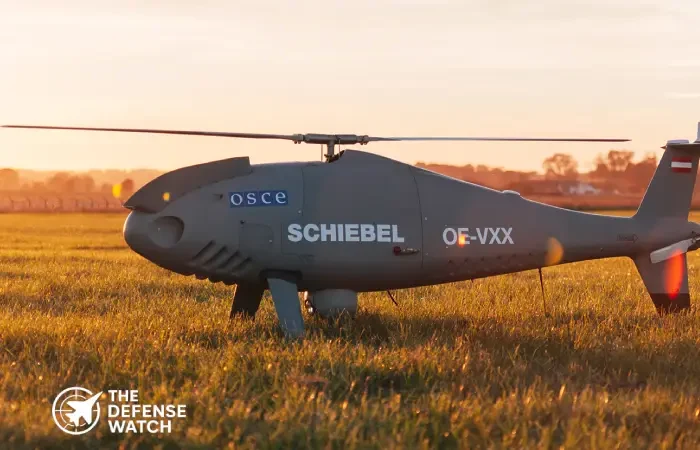
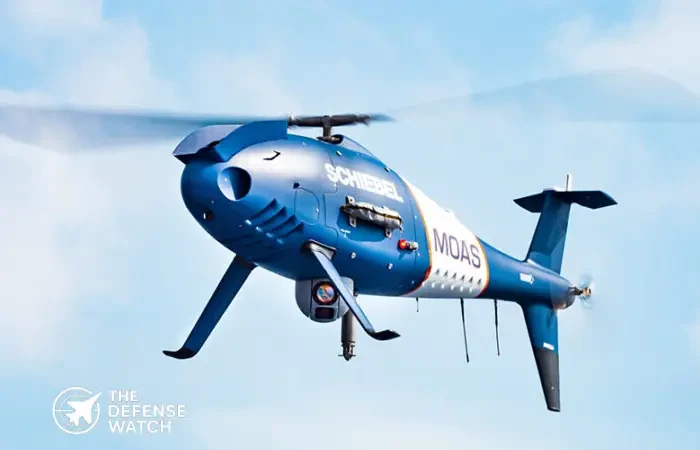
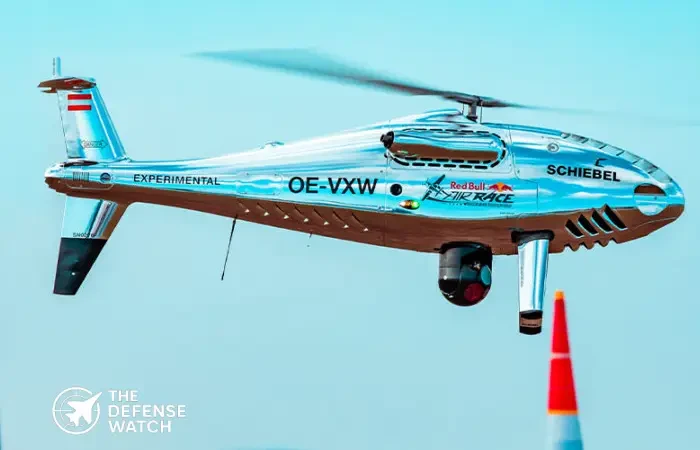
The Schiebel Camcopter S-100 is a versatile vertical-takeoff-and-landing (VTOL) unmanned aerial system that delivers flexible maritime and land-based surveillance, reconnaissance and support capabilities from small decks or austere launch sites. Developed by Austrian aerospace firm Schiebel between 2003 and 2005, the S-100 entered service in 2005 and has since become an internationally adopted platform across naval, border-security and civilian agencies.
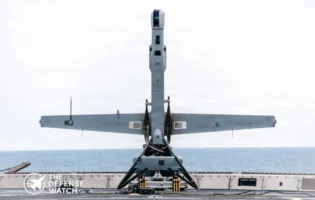
S-100 is engineered for both maritime and overland use — operating from ships, coastal patrol vessels, remote airfields or improvised ground sites without needing prepared runways or heavy ground equipment. Its rotorcraft design, with compact fuselage and twin-rotor configuration, enables automatic vertical take-off and landing (VTOL) as well as precise deck landings on frigates or patrol vessels.
Equipped with a range of sensor payloads — daytime and infrared electro-optical/IR cameras, thermal surveillance, synthetic-aperture radar (SAR), ground-moving target indication (GMTI), laser/radar imaging, plus optional maritime radars, communications relays, and IFF or drop-container capability — the S-100 can be configured for maritime patrol, surveillance, border control, search & rescue, minefield mapping, convoy escort, and disaster-response.
Powered by a single Wankel-type rotary engine (approximately 50 hp), the S-100 reaches a top speed of about 220–222 km/h, with cruise/loiter speeds around 100–105 km/h. Standard flight endurance is 6 hours with a typical 34–50 kg payload; when fitted with an external fuel tank (using AVGas or heavier JP-5 / Jet-A1 fuel), endurance extends to 10+ hours, enabling beyond-line-of-sight missions over land or sea, with data links up to roughly 200 km.
Navigation and control are handled via redundant GPS/INS systems; missions can be flown autonomously via pre-programmed waypoints or manually from a ground control station. The S-100 supports real-time data transmission to remote operators, even in adverse weather or night conditions.
Today, operators include naval and coast-guard forces worldwide — reflecting the S-100’s proven reliability and adaptability to evolving maritime and land-based security challenges.
Disclaimer Note
The information provided on TheDefenseWatch.com is for general informational purposes only. While we strive to ensure the accuracy, completeness, and timeliness of our content regarding defense and aerospace products, technologies, and specifications, we cannot guarantee that all information is 100% accurate or up-to-date due to the evolving nature of military technology and classified data.TheDefenseWatch.com does not warrant the reliability, suitability, or availability of the information for any specific purpose. Users are advised to consult official sources, such as manufacturers, government publications, or defense agencies, for precise and verified data before making decisions based on our content.We are not affiliated with any defense manufacturers, governments, or military organizations mentioned. Opinions, reviews, and ratings reflect expert analysis but are subjective and should not be considered endorsements. TheDefenseWatch.com is not responsible for any errors, omissions, or consequences arising from the use of this website’s content.External links are provided for convenience and do not imply endorsement. TheDefenseWatch.com reserves the right to update or modify content without prior notice. By using this website, you agree to our Privacy & Cookies Policy.
New Arrivals
Popular Comparisons
-
 Tejas vs Gripen: Key Differences and Capabilities
View Comparison →
Tejas vs Gripen: Key Differences and Capabilities
View Comparison → -
Tejas vs MiG-21 Bison: How India Replaced Its Iconic Supersonic Fighter
View Comparison →
-
F-35 vs F-16: Stealth, Sensors and Combat Roles
View Comparison →
-
Tejas Fighter Jet vs F-16 Fighting Falcon: Capability Compared
View Comparison →
-
Rafale Fighter Jet vs F-16 Fighting Falcon : Which Fighter Has the Edge?
View Comparison →
-
Su-57 Fighter Jet vs J-20 Fighter Jet: Stealth and Air Combat Compared
View Comparison →
-
Mirage 2000 vs Tejas Mk1A: Legacy Combat Power vs Indigenous Modernization
View Comparison →
-
Rafale Fighter Jet vs F-22 Raptor: Which Air Dominance Fighter Has the Edge?
View Comparison →
-
Tejas Fighter Jet vs. Rafale Fighter Jet: India’s Indigenous Fighter Meets France’s Proven Multirole Combat Aircraft
View Comparison →
-
F-22 Raptor vs. F-35 Joint Strike Fighter: Which Fifth Generation Fighter Has the Edge?
View Comparison →
- F-15E Shot Down Over Iran: How the Dude 44 Crew Was Brought Home

- Operation Mount Hope III: How Two Night Stalker Chinooks Carried a Libyan Hind Out of Chad
- North Korea Fires Ballistic Missile From Wonsan Toward East Sea
- BAE Systems Wins $70.5 Million Trident II D5 Support Contract
- Saudi Arabia Weighs Yemen Offensive to Retake Bab el-Mandeb
- L3Harris Expands WESCAM Manufacturing Focus for Mission-Ready EO/IR Systems
- Northrop Grumman Unveils FORTITUDE RF Chip for Faster Defense Systems
- Northrop Grumman YFQ-48A Talon Blue Completes Autonomous Flight Test
- U.S. Warns Defense Industry Lacks Capacity for Rapid Weapons Surge
- NATO Uses B-1B Bomber in Baltic Air Defense Training