












@2026 – All Right Reserved. TheDefenseWatch.com
- Home
- Defense Systems
- Missiles & Precision Weapons
- YJ-20 Missile
YJ-20 Missile
Defense Systems Full Specifications
1. General Information
| Name / Designation | YJ-20 |
| Type / Role | Hypersonic Anti-Ship Aeroballistic Missile / Long-Range Strike Weapon |
| Country of Origin | China |
| Manufacturer | Chinese defense industry (PLA / associated design bureaus) |
| Service Entry / Year Introduced | Publicly revealed 2025; operational status not independently confirmed |
| Operational Status | Reportedly entering service / induction phase |
2. Performance & Range
| Range | ~1,500–2,000 km |
| Speed | Hypersonic – Mach 6–7 cruise/terminal, terminal possibly up to Mach 9 |
| Ceiling / Altitude Limit | High-arc ballistic flight; reentry trajectory (exact altitude unknown) |
| Accuracy (CEP) | Not publicly disclosed; terminal guidance via radar/IR seeker |
| Warhead Type | High-explosive (HE) with kinetic penetration effect |
3. Guidance & Targeting
| Guidance System | Inertial + mid-course datalink/satellite updates + terminal radar/IR seeker |
| Targeting Mode | Mid-course guidance + terminal active seeker homing |
| Launch Platform Compatibility | Surface warship VLS; potential future submarine or surface launchers |
| Seeker Type | Active radar or imaging infrared (IIR) terminal seeker |
4. Physical Characteristics
| Length | Not publicly confirmed (large missile) |
| Diameter | Not publicly confirmed |
| Wingspan | N/A – uses aerodynamic body, no fixed wings |
| Launch Weight | Likely heavy / large for surface warship VLS |
| Propulsion | Solid rocket booster + aeroballistic reentry |
5. Warhead & Payload
| Warhead Weight | Not disclosed; sufficient for catastrophic naval damage |
| Explosive Type | High-explosive (HE) + kinetic/penetrator effect |
| Detonation Mechanism | Impact / penetration fuse (expected) |
| Payload Options | Conventional naval strike payload |
6. Operational Use & Capabilities
| Operational Range Type | Long-range strike capability |
| Deployment Platform | Surface warships (destroyers, cruisers); potential submarine/surface VLS |
| Target Types | Large surface warships (carriers, amphibious ships), possibly high-value fixed targets |
| Combat Proven | No confirmed combat use; under induction |
| Users / Operators | China (People’s Liberation Army Navy) |
YJ‑20 Hypersonic Anti‑Ship Missile
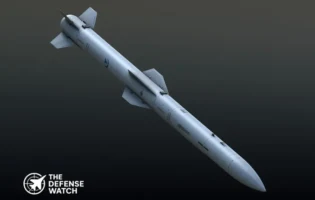
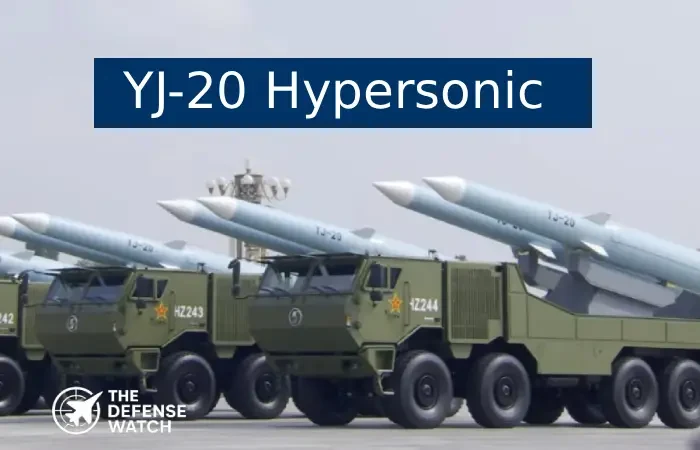
The unveiling of the YJ-20 marks a significant leap in modern naval strike capability — a hypersonic, aeroballistic anti-ship missile that could reshape maritime power balance in the Indo-Pacific and beyond. Designed by China’s defense industry, the YJ-20 was publicly revealed during the 2025 Victory Day parade, signaling the introduction of a next-generation “carrier killer.”
Manufactured in China, the YJ-20 is purpose-built for long-range anti-ship strike missions, intended to target large surface combatants such as aircraft carriers, amphibious assault ships, and other high-value naval assets. Its biconic aerodynamic design — a comparatively simpler profile than scramjet‑powered cruise missiles — suggests an aeroballistic trajectory, relying on a solid rocket boost followed by a high-speed reentry with terminal maneuvering capability to evade defenses.
Performance estimates indicate a cruise or mid-course flight at hypersonic speeds and a terminal dive likely reaching speeds up to Mach 6–7, potentially accelerating toward Mach 9 in the final seconds. The YJ-20’s range is assessed at roughly 1,500–2,000 kilometers — giving the launching navy the ability to strike targets far beyond the horizon, keeping launch platforms out of enemy counterstrike envelope.
Guidance is believed to integrate inertial navigation with mid-course updates (likely via datalink or satellite navigation) and an active radar or imaging-infrared seeker for terminal homing, designed to hit maneuvering surface vessels even under contested electronic-warfare conditions. The warhead—though exact weight is unconfirmed—is believed sufficient to inflict catastrophic damage on large ships, through a combination of hypersonic kinetic energy and explosive payload.
Operationally, the YJ-20 is slated for launch from the vertical launch systems (VLS) of major surface combatants — especially large destroyers — and potentially future submarine or surface-based launchers. In doing so, it becomes a critical element of China’s Anti-Access/Area-Denial (A2/AD) posture — capable of deterring or threatening carrier strike groups and other forward-deployed naval forces.
YJ-20 Missile Price
Pricing for advanced hypersonic anti-ship missiles like YJ-20 is not publicly disclosed. Given its strategic nature, cost likely depends on batch production and delivery terms; no credible public estimates exist for U.S. sale or export variants.
Disclaimer Note
The information provided on TheDefenseWatch.com is for general informational purposes only. While we strive to ensure the accuracy, completeness, and timeliness of our content regarding defense and aerospace products, technologies, and specifications, we cannot guarantee that all information is 100% accurate or up-to-date due to the evolving nature of military technology and classified data.TheDefenseWatch.com does not warrant the reliability, suitability, or availability of the information for any specific purpose. Users are advised to consult official sources, such as manufacturers, government publications, or defense agencies, for precise and verified data before making decisions based on our content.We are not affiliated with any defense manufacturers, governments, or military organizations mentioned. Opinions, reviews, and ratings reflect expert analysis but are subjective and should not be considered endorsements. TheDefenseWatch.com is not responsible for any errors, omissions, or consequences arising from the use of this website’s content.External links are provided for convenience and do not imply endorsement. TheDefenseWatch.com reserves the right to update or modify content without prior notice. By using this website, you agree to our Privacy & Cookies Policy.
New Arrivals
-
 PAC-2 Patriot Missile System
-
Patriot PAC-3 Missile Defense System
-
EA-18G Growler
-
J-50 Fighter Jet
-
Northrop Grumman GHOST-R GEO Recon Satellite
-
A-50 Mainstay Aircraft
-
Spanish EF-18 Hornet Fighter
-
Trident II D5 Missile
-
B-21 Raider Bomber
-
F-47 Fighter Jet
-
F-35i Adir Fighter Jet
-
Type 99B Main Battle Tank
Popular Comparisons
-
 Tejas Fighter Jet vs F-16 Fighting Falcon: Capability Compared
View Comparison →
Tejas Fighter Jet vs F-16 Fighting Falcon: Capability Compared
View Comparison → -
Rafale Fighter Jet vs F-16 Fighting Falcon : Which Fighter Has the Edge?
View Comparison →
-
Su-57 Fighter Jet vs J-20 Fighter Jet: Stealth and Air Combat Compared
View Comparison →
-
Mirage 2000 vs Tejas Mk1A: Legacy Combat Power vs Indigenous Modernization
View Comparison →
-
Rafale Fighter Jet vs F-22 Raptor: Which Air Dominance Fighter Has the Edge?
View Comparison →
-
Tejas Fighter Jet vs. Rafale Fighter Jet: India’s Indigenous Fighter Meets France’s Proven Multirole Combat Aircraft
View Comparison →
-
F-22 Raptor vs. F-35 Joint Strike Fighter: Which Fifth Generation Fighter Has the Edge?
View Comparison →
-
F-35A vs. F-22 Raptor: Which U.S. Stealth Fighter Dominates Modern Air Combat?
View Comparison →
-
AGM-114 Hellfire vs. AGM-179 JAGM: Which U.S. Precision Missile Is Better?
View Comparison →
-
Patriot (PAC-3) vs. THAAD: Complete Missile Defense System Comparison, Capabilities, Range, and Strategic Roles
View Comparison →
- X-Planes in the Drone Era: Why Experimental Aircraft Still Matter

- France to Deploy Troops, Radar and Air Defense to Protect Saudi Yanbu Oil Hub
- Greek-Operated Patriot Intercepts Ballistic Missile and Drone Over Saudi Arabia
- Raytheon Wins $50.1 Million Navy Order for EA-18G Next Generation Jammer Repairs
- Stark Aerospace Wins $114 Million MK 41 VLS Canister Contract
- Northrop Grumman Wins $123.8M F-35 APG-85 Lot 7 Radar Contract
- Leonardo, Fincantieri Win €3.7B Contract for Two Italian Navy DDX Destroyers
- Finnish President Urges Musk to Expand Starlink Access for Ukraine to Target Russian Missile Launchers
- MV-22B Osprey Completes First Navy Sonobuoy Acceptance Test
- Saab expands Swedish space role through new partnerships with SSC Space, OHB Sweden and Ericsson