













@2026 – All Right Reserved. TheDefenseWatch.com
- Home
- Defense Systems
- Fighter Jets
- F-15E Strike Eagle Fighter Jet
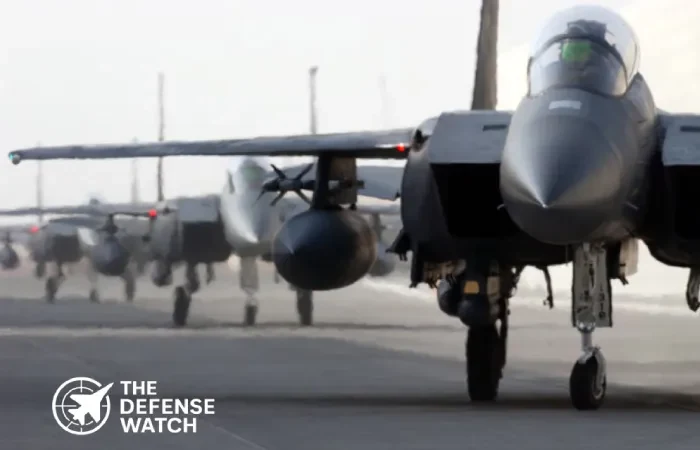
F-15E Strike Eagle Fighter Jet
Defense Systems Full Specifications
General Information
| Name | F-15E Strike Eagle |
| Manufacturer | McDonnell Douglas / Boeing |
| Country of Origin | United States |
| Type / Role | Multirole Strike Fighter |
| Generation | 4.5 |
| Status | In Service |
| First Flight | 1986 |
| Introduction / In Service Since | 1989 |
| Number Built | ~250+ |
| Operators | United States, South Korea, Singapore, Qatar, Israel (F-15I variant) |
Dimensions & Structure
| Length | 63.8 ft (19.43 m) |
| Wingspan | 42.8 ft (13.05 m) |
| Height | 18.5 ft (5.63 m) |
| Wing Area | 608 sq ft |
| Empty Weight | 31,700 lb |
| Maximum Takeoff Weight (MTOW) | 81,000 lb |
| Internal Weapons Bay | None |
| External Hardpoints | 11 |
Performance
| Maximum Speed | Mach 2.5+ |
| Range | 2,400+ miles (ferry) |
| Combat Radius | ~790 miles |
| Service Ceiling | 60,000 ft |
| Rate of Climb | >50,000 ft/min |
| Thrust-to-Weight Ratio | ~1.1:1 |
| G Limits | +9 G |
Powerplant
| Engine Type | Pratt & Whitney F100-PW-229 |
| No. of Engines | 2 |
| Thrust (each) | 29,000 lbf w/ afterburner |
| Thrust Vectoring | No |
| Fuel Capacity | ~13,500 lb internal + CFTs |
Armament
| Gun | 20 mm M61A1 Vulcan |
| Missiles (Air-to-Air) | AIM-9, AIM-120 |
| Missiles (Air-to-Ground) | AGM-65, AGM-154, AGM-84H |
| Bombs | JDAM, Paveway, SDB, GBU series |
| Hardpoints | 11 |
| Payload Capacity | 23,000+ lb |
Avionics & Systems
| Radar | AN/APG-82(V)1 AESA |
| Radar Range | 100+ miles |
| Electronic Warfare (EW) System | ALQ-135 / DEWS |
| Targeting System | LANTIRN, Sniper ATP |
| Helmet Display | JHMCS compatible |
| Navigation | GPS/INS |
| Autopilot / AI Assistance | Advanced flight control & mission automation |
| Communication | Secure UHF/VHF, Link-16 |
Stealth & Technology
| Radar Cross Section (RCS) | High (Non-stealth) |
| Stealth Features | Limited signature reduction |
| Infrared Signature Reduction | Minimal |
| Sensor Fusion | Partial |
| Networking Capabilities | Link-16, data-sharing |
Variants
| Special Export Versions | F-15E (Base), F-15I, F-15K, F-15SG, F-15QA |
Operational History
| Major Conflicts / Deployments | Iraq, Afghanistan, Syria, Libya |
| Notable Operators | USAF, IAF, RSAF, ROKAF |
| Combat Proven? | Yes |
| Mission Types | Strike, CAS, interdiction, air superiority |
Cost & Program
| Unit Cost | $90–100 million |
| Development Cost | Classified / multi-billion |
| Program Name | F-15E Strike Eagle Program |
| Funding Countries | United States |
Additional Information
| Upgrades Planned | Radar, EW, cockpit displays |
| Future Replacement | NGAD / F-35A combinations |
| Export Restrictions | ITAR controlled |
| Notable Achievements | Highly successful precision strike history |
| Competitors | Su-34, Rafale, Typhoon, F-16V |
PROS
- Exceptional range and payload for deep-strike missions
- Proven combat record in multiple conflicts
- Advanced AESA radar and modern avionics
- High thrust-to-weight ratio and Mach 2+ performance
- Compatible with a wide range of precision weapons
CONS
- Not a stealth aircraft; higher radar signature
- Maintenance-intensive due to age and complexity
- High operating cost compared to newer fighters
- Limited survivability in heavily contested airspace
- Requires two-person crew, increasing training/logistics load
F-15E Strike Eagle Multirole Strike Fighter
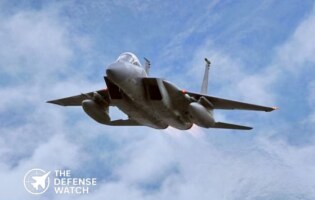
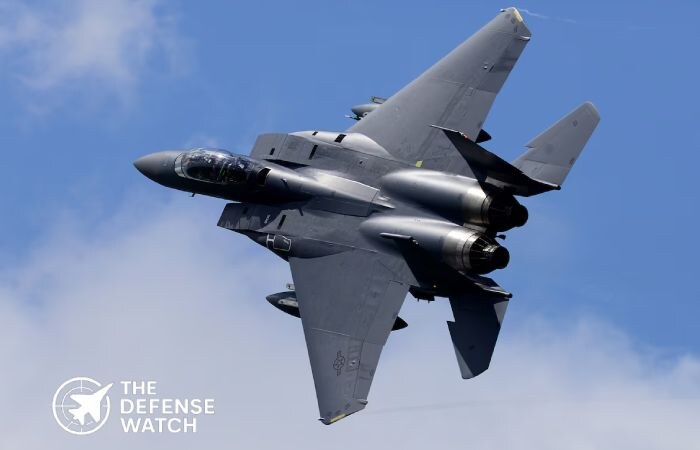
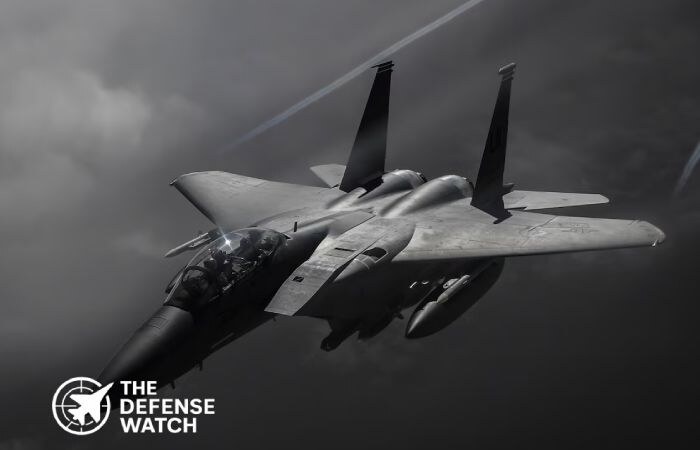
The F-15E Strike Eagle stands as one of the United States Air Force’s most proven multirole strike fighters, combining the air-to-air supremacy of the original F-15 with long-range, precision strike capability. Developed by McDonnell Douglas (now Boeing) and introduced during the late Cold War, the F-15E remains an essential combat aircraft for high-tempo operations, deep interdiction missions, and all-weather close-air support.
Powered by two Pratt & Whitney F100-PW-229 afterburning turbofans, the aircraft achieves speeds over Mach 2.5, enabling rapid response and penetration into contested airspace. Its strengthened airframe, conformal fuel tanks, and two-seat cockpit were designed specifically for long-range strike missions while keeping full fighter maneuverability. The aircraft’s operational combat radius exceeds 790 miles, allowing extended missions without refueling.
The Strike Eagle’s weapon suite includes the M61A1 20mm cannon, AIM-9 and AIM-120 air-to-air missiles, and a diverse arsenal of air-to-ground munitions such as JDAM, SDB, Harpoon, and laser-guided bombs. Eleven external hardpoints allow the F-15E to carry over 23,000 lb of mixed ordnance.
Avionics upgrades over the years—such as the APG-82(V)1 AESA radar, digital EW suite, and advanced targeting pods—enable precise engagement of moving and fixed targets in all weather conditions. The integrated LANTIRN/ Sniper systems and rear-cockpit WSO controls make the F-15E highly effective in night, low-altitude, and high-threat missions.
Operationally, the Strike Eagle has seen extensive use in the Middle East, supporting counterterrorism, interdiction, and suppression missions. Its reliability, payload capacity, and long-range strike performance keep it relevant even as newer 5th-generation fighters enter service.
F-15E Strike Eagle Price
The F-15E Strike Eagle has an estimated unit cost of $90–100 million, depending on configuration and upgrades. Support, training, and sustainment packages can significantly increase the total program cost for international buyers.
FAQs
Why is the F-15E so good?
The F-15E Strike Eagle is highly regarded because it blends the air superiority performance of the original F-15 with advanced strike capabilities. Its powerful twin engines, heavy payload capacity, long combat radius, and modern avionics allow it to conduct deep interdiction, precision attack, and air-to-air missions in a single sortie. The aircraft’s proven combat record, reliability, and ability to operate effectively in all weather conditions further elevate its reputation.
What is the difference between the F-15 and the F-15E?
The biggest difference lies in mission roles and design.
The F-15A/C variants were built primarily as air superiority fighters.
The F-15E was redesigned as a two-seat multirole strike fighter with reinforced airframe, conformal fuel tanks, upgraded avionics, and expanded air-to-ground capabilities.
Visually, the Strike Eagle also features darker paint, conformal fuel tanks along the fuselage, and a cockpit configured for a pilot/WSO team that manages complex strike missions.
Why is the F-15 so feared?
The F-15 series—particularly the F-15C—earned its reputation for being “feared” due to its unmatched air-to-air combat record, boasting over 100 confirmed air-to-air victories with zero losses in direct air combat. Its combination of high speed, powerful radar, superior climb rate, and long-range missile capability made it highly dominant against adversary aircraft for decades.
Can the F-15E dogfight?
Yes. While the F-15E is optimized for strike missions, it retains the full aerodynamic performance of the original F-15 air superiority fighter. It can reach Mach 2.5, pull high-G maneuvers, and employ air-to-air weapons such as the AIM-9 and AIM-120. However, when fully loaded with strike weapons and fuel tanks, its dogfighting agility decreases compared to the lighter F-15C.
Disclaimer Note
The information provided on TheDefenseWatch.com is for general informational purposes only. While we strive to ensure the accuracy, completeness, and timeliness of our content regarding defense and aerospace products, technologies, and specifications, we cannot guarantee that all information is 100% accurate or up-to-date due to the evolving nature of military technology and classified data.TheDefenseWatch.com does not warrant the reliability, suitability, or availability of the information for any specific purpose. Users are advised to consult official sources, such as manufacturers, government publications, or defense agencies, for precise and verified data before making decisions based on our content.We are not affiliated with any defense manufacturers, governments, or military organizations mentioned. Opinions, reviews, and ratings reflect expert analysis but are subjective and should not be considered endorsements. TheDefenseWatch.com is not responsible for any errors, omissions, or consequences arising from the use of this website’s content.External links are provided for convenience and do not imply endorsement. TheDefenseWatch.com reserves the right to update or modify content without prior notice. By using this website, you agree to our Privacy & Cookies Policy.
New Arrivals
-
 PAC-2 Patriot Missile System
-
Patriot PAC-3 Missile Defense System
-
EA-18G Growler
-
J-50 Fighter Jet
-
Northrop Grumman GHOST-R GEO Recon Satellite
-
A-50 Mainstay Aircraft
-
Spanish EF-18 Hornet Fighter
-
Trident II D5 Missile
-
B-21 Raider Bomber
-
F-47 Fighter Jet
-
F-35i Adir Fighter Jet
-
Type 99B Main Battle Tank
Popular Comparisons
-
 Tejas Fighter Jet vs F-16 Fighting Falcon: Capability Compared
View Comparison →
Tejas Fighter Jet vs F-16 Fighting Falcon: Capability Compared
View Comparison → -
Rafale Fighter Jet vs F-16 Fighting Falcon : Which Fighter Has the Edge?
View Comparison →
-
Su-57 Fighter Jet vs J-20 Fighter Jet: Stealth and Air Combat Compared
View Comparison →
-
Mirage 2000 vs Tejas Mk1A: Legacy Combat Power vs Indigenous Modernization
View Comparison →
-
Rafale Fighter Jet vs F-22 Raptor: Which Air Dominance Fighter Has the Edge?
View Comparison →
-
Tejas Fighter Jet vs. Rafale Fighter Jet: India’s Indigenous Fighter Meets France’s Proven Multirole Combat Aircraft
View Comparison →
-
F-22 Raptor vs. F-35 Joint Strike Fighter: Which Fifth Generation Fighter Has the Edge?
View Comparison →
-
F-35A vs. F-22 Raptor: Which U.S. Stealth Fighter Dominates Modern Air Combat?
View Comparison →
-
AGM-114 Hellfire vs. AGM-179 JAGM: Which U.S. Precision Missile Is Better?
View Comparison →
-
Patriot (PAC-3) vs. THAAD: Complete Missile Defense System Comparison, Capabilities, Range, and Strategic Roles
View Comparison →
- X-Planes in the Drone Era: Why Experimental Aircraft Still Matter

- France to Deploy Troops, Radar and Air Defense to Protect Saudi Yanbu Oil Hub
- Greek-Operated Patriot Intercepts Ballistic Missile and Drone Over Saudi Arabia
- Raytheon Wins $50.1 Million Navy Order for EA-18G Next Generation Jammer Repairs
- Stark Aerospace Wins $114 Million MK 41 VLS Canister Contract
- Northrop Grumman Wins $123.8M F-35 APG-85 Lot 7 Radar Contract
- Leonardo, Fincantieri Win €3.7B Contract for Two Italian Navy DDX Destroyers
- Finnish President Urges Musk to Expand Starlink Access for Ukraine to Target Russian Missile Launchers
- MV-22B Osprey Completes First Navy Sonobuoy Acceptance Test
- Saab expands Swedish space role through new partnerships with SSC Space, OHB Sweden and Ericsson