

















@2026 – All Right Reserved. TheDefenseWatch.com
- Home
- Defense Systems
- Missiles & Precision Weapons
- Agni-V Missile
Agni-V Missile
Defense Systems Full Specifications
1. General Information
| Name / Designation | Agni-5 (Agni V) |
| Type / Role | Long-Range Ballistic Missile / Strategic Nuclear Delivery System |
| Country of Origin | India |
| Manufacturer | DRDO (Development), BDL (Production) |
| Service Entry / Year Introduced | Testing since 2012; Strategic deployment ongoing |
| Operational Status | Active in limited numbers with India’s Strategic Forces Command |
2. Performance & Range
| Range | ~5,000 km officially; up to 8,000+ km (unconfirmed open-source estimates) |
| Speed | Mach 20–24 (terminal phase) |
| Ceiling / Altitude Limit | Exo-atmospheric flight; space midcourse trajectory |
| Accuracy (CEP) | High accuracy with advanced INS (estimated within tens of meters) |
| Warhead Type | Nuclear (single or potential MIRV payloads) |
3. Guidance & Targeting
| Guidance System | Ring Laser Gyro INS + Micro Navigation System |
| Targeting Mode | Pre-programmed ballistic targeting; MIRV bus (future capability) |
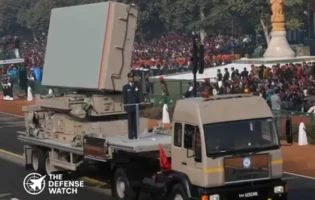
| Launch Platform Compatibility | Road-mobile TEL (Transporter-Erector-Launcher) |
| Seeker Type | None (ballistic missile; midcourse inertial guidance only) |
4. Physical Characteristics
| Length | ~17.5 m |
| Diameter | ~2.0 m |
| Wingspan | N/A (ballistic missile) |
| Launch Weight | ~50,000 kg |
| Propulsion | Three-stage solid-fuel rocket motors |
5. Warhead & Payload
| Warhead Weight | ~1,000–1,500 kg (est.) |
| Explosive Type | Nuclear warhead |
| Detonation Mechanism | Re-entry triggered fuse |
| Payload Options | Single RV or MIRV-capable (multiple re-entry vehicles) |
6. Operational Use & Capabilities
| Operational Range Type | Long-range / Intercontinental-class |
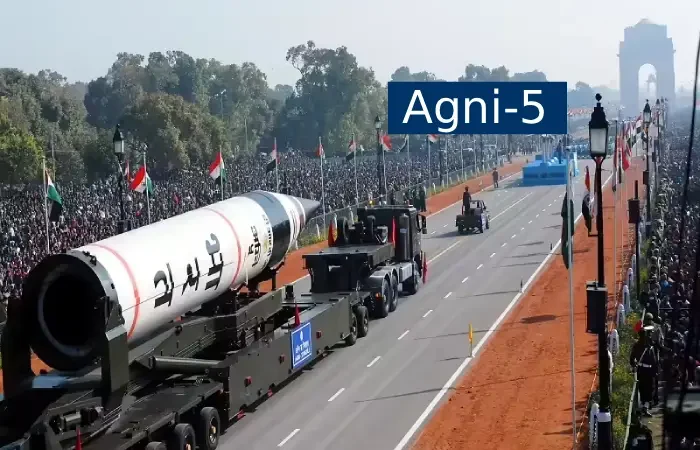
| Deployment Platform | Road-mobile canister launcher (high survivability) |
| Target Types | Strategic infrastructure, high-value military assets |
| Combat Proven | No (strategic deterrent weapon) |
| Users / Operators | India (Strategic Forces Command) |
PROS
- Capable of 5,000 km+ range consolidates India’s long-range strike capability.
- Three-stage solid-fuel design offers rapid launch readiness and reliability.
- Advanced navigation (RINS + MINS) improves warhead accuracy.
- Canisterised, road-mobile launcher supports survivability and flexibility.
- Potential MIRV capability allows multiple independent warheads per missile.
CONS
- Very high cost per unit and maintenance for solid propellant ICBMs.
- Strategic deployment may provoke regional arms races.
- MIRV integration raises proliferation and arms control concerns.
- Road-mobile infrastructure still requires secure logistics and protection.
- Limited transparency on CEP (accuracy) and actual operational numbers.
Agni-V Strategic Ballistic Missile
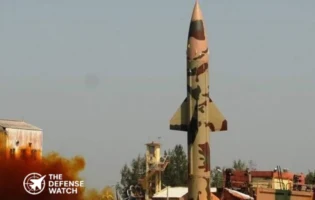
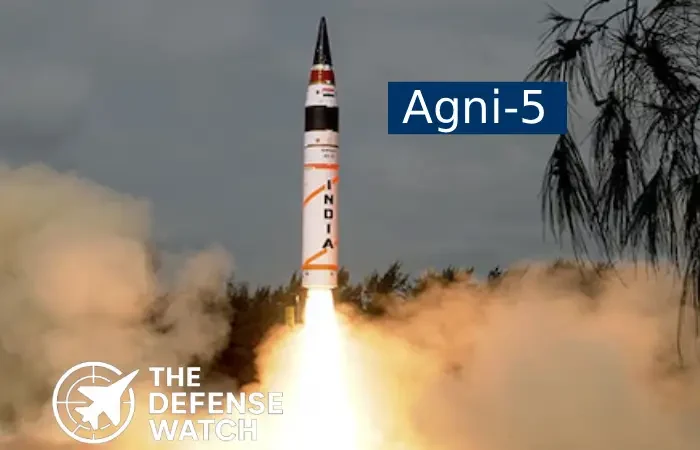
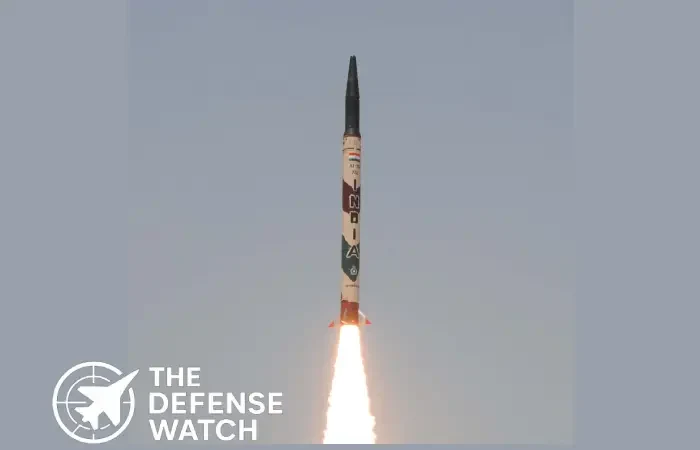
The Agni-V missile stands out as one of India’s most advanced long-range strategic weapons — a cornerstone of its nuclear deterrence posture. Developed indigenously by the Defence Research and Development Organisation (DRDO), this road-mobile, three-stage, solid-fuel ballistic missile reflects New Delhi’s commitment to maintaining a credible second-strike capability.
Origin and Purpose
Agni V was designed for intercontinental or near-intercontinental roles, pushing India’s strategic reach deep into Asia, and potentially into parts of Europe. With a declared range of around 5,000 km, it can cover key regional adversaries and reinforce India’s nuclear doctrine of “credible minimum deterrence.”
Key Capabilities
- Three-Stage Solid Propellant: Each stage uses solid-fuel motors, enhancing reliability, quick launch readiness, and shelf life.
- Guidance Technology: The missile integrates a ring-laser gyro-based Inertial Navigation System (RINS) coupled with a Micro Navigation System (MINS) to deliver high accuracy.
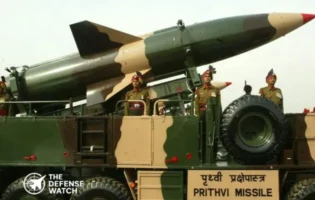
- Canisterised Launch Platform: Agni-5 can be launched from a sealed canister mounted on a mobile launcher, reducing launch preparation time.
- Payload: It supports nuclear warheads of up to ~1,500 kg and has demonstrated potential for MIRV (Multiple Independently Targetable Re-entry Vehicles) capability.
- Speed: Reports suggest the missile may exceed Mach 24 during reentry, though exact performance figures remain limited.
Operational Use
Agni V is part of India’s Strategic Forces Command inventory and has been tested multiple times since its first flight in 2012. Its deployment on mobile launchers enables flexible basing and survivability, while its long range enhances India’s deterrence depth. Recent tests, including MIRV-enabled versions, underscore ongoing efforts to mature its strategic strike capability.
Agni-5 Missile Title Price
As a strategic defense asset, the Agni-5 missile is not commercially available on any open arms market, especially in the United States. It is produced under India’s national defense infrastructure and cannot be legally purchased by non-state actors or foreign governments under international arms control regulations. Any “price” would be classified or part of bilateral defense agreements, not publicly disclosed.
FAQs
Is the Agni-5 the fastest missile in the world?
No. While the Agni-5 can reach extremely high terminal speeds—estimated between Mach 20 and Mach 24 during re-entry—it is not the fastest missile in the world. Several intercontinental ballistic missiles (ICBMs) from the U.S., Russia, and China also reach Mach 20+ speeds in the terminal phase. Agni-5, however, is among the fastest missiles developed by India and ranks comparably with other long-range ballistic systems.
Can an Indian missile reach the USA?
No current Indian missile, including Agni-5, can reach the continental United States. Agni-5’s official range is ~5,000 km, with some unconfirmed estimates suggesting slightly longer capability. The distance from India to the U.S. typically exceeds 12,000 km, far beyond the missile’s reach. India has not developed or tested any true intercontinental-range missile (10,000 km+).
Was the Agni-5 test successful?
Yes. India has conducted multiple successful test launches of Agni-5 since its maiden flight in 2012. These tests validated its three-stage solid propulsion, advanced guidance systems, and canisterised launch capability. More recent trials, including MIRV-capable variants, have also been reported as successful by India’s Ministry of Defence.
What is the significance of Agni-5?
Agni-5 is significant because it represents India’s most advanced long-range strategic missile, extending its nuclear deterrence envelope across Asia. Key strategic roles include:
Strengthening India’s credible minimum deterrence posture
Providing long-range second-strike capability
Enhancing survivability through road-mobile, canisterised launches
Supporting future MIRV deployment, increasing strike flexibility
It is a cornerstone of India’s long-range strategic arsenal.
Agni-5 Price
The exact price of the Agni-5 missile is not publicly disclosed, as it is a strategic, non-export, nuclear-capable weapon. Cost figures fall under classified defense budgeting in India. Defense analysts estimate that a long-range, three-stage solid-fuel missile of this class could cost tens of millions of dollars per unit, but no official figure is available. Additionally, systems like Agni-5 are not for sale, including in the United States or any export market.
Disclaimer Note
The information provided on TheDefenseWatch.com is for general informational purposes only. While we strive to ensure the accuracy, completeness, and timeliness of our content regarding defense and aerospace products, technologies, and specifications, we cannot guarantee that all information is 100% accurate or up-to-date due to the evolving nature of military technology and classified data.TheDefenseWatch.com does not warrant the reliability, suitability, or availability of the information for any specific purpose. Users are advised to consult official sources, such as manufacturers, government publications, or defense agencies, for precise and verified data before making decisions based on our content.We are not affiliated with any defense manufacturers, governments, or military organizations mentioned. Opinions, reviews, and ratings reflect expert analysis but are subjective and should not be considered endorsements. TheDefenseWatch.com is not responsible for any errors, omissions, or consequences arising from the use of this website’s content.External links are provided for convenience and do not imply endorsement. TheDefenseWatch.com reserves the right to update or modify content without prior notice. By using this website, you agree to our Privacy & Cookies Policy.
New Arrivals
Popular Comparisons
-
 Tejas vs Gripen: Key Differences and Capabilities
View Comparison →
Tejas vs Gripen: Key Differences and Capabilities
View Comparison → -
Tejas vs MiG-21 Bison: How India Replaced Its Iconic Supersonic Fighter
View Comparison →
-
F-35 vs F-16: Stealth, Sensors and Combat Roles
View Comparison →
-
Tejas Fighter Jet vs F-16 Fighting Falcon: Capability Compared
View Comparison →
-
Rafale Fighter Jet vs F-16 Fighting Falcon : Which Fighter Has the Edge?
View Comparison →
-
Su-57 Fighter Jet vs J-20 Fighter Jet: Stealth and Air Combat Compared
View Comparison →
-
Mirage 2000 vs Tejas Mk1A: Legacy Combat Power vs Indigenous Modernization
View Comparison →
-
Rafale Fighter Jet vs F-22 Raptor: Which Air Dominance Fighter Has the Edge?
View Comparison →
-
Tejas Fighter Jet vs. Rafale Fighter Jet: India’s Indigenous Fighter Meets France’s Proven Multirole Combat Aircraft
View Comparison →
-
F-22 Raptor vs. F-35 Joint Strike Fighter: Which Fifth Generation Fighter Has the Edge?
View Comparison →
- Bolt Action Rifles: History, Design and Military Role

- India’s Nuclear Arsenal Reaches 190 Warheads as Triad Expands
- U.S. Navy Plans Major Redesign of F-35 Mission Planning Environment
- U.S. Navy Restores USS Donald Cook 5-Inch Gun After Two-Year Casualty
- Russia Deploys Upgraded Geran-4 With Warhead Designed for Bridges, Power Lines
- U.S. Air Force Returns Bombers From RAF Fairford to U.S. Amid Security Investigation
- Chinese PLA Completes Russia’s Center 2026 Drills With Type 99A Tanks and Unmanned Systems
- China Shows PLA Laser and Microwave Counter-Drone Weapons in Live-Fire Drill
- NASA’s SpaceX Crew-12 Nears Return After Extended ISS Science Mission
- F-15E Shot Down Over Iran: How the Dude 44 Crew Was Brought Home