- Home
- Catalog
- Attack & Multirole Drones (UAVs)
- YFQ 42A Drone
YFQ 42A Drone
Full Specifications
1. General Information
| Name | YFQ 42A |
| Manufacturer | General Atomics Aeronautical Systems (GA-ASI)/United States Defense Contractor |
| Country of Origin | United States |
| Type / Role | Autonomous Combat Jet |
| First Flight / Introduced | 2025 (Projected) |
| Status | Under Development |
| Unit Cost | Not Yet Released |
2. Performance
| Maximum Speed | Mach 1 class |
| Cruise Speed | High subsonic |
| Operational Range | 1,500 km |
| Endurance | 6 to 8 hours |
| Service Ceiling | 45,000 ft |
| Rate of Climb | High performance climb |
3. Dimensions
| Length | 11 m |
| Wingspan | 9 m |
| Height | 3 m |
| Maximum Takeoff Weight (MTOW) | 8,000 kg |
4. Payload & Armament
| Payload Capacity | 1,500 kg |
| Hardpoints | Internal Bays |
| Weapons | Air to Air Missiles, Guided Bombs |
| Sensors | EO IR, Radar, Passive Sensors |
| Avionics | Secure Link, GPS INS, Sensor Fusion |
5. Propulsion
| Engine Type | Single Turbofan |
| Engine Power | High thrust class |
| Propeller Type | Not Applicable |
6. Communication & Control
| Control Type | Remote and Autonomous |
| Data Link Range | Beyond Line of Sight |
| Navigation | GPS and INS |
| Ground Control Station | Mobile or Fixed |
7. Operational Use
| Primary Users | United States (Projected) |
| Combat Proven | No |
| Notable Operations | None |
PROS
- Long range and strong endurance
- Low observable design
- Advanced autonomous flight
- Works with manned fighters
- Flexible payload options
CONS
- Still under development
- High expected cost
- Limited public data
- Requires secure network support
- Complex maintenance needs
YFQ 42A Next Gen Autonomous Combat Jet
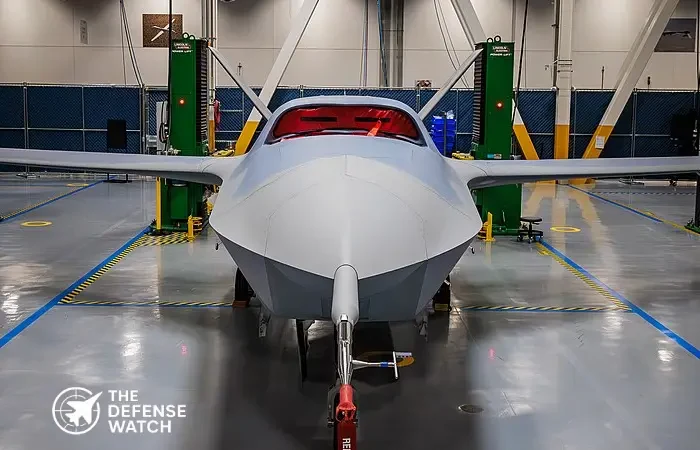
The YFQ 42A is a new autonomous combat jet developed in the United States for long range missions and high risk strike work. It fills a growing demand for crewless fighters that can work with manned aircraft or fly alone when needed. The jet pairs high speed with strong endurance, giving planners a flexible tool for contested areas.
The aircraft comes from a leading US defense contractor that focuses on autonomous flight and sensor fusion. The goal behind the YFQ 42A is simple. Reduce pilot risk, bring faster decision making to the fight, and support manned fighters with a wingmate that can carry weapons and run complex tasks on its own.
The YFQ 42A Drone features a clean low observable shape, internal weapons space, and a high thrust engine built for fast climbs and quick response. Its range lets it push far into denied zones. Its sensor suite uses radar, infrared, and data fusion to track multiple threats at long distances. A secure link keeps it tied to command centers or a leading manned jet, but it can continue to fly and fight if the link drops.
The jet can carry air to air missiles, guided bombs, and electronic attack pods. Its onboard system can plan routes, avoid threats, and sort targets with little input. This makes it well suited for deep strike, escort, and high risk intelligence missions.
YFQ 42A Price
The YFQ 42A does not have a confirmed unit price yet, but estimates place it in the same range as other advanced crewless combat jets now in development.
Get real time update about this post category directly on your device, subscribe now.
Reviews
Disclaimer Note
The information provided on TheDefenseWatch.com is for general informational purposes only. While we strive to ensure the accuracy, completeness, and timeliness of our content regarding defense and aerospace products, technologies, and specifications, we cannot guarantee that all information is 100% accurate or up-to-date due to the evolving nature of military technology and classified data.TheDefenseWatch.com does not warrant the reliability, suitability, or availability of the information for any specific purpose. Users are advised to consult official sources, such as manufacturers, government publications, or defense agencies, for precise and verified data before making decisions based on our content.We are not affiliated with any defense manufacturers, governments, or military organizations mentioned. Opinions, reviews, and ratings reflect expert analysis but are subjective and should not be considered endorsements. TheDefenseWatch.com is not responsible for any errors, omissions, or consequences arising from the use of this website’s content.External links are provided for convenience and do not imply endorsement. TheDefenseWatch.com reserves the right to update or modify content without prior notice. By using this website, you agree to our Privacy & Cookies Policy.
New Arrivals


Popular Comparisons
-
 SIG XM7 Rifle vs M4: Key Differences and Performance Comparison
View Comparison →
SIG XM7 Rifle vs M4: Key Differences and Performance Comparison
View Comparison → -
Eurofighter Typhoon vs Rafale vs F-35: Fighter Jet Comparison
View Comparison →
-
J-20 vs F-22: Stealth Fighter Showdown Explained
View Comparison →
-
F-14 Tomcat vs Su-57: Can a Legend Challenge Russia’s Stealth Fighter?
View Comparison →
-
Su-35 vs Su-57: Russia’s Top Fighter Jets Compared
View Comparison →
-
Eurofighter Typhoon vs Su-57: Ultimate Fighter Jet Comparison
View Comparison →
-
Rafale vs Su-57: 4.5 Gen vs 5th Gen Fighter Jet Comparison
View Comparison →
-
Su-57 vs F-16 Fighting Falcon: Stealth vs Speed
View Comparison →
-
China vs Russia: J-20 Mighty Dragon vs Su-57 Felon Comparison
View Comparison →
-
Su-57 Felon vs F-22 Raptor: Stealth Air Superiority Face-Off
View Comparison →


- Pentagon Considers Second B-21 Raider Production Line To Accelerate U.S. Stealth Bomber Expansion

- France Unveils 78,000-Ton Nuclear Aircraft Carrier France Libre With 40-Aircraft Capacity
- L3Harris Wins $77.8M U.S. Navy Contract for Kineto Tracking Mount Sustainment
- US Navy Awards $15.38B Columbia-Class Submarine Contract To Strengthen Nuclear Deterrent
- China Surges Production Capacity For J-20 And J-35 Stealth Fighters As Beijing Expands Fifth-Generation Fleet
- Netanyahu Announces Elimination Of Senior Iranian Figures In Air Campaign
- US Bombers Avoid European Airspace On Iran Bombing Runs In Strategic Route Shift
- Japan’s EC-2 Electronic Warfare Jet Completes First Flight, Expanding Standoff Jamming Capabilities
- NASA’s X-59 Quiet Supersonic Jet Gears Up for Second Flight — A Giant Leap Toward Silent Boom AviationNASA X-59 Second Flight: Supersonic Aviation Reborn
- US Weapons Shipments to Taiwan Unaffected by Iran War, Officials Confirm